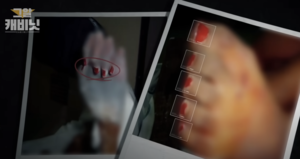
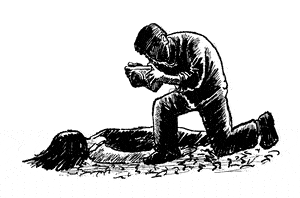
A thinly framed girl in a school uniform walks along a narrow shortcut on the outskirts of town. Quiet and dimly lit, the rhythmic crunch of her footsteps on the pavement is the only sign of human presence.
“I’m walking home, mom” her voice on the phone echoes alongside her tread.
Home is just 700 meters down this eerily deserted path, the quickest route home.
What should have been a few minutes’ walk, however, turned into an agonizing wait for her mom and all those who knew her, stretching from hours to days, then to weeks and months.
Eventually their worst fears were confirmed: Her body was found, far from home, with few clues as to what had happened.
The only mark on her was the bright red polish on her fingernails and toenails — unbefitting of a girl who had never painted her nails, let alone in such a bold color.
In this episode of True Crime, we delve into the 2003 kidnapping and murder of a girl named Eom Hyun-ah in a village in Pocheon.
The missing girl
It was Nov. 5, 2003. The US and its coalition had just toppled the Saddam Hussein regime in Iraq. While on the web, 95 percent of people were still using Microsoft's Internet Explorer.
In South Korea, President Roh Moo-hyun, an iconoclastic leader who was the first Korean politician to have an online fan club, was having a rough first year in office, with his approval ratings dropping quickly.
But on that Wednesday, Nov. 5, the entire country was focused on something far more significant: the annual college entrance exam, or Suneung.
This was the day when tens of thousands of high school seniors in South Korea sit for a grueling daylong test that could determine their chances in university admissions. Years of preparation came down to these scores and rankings.
But for 15-year-old Eom Hyun-ah, it was a day of fun. Still in middle school, classes finished early, so she could hang out with friends in the afternoon.
In her village of Songuri, Pocheon, there wasn‘t much for young students to do. As usual, she and her friends gathered at one of their homes not too far from their school.
Pocheon, where she lived, is north of Seoul, South Korea's capital, and near the border with North Korea. Because of this, there were a number of military bases nearby. Her father was a sergeant major stationed at one of them, and they lived in an apartment designated for military personnel.
Hanging out at her friend’s place, Hyun-ah lost track of time. It was only when her mother called around 6 p.m. that she realized it was time to head back home. Wanting to return before dinner, she decided to take a shortcut.
One of her friends walked with her until they reached the back gate of an elementary school near the middle school they both attended. There, the shortcut home was a narrow, seldom-traveled path — the kind only known to those who lived close by. With few streetlights, it was already growing dark. Hyun-ah parted ways with her friend and continued on alone.
At 6:18 p.m., Hyun-ah called her mother to let her know she would be home soon.
This six-second phone call was the last trace of her while she was still alive.
When, by 9 p.m., Hyun-ah had not come home or answered her mother’s calls, her worried parents called the police and reported her missing.
At first, the police didn’t take the matter seriously. Kids not coming home until late at night didn’t necessarily indicate a situation that required immediate action. The police said, “Wait a day or two; they’ll come to their senses and go home.”
A day or two turned into weeks, but no sign of Hyun-ah.
Her parents were frantic in their search. They created and distributed 150,000 copies of a poster featuring her photograph and a physical description including her height, hairstyle, and what she wore the day she went missing.
In addition to the posters, banners were hung throughout the neighborhood.
Three weeks went by without any word from Hyun-ah or any clue about where she might be.
Then, 23 days after she vanished, her phone turned up.
A construction manager in the nearby city of Uijeongbu, Gyeonggi Province, had found it on Nov. 14, nine days after Hyun-ah went missing. It was about 8 kilometers from where she was last seen. Unaware of the missing person case or any possible connection to his find, he kept the phone for two weeks before finally turning it over to the police on Nov. 28.
The phone led to the discovery of 13 items belonging to Hyun-ah, including her shoes, school bag, socks, textbooks, school necktie and gloves. They were found among piles of trash near the roadworks site where the construction manager had discovered the phone.
As the police examined the items, they noticed something disturbing: The name tags on her belongings had been torn off.
What they had all feared was becoming a reality: This was no ordinary missing persons case; it looked like foul play.
A massive search operation was launched, joined by personnel from the military base where Hyun-ah’s father worked. But the end of the year passed, and a new one started without a resolution. Then January gave way to February.
On Feb. 8, 2004, a police officer spotted a big cardboard box dumped on the side of the road, blocking a concrete drainage pipe. It was in Pocheon, 6 kilometers from Hyun-ah’s home. The box was for a 29-inch TV.
Removing it, he glimpsed a pair of human feet. A woman lay there inside the pipe, naked and lifeless.

The upper part of body in particular, including the face, was severely decomposed. But Hyun-ah’s father knew it was her. He could see the scar from a burn on her right arm and another scar on her lower abdomen from an appendectomy. It was the 95th day since she had gone missing on that shortcut home.
Because her body was severely decomposed, an autopsy was unable to determine the exact cause of or time of her death. No DNA evidence was retrieved from the victim’s body or from the location where she was found. There was no trace of semen, either.
Hyun-ah's fingernails and toenails were painted red. She was not known to wear nail polish and, even if she’d wanted to, it wasn’t allowed at school.
First, she would never have worn nail polish, especially such a bold color; her school had strict rules and it wasn’t allowed. Second, the application was also unusual, crude and uneven.
The absence of security cameras, coupled with a lack of eyewitness accounts left the investigators little to go on.
They clung to the only clues they had: the nail polish and the TV box.
Their theory was as follows:
The perpetrator likely had access to a vehicle.
A sex offender may have been involved.
And they would be familiar with the area and might even know the victim.
It was estimated that Hyun-ah was murdered — possibly by strangulation — at a different location and was then hidden inside the drainage pipe. The murderer likely used a vehicle to move her after midnight because the adult shops near where she was abandoned would have closed and turned off their lights.
Investigators had to use whatever evidence they had.
First, the TV box.
It had a serial number, which allowed investigators to track down who made the purchase and who handled the delivery.
One of the men who delivered and installed the TV had a criminal record – he was a sex offender. But he had solid alibis. The man said he’d simply discarded the box on the road. A dead end.
Investigators still had red paint on Hyeon-ah’s nails, most likely put there by the killer.
It was applied crudely, in a haphazard manner from side to side rather than in the usual lengthwise strokes. It seemed the perpetrator had even taken the time to clip some of her nails after painting them.
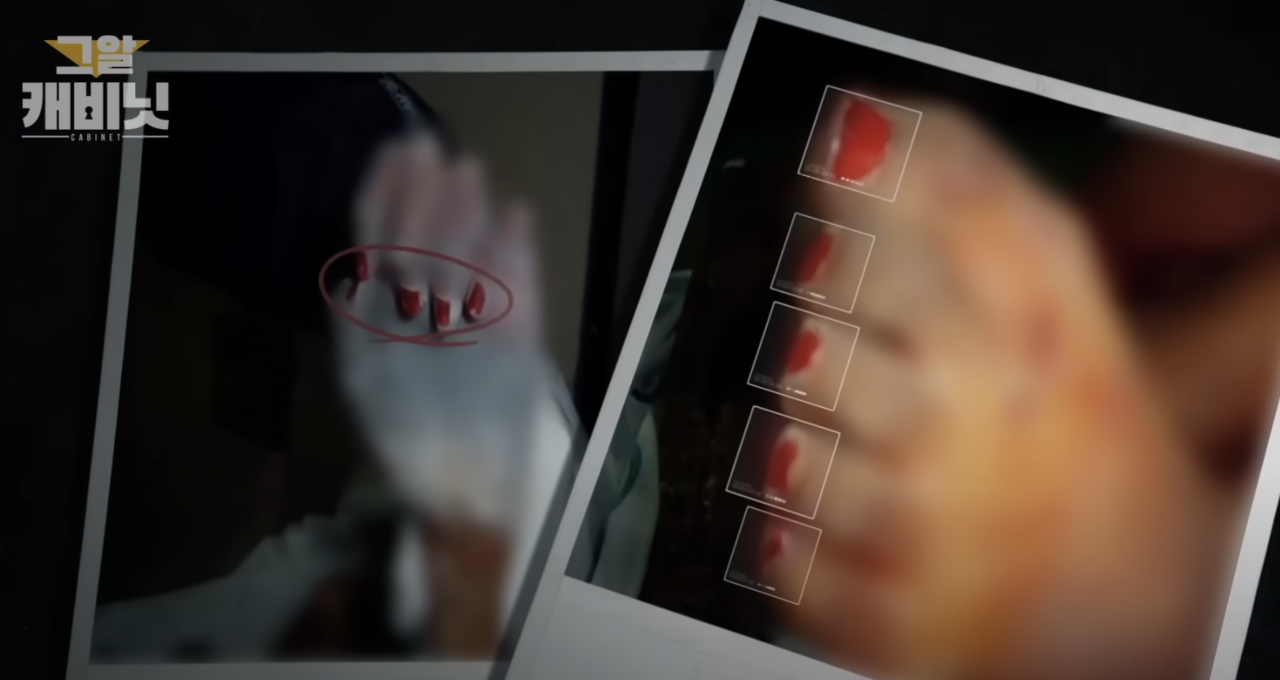
The source of the nail polish could provide a key to identifying the killer.
The police investigation analyzed the components of the red nail polish and tried to trace its origin. But despite an extensive search of over 60 types of nail polish available in stores, even including those used by children for painting their doll’s nails, they couldn’t find a match.
From there, investigators moved on by examining anyone in the area who seemed suspicious, particularly those who’d shown sexually deviant behaviors. Though there was no direct evidence of sexual assault, investigators strongly believed there must have been a sexual motive involved.
In addition to painting the victim's nails, the perpetrator had clipped them. And the fact that the victim’s school uniform, underwear and stockings were missing suggested that the perpetrator had kept these items as trophies.
They examined people in the area with history of sex crimes, including flashing — they even questioned male crossdressers — but these efforts did not lead to a significant breakthrough.
Now desperate, investigators even hypothesized that the red nail polish may have been related to funeral rituals practiced in certain other countries. They checked up on migrant workers in the area, but to no avail.
The men in the victim’s town must have felt a high degree of suspicion against them.
The path where Hyun-ah was believed to have been kidnapped was not frequented by outsiders. The name tags torn off her belongings also suggested that the perpetrator might have been someone she knew.
High on the list of potential suspects was a boy, 17 years old.
He was known to have feelings for Hyun-ah, and was found to have made a phone call in the area on the day she went missing. According to local residents, he sometimes drove his mother’s car.
But he denied any involvement, passed a polygraph test, and there was no evidence — nothing at all — to implicate him in Hyun-ah’s death.
Another potential suspect was the owner of a stationery store near Hyun-ah’s middle school. The store had a darkroom used for developing student ID photos. When police sprayed luminol and observed a luminescent reaction, they believed it indicated the presence of bloodstains.
He owned a vehicle with a sliding door, which would have made it easier to abduct the girl from that narrow pathway. They discovered a strand of a woman’s hair in the trunk of the vehicle. The factory the suspect frequently visited to make photo frames was not very far from the site where the girl’s body was discovered.
However, further analysis revealed that the luminol had reacted to iron rust, not blood, and the hair was not the victim’s. This, combined with the man’s alibi, ultimately cleared him of any suspicion.
Despite examining more than 1,500 suspects and DNA evidence, the case had hit a dead end.
Turn of events
Fifteen years passed.
Then, in early 2019, a woman came forward to the authorities, saying she might have met the killer in that winter of 2003, in the same village in Pocheon.
Less than a week before Hyun-ah disappeared, the woman had escaped a kidnapping attempt. Later, when she saw the missing person poster, her instincts told her it was the same kidnapper, but she was too afraid to report it to the police.
This is what the woman shared, appearing on the SBS TV investigative program “Unanswered Questions.”
Identified by her surname Han, the woman was then a college student living in Pocheon. She was walking along a rural road one evening in October 2003.
She was alone, but soon realized that a white vehicle was slowly trailing her.
“Where are you headed?” the driver asked while keeping pace with her. He addressed her as “haksaeng,” or “student,” and asked if she needed a ride home.
She initially rejected the offer, but at that moment, she felt she had no choice but to accept. The man’s domineering attitude filled her with a premonition that he might get out of the vehicle to assault her.
After getting in the car, Han recalled that the man seemed to have no emotion while asking her questions about where she lived and her age.
“Let me off here,” she pleaded, but the driver responded by locking the car doors. Her fear intensified as he instead suggested they “have coffee” together.
In desperation, she unlocked the car door and stuck out her foot, dragging it on the ground as the vehicle moved. The car came to a stop and she managed to get out. The man then quickly took off.
Though she felt relieved, she also recalled a sense of unease as she watched the vehicle drive back down the road toward a middle school — in fact, it was Hyun-ah’s school.
The place where Han experienced her near-kidnapping was within two kilometers of the elementary school where Hyun-ah parted ways with her friend the night of her disappearance, also the middle school they attended, and the narrow path that Hyun-ah took that day.
According to Han, the man had looked a little unusual.
“The man was pale, as if wearing makeup,” she said. “His eyes were unusually bright and a transparent brown.”
One of the driver’s most striking features was his hairless, white hands. They were unusually “glossy” and “manicured,” with transparent nail varnish, Han said.
Later, investigators put Han under hypnosis to help her recall the incident in greater detail.
She remembered that the car that followed her had come from a local mechanic’s shop. She was even able to recall three of the four digits of the car’s license plate number and, for the missing digit, she could give two possible options.
Based on her memory, newly refreshed from the hypnosis, the police could create a facial sketch of the driver. He appeared to be in his late 20s or early 30s and was estimated to be between 170 and 175 centimeters tall.
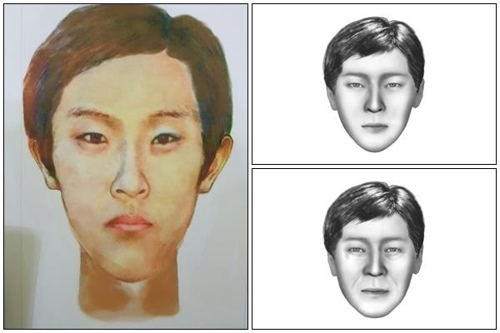
Yet, despite extensive efforts to investigate the license plate numbers, police were unable to identify a suspect.
Following the broadcast of Han’s story, numerous reports came in.
Soon, a notable tip came from a man who had worked at an auto repair shop in Pocheon during that time.
The man reported that one of the sketches resembled a former co-worker of his at the repair shop whom he described as “timid” and “feminine.”
“I got goosebumps when I came across the sketch and the story,” he remarked.
According to the man, the coworker, who was responsible for car painting, had white, manicured hands with transparent nail polish. The coworker was obsessively clean, washing his hands for 30 minutes after painting each car.
From this report, police raised the possibility that the suspect may have used a car left at the shop for repairs, and that the red on Hyun-ah’s nails might not have been a nail polish but a type of automotive paint.
The police found that the man who painted cars did have a criminal record, albeit not for a sex crime.
Finally, a glimmer of hope that the cold case finally had a main suspect, but it turned out to be rather anti-climactic.
The suspect had died 5 or 6 years after the crime for reasons that remain undisclosed, leaving the question of whether he was indeed the murderer shrouded in mystery.
While the dead repairman is unable to defend himself against any of the suspicions, experts also remain cautious against jumping to conclusions.
Kim Bok-jun, the former chief investigator in Eom Hyun-ah’s case and now a researcher at the Korean Institute for Criminology, thinks it was unlikely that the dead man was the killer.
On his YouTube channel, Kim questioned whether the person whose kidnapping attempt had been thwarted just five days earlier could have committed the crime in the same way again in that same village, especially considering that the girl who escaped might have reported him to the police.
“Nothing is certain,” Kim said, “but I think the chance is slim.”
Kim also noted that the sketches based on Han’s memory bear a striking resemblance to a notorious serial killer in Hwaseong. For those unfamiliar with the Hwaseong case, it’s the most infamous serial murder case in South Korea, which remained unsolved for more than two decades and inspired the highly acclaimed film “Memories of Murder,” directed by Bong Joon-ho in 2003. The former investigator Kim suggested that media exposure could have influenced the image conjured up by Han.
And so, the kidnapping and murder of Eom Hyun-ah remains a cold case to this day.
This article is a written adaptation of The Korea Herald's podcast True Crime. You can listen to the full episode on Spotify and Podbbang. ― Ed.