Lover conquers all, even tedious administrative process for marriage
A growing number of South Koreans are getting married with people of various countries.
Each year, around 20,000 international marriages occur throughout the country — 20,759 in 2024 — and this article aims to provide guidelines about issues one should be mindful in a wedding that involves two people of different nationalities.
Those with foreign roots can also reach out to the government for assistance through various programs to adjust to the life in Korea, namely on the obvious language barrier and understanding of the unique culture involving marriage and family in the country.

Legal status and visa
As in most countries, the spouses of local citizens are given certain benefits when staying in South Korea. The most obvious is the F-6-1 marriage visa, a subcategory of the F-6 visa issued for those staying in the country due to reasons related to their marital status.
If you meet your spouse during your stay here, you likely already have a Residence Card — called the Alien Registration Card prior to 2021 — required for most foreign nationals staying here for 90 days or longer. In that case, you will already be eligible for state-run health insurance, and if you have children they can enroll in the public education system. But an F-6 visa also entitles you to various child-rearing benefits from the government, such as subsidies for childbirths, though you must have lived in the country for at least six months.
Those permitted to stay in the country as a foreign national can apply to have one's status to F-6 after registering the marriage. An enforcement decree of the Immigration Act states that foreign nationals eligible for an F-6 visa includes the spouse of a South Korean national (F-6-1), the parent of a child born in one's marriage or common-law marriage with a South Korean (F-6-2) or a person whose marriage with a South Korean has been terminated due to reasons for which one is not responsible (F-6-3) — such as the death or disappearance of a spouse or divorce for which one is not responsible.
F-6-2 and F-6-3 visas are issued for specific purposes. The former is to ensure that the child is raised safely until one becomes of age, and the latter to allow one to get one's affairs in order.
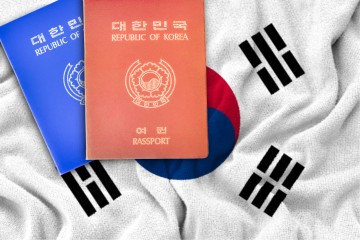
The F-6-1 visa is a residence visa for people married to a South Korean, and must be renewed regularly. The applicant must have a valid passport to ensure they are not subject to an entry ban in accordance with the Immigration Act and must prove that the marriage is legitimate, such as the couple maintaining permanent residence in the country.
Marriage visas can also be granted to those who got married outside the country and are moving to Korea for the marriage.
Immigration authorities' review also includes whether the Korean spouse supported a visa application for another spouse in the past five years, as well as if the foreign spouse can speak basic Korean.
One should note that regulations related to international marriages and issuing visa are subject to frequent changes due to government policies.
The homepage of the Korea Immigration Service — available in Korean and English — provides the latest information on visas and immigration policies. Korea Visa Portal, available in Korean, English and Chinese, has a guide on applying for visas.
Government programs
Strict regulations on visas are to prevent complications related to international marriages, which can range from marriage fraud or domestic abuse to simple misunderstanding between couples due to language barrier. Immigration authorities in particular mandate Koreans wishing to marry people from China, Vietnam, the Philippines, Cambodia, Mongolia, Uzbekistan or Thailand to complete the International Marriage Guidance Program, which covers the culture, etiquette and other information related to these countries.
Even when a Korean wishes to marry a person from one of the aforementioned seven countries, one could be exempt from taking the course if he or she had lived in the country of the spouse for at least six months and maintained a romantic relationship. The same goes for a foreign spouse who stayed in Korea for at least 91 days and dated the Korean applicant.
Couples requiring an immediate visa for humanitarian reasons — such as the imminent childbirth of the foreign spouse — could theoretically be exempt from this process.
While the International Marriage Guidance Program is a key course for Koreans wishing to marry foreign nationals, the Korea Immigration and Integration Program is an essential course for foreign spouses. This targets foreign nationals adapting to life here, educating them on basic knowledge of Korean society, including the language, economy, customs and law.
Completing the course and passing the test in the end grants one benefits in applying for a visa or permanent residence in the country, such as an exemption from the Korean language skill test.
Another program for potential spouses is the Initial Adjustment Support Program, a three-hour course designed to help early adjustment for foreigners intending to stay here long term. In addition to essential information about life in Korea, a course targeting F-6 visa applicants teaches about the culture of mutual respect and understanding between married couples and families, as well as prevention of sexual and domestic violence and how to report cases.
The program is not mandatory for F-6 visa applicants. Those from China, Vietnam, the Philippines, Cambodia, Mongolia, Uzbekistan and Thailand will have their initial stay limited to six months before they are officially issued the F-6 visa, after they have registered themselves as foreign residents of Korea.
Those who have taken the IASP can also be granted longer periods of stay under the F-6-1 visa.
The Immigration & Social Integration Network, also known as Soci-Net, provides the platform to apply for various programs for those wishing to marry a South Korean, including the aforementioned International Marriage Guidance Program.
Foreigners marrying each other
Foreign residents marrying each other in South Korea should note that most embassies and consulates are not authorized to perform marriages, and that the nuptials would be under Korean law.
The US Embassy and Consulate in South Korea stated in a Sept. 3, 2024, post that marriages performed in South Korea under its law are recognized in all states, and that consular officials — while unable to perform ceremonies themselves — can assist US citizens in necessary paperwork.
The law and regulations for foreign residents marrying on South Korean soil may vary by country. Those interested should check with the diplomatic missions and governments of their respective countries.
minsikyoon@heraldcorp.com