17 murders in two months and belated atonement in prison
Why do some killers capture more attention than others? In South Korea's relatively short list of serial killers, there are infamous figures whose crimes have inspired acclaimed films such as the 2003 film "Memories of Murder" and 2008's "The Chaser."
However, the man featured in this episode doesn't quite fit that mold. Despite his staggering murder count and the brutal nature of his killings, he remains largely forgotten among South Koreans today. In fact, he has never gained the same level of attention, alive or dead. That was his perennial problem, the one that twisted him so deeply.
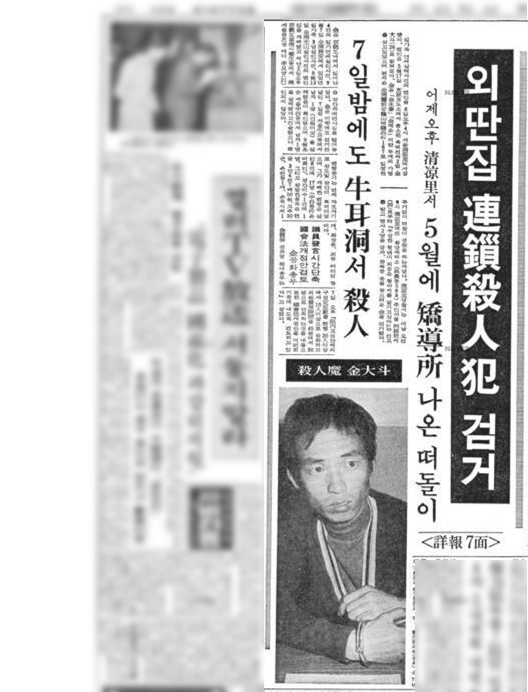
In this episode, we delve into the life of Kim Dae-doo, South Korea's first known serial killer, who killed 17, including a 3-month-old baby, for nothing more than petty money.
Man with bloody jeans
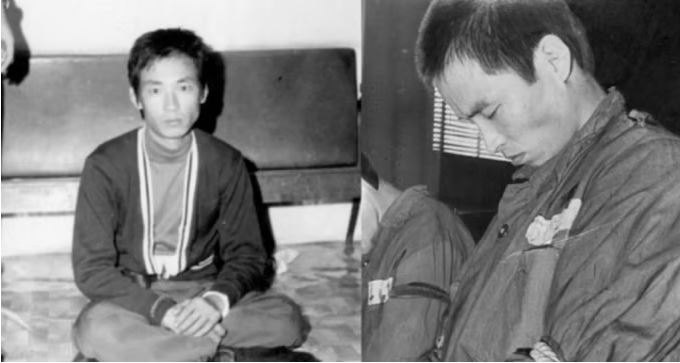
Early one morning in October 1975, a gaunt, short-statured young man walked into a laundry shop in Dongdaemun-gu, Seoul, and asked to have his jeans dry-cleaned.
The clothes were heavily stained with what appeared to be blood. The customer calmly attributed the stain to a nosebleed, saying that he had had a minor scuffle with a friend.
The shop owner, feeling uneasy because the bloodstain was far too large for a nosebleed, accepted the man's pants. However, after he left, she called the police.
When the customer returned to collect his pants at around 4 p.m., officer Hong from the nearby Cheongnyangni Police Station was waiting for him.
At first, Hong didn’t take the case seriously; he only intended to ask a couple of questions to clear the young man. But the man's behavior, evading questions and giving conflicting stories about the source of the blood, raised a multitude of red flags. He needed to be interrogated thoroughly.
The man was taken to the police station, where he refused to cooperate. Complaining of hunger, he claimed he hadn’t eaten for nearly a day.
Only after filling his belly with a Chinese dish and hard liquor — a treat from the police officer — did he start talking.
What followed was a bombshell revelation: South Korea had just uncovered its first serial killer since modern policing began.
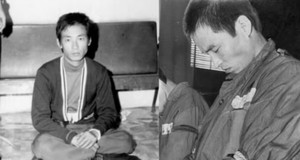
“I actually bumped one off,” the 26-year-old Kim Dae-doo casually said, after taking a drag on his cigarette. With that, he began rattling off a series of murders, one after another, committed all in 55 days, until the tally reached a staggering 17.
Sad-sack murderer
Kim is recognized as the nation’s first serial killer since the founding of the Republic of Korea in 1948. His killing spree remained the most prolific in modern South Korean history for nearly three decades, until Yoo Young-chul shattered the record in 2004, with 20 murders.
Before committing the 17 homicides, Kim was no stranger to criminal activity, though his earlier offenses had not foreshadowed the series of murders.
Kim was born in 1949 as the firstborn to farming parents in a rural village in Yeongam, South Jeolla Province. His moral decline began with a seemingly minor rebellion against his parents’ wishes.
His father, like many other parents at the time, believed that academic success was the key to climbing the social ladder and overcoming poverty. The young Kim, however, had no interest in studying. He barely managed to graduate from elementary school at the age of 15.
Choosing not to pursue middle school, he instead helped his parents with farm work until he left home at 17.
Away from his parents, he dreamed of making big money. He spent the next five years drifting around Jeolla Province, taking on various manual labor jobs in farming and retail stores. His desire for rapid success, however, yielded little.
In 1972, then 24 years old, Kim returned home empty-handed. He stole 50,000 won from home and left for Seoul. At that time, 50,000 won was equivalent to 1 million won or $700 in today’s value. He rented a room in northern Seoul, with a monthly rent of 3,000 won and a 10,000 won deposit paid upfront.
However, his Seoul dream did not unfold as he expected. With no stable job, he remained unemployed most of the time and depleted his savings.
Even his plan to escape the harsh reality by joining the military fell through: standing at less than 160 centimeters tall and weighing under 50 kilograms, he was rejected, deemed physically unfit to serve.
This was likely a major blow. His frustration with society seemed to deepen then, manifesting in violent outbursts. Between 1973 and 1975, he was involved in two incidents of physical violence, which led to a suspended sentence and a one-year prison stint.
After his release from prison in Suwon, Gyeonggi Province, in May 1975, Kim was confronted with an even bleaker reality when he returned to his hometown as an ex-convict.
His criminal record seemed to cast a dark cloud over any attempt to rebuild his life, affecting both his prospects for employment and his social interactions.
Driven by deep-seated resentment, he abandoned his original aspirations and turned to indiscriminate violence. His subsequent acts of brutality far exceeded his previous transgressions.
Rampage killing
In less than three months of regained freedom, his unchecked violence erupted in a seemingly random pattern, targeting individuals with whom he had no apparent connection.
His first murder took place on Aug. 13, 1975, in Gwangsan, South Jeolla Province — now part of Gwangju. At around 3 a.m., Kim, wearing a face mask, broke into an elderly couple’s home. He killed the 62-year-old husband with a scythe and attacked the 58-year-old wife with a wooden pestle.
His loot was a single flashlight and a wristwatch. Though severely injured, the woman survived.
After the first murder, Kim ran into his former cellmate, 29-year-old Kim Hae-woon, on a train. Together, they plotted another crime.
With the 25,000 won his cellmate had, they purchased a jackknife and razor blades, then spent the rest of their funds hanging out until they ran out.
Six days had passed since Kim’s first murder.
Harboring no particular plan, the two ex-convicts were walking along a railway in Muan, South Jeolla Province, on Aug. 19, eventually coming across a small corner shop.
The shop was in a secluded area, making it the ideal target for their first collaborative act of murder.
There, using the recently purchased weapons, they killed the shop-owner couple in their 50s, along with their 7-year-old grandson, who faced the most horrific end.
Later, when asked why he had committed such cruelty, even toward children, Kim replied that it was to ensure the perfect crime, leaving “no one” at the scene.
The money Kim and his ex-cellmate stole amounted to just 250 won, along with some bread, soda and snacks. Though the motive for the crime was financial, the two failed to find 26,000 won hidden in the couple’s bedroom.
After the killings, the duo spent the night at a nearby hillock and decided they would move to the capital, where people would have more money. Kim had a sister and a relative living in the city.
So, on Sept. 7, 1975, they traveled to Seoul.
But for some reason, the two parted ways. Investigators suspected that they stopped collaborating for financial reasons and that Kim Hae-woon was fearful of his crime partner’s cruelty.
Kim Dae-doo then acted alone, roaming around Seoul and the surrounding Gyeonggi Province.
On the day of his arrival in Seoul, he fatally stabbed a man in his 60s living in a tent on a hillside in Dongdaemun-gu, with no apparent motive for the murder.
In Pyeongtaek, Gyeonggi Province, where he went to search for work at a US military base, he brutally murdered a family of four living in the countryside, with a claw hammer on Sept. 25.
The victims were a 71-year-old grandmother and three children aged 5, 7 and 11, one of whom, the 11-year-old girl, was raped by Kim. The girl was later found with a cloth wrapped around her head. The hammer’s handle, nearly snapped in two, attested to the brutal nature of the crime.
A couple in their 20s fell prey to Kim two days later in Guri, Gyeonggi Province, along with their 3-year-old child.
Three days later, on Sept. 30, in Gunpo, also in Gyeonggi Province, Kim raped and murdered a 28-year-old woman. Her 3-month-old infant, Kim’s youngest victim, was also later found dead after being struck with a blunt object. Kim later remarked that the baby’s crying was too annoying.
His murder spree continued in Gyeonggi Province when he killed a couple in their 30s in Suwon on Oct. 2.
The next day, he wandered around a golf center in Suwon and attacked a 21-year-old golf caddy returning home. However, his attempt at sexual assault was foiled when the woman called for help from a passing vehicle. He took her wristwatch and jacket before fleeing back to Seoul.
This failure probably prompted Kim to look for another accomplice.
He somehow met another ex-convict at Yeongdeungpo Station and convinced the 23-year-old, who was freshly out of jail, to join him.
However, the young man had no intention of partnering with Kim and instead stole 3,000 won and a pair of shoes from Kim’s relative’s house.
Fueled by betrayal, Kim tracked him down. On the night of Oct. 7, on a hillside in Ui-dong, Seoul, he became Kim’s last victim. Kim then robbed the victim of his meager possessions: a fake gold ring, a wallet and the jeans he was wearing. Yes. The jeans that he took to the laundromat.
At the time, a nationwide curfew was in effect between 10 p.m. and 4 a.m., so Kim buried the body and slept nearby. The following morning, he descended the hill and headed to the laundry shop.
Throughout his crimes, he stole a total of 26,800 won. In today’s money, that would be around $360.
As to why the financially motivated murderer did not target upper-class people, Pyo Chang-won, director of the Pyo Institute of Crime Science, suggested in his book on Korean serial killers that Kim may have committed these crimes because he had limited knowledge of what life was like beyond the confines of his environment.
Murderer-turned-devotee
Before Kim’s startling confession, law enforcement, on high alert due to a spate of nationwide homicides, had grappled with the question of whether a single perpetrator was accountable for all the deaths.
The anticlimactic cessation of Kim's killing rampage, therefore, elicited a profound shock to both law enforcement and the public.
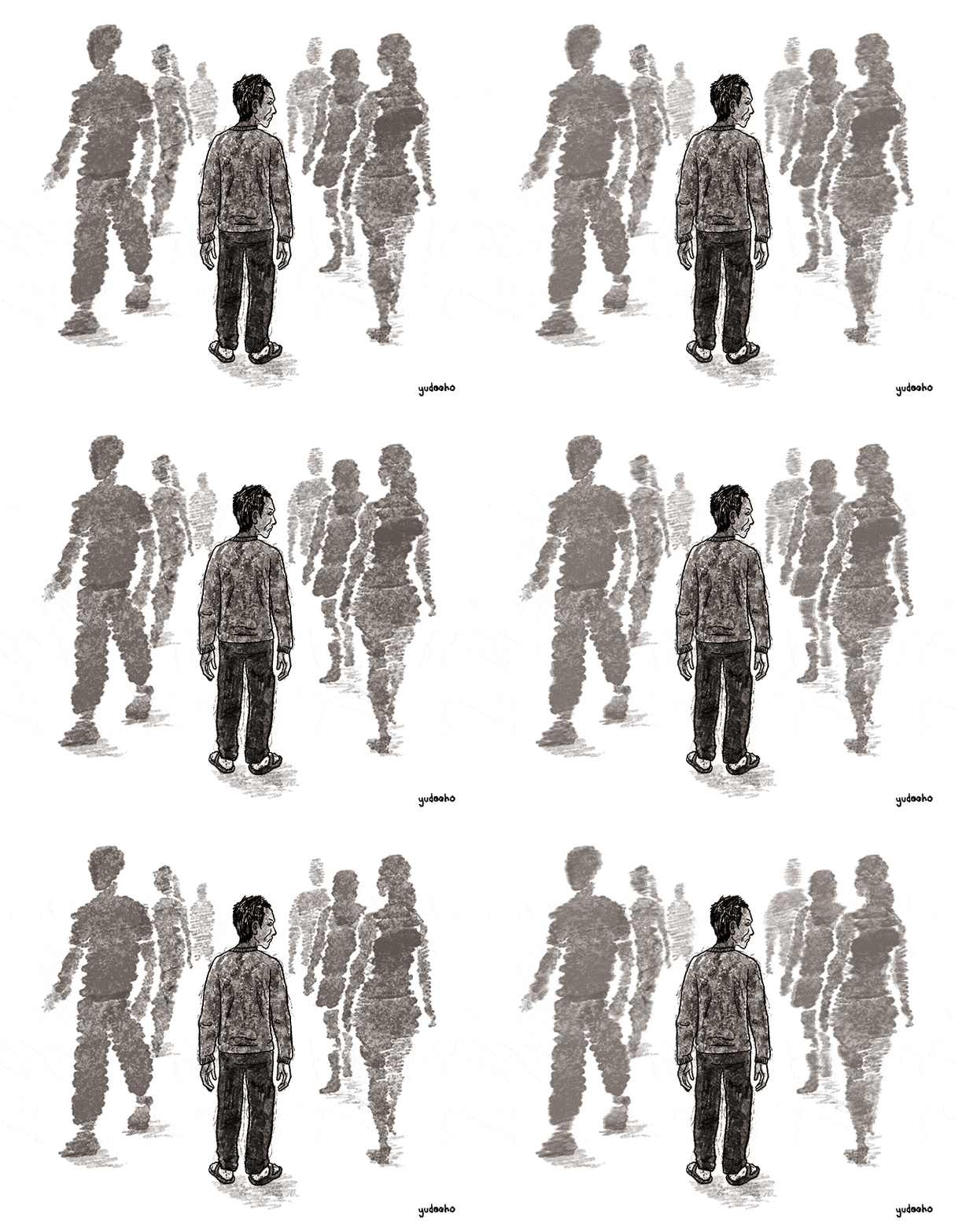
At first, Kim showed no sign of remorse for his actions. During the crime scene reenactments, Kim appeared nonchalant, smiling and chewing gum at the sites of the murders.
He insisted that society’s cold shoulder and rejection had shaped him into a monster.
“I wanted to live better than anyone, but no one accepted me after I came back from prison,” Kim told the press. “Looking down from Namsan, I saw so many lights, but none of them were mine.”
Kim said that his first murder had extinguished any fear within him, only furthering the desire to show that he was not a force to be trifled with.
According to Lee Sang-hyuk, a public defender for Kim, the killer’s words were “spiteful.” Accusing his attorney of being a police informant intent on securing a death sentence for him, Kim stated that the wealthy are full and content, ignorant of what people like him are going through.
Lee, however, assured Kim that he would strive to secure a life sentence rather than the ultimate punishment. He implored Kim to embrace humanity and atone for his sins, urging him to live a life of meaning and purpose.
Although Lee defended Kim in court, arguing that the defendant, who had failed to belong and felt alienated from society, should receive life imprisonment, nothing changed Kim’s fate.
In the initial trial, held in November 1975, the court sentenced both Kim Dae-doo and his accomplice, Kim Hae-woon, to capital punishment. However, in a subsequent trial in March 1976, the court commuted Kim Hae-woon’s sentence to life imprisonment, citing his relative passivity in the one murder case he was implicated in.
Kim Dae-doo did not appeal the verdict, and as a result, his execution was finalized. Today, South Korea is a de facto abolitionist country, which means it no longer carries out executions. But at that time, heinous criminals sentenced to death were counted on being executed.
By coincidence, or perhaps fate, the name of the next person in this story was strikingly similar to that of Kim's only accomplice in crime.
Kim Hye-won, a retired English teacher and devoted Christian, learned about the horrific details of Kim Dae-doo’s killings through the newspapers. Yet, something in her stirred. She felt compelled to reach out to him.
In an interview with The Korea Herald in 2006, she shared that she saw herself in him — a person who had lost all hope. Kim had experienced similar feelings during her own struggle with depression, and her path to healing had been through the Bible. She wanted to offer Kim Dae-doo the same chance at redemption. Plus, her husband was from the same hometown as Kim Dae-doo.
She first reached out to him in jail in December 1975, offering him words of encouragement to find redemption through faith. Ten days later, she received a reply from him that expressed feelings of profound loneliness and regret.
A part of his reply read, “Can I be forgiven by the grace of the Cross? If that’s possible, I will devote the rest of my life to gazing upon the Cross.”
In her memoir, published in 2005, Kim Hye-won described him referring to himself as someone no better than a bug. She recalled their first encounter, where her expectation of him being intimidating and ferocious turned out to be quite different in person; he seemed naive and simple-minded.
Ever since he turned religious, Kim Dae-doo spent his days reading the Bible and singing hymns. Before his death, he sent a total of 18 letters to his spiritual guide. The last letter, sent on Dec. 18, 1976, 10 days before his execution, expressed gratitude toward his spiritual mentor, who visited “the sinner” in all kinds of weather, rain or snow.
Kim’s last words, as shared by Kim Hye-won, touched on both personal and societal issues.
He expressed deep remorse for his sins and apologized to his victims and their bereaved families while wishing for society to be more lenient toward criminals like him to facilitate rehabilitation.
“As much as they exist in the shadows, let people know that their dreams are as big and desperate as anyone else,” Kim told a correctional chaplain in charge of faith services. He also requested that first-time offenders be separated from repeat offenders, as newcomers to crime might learn from those with more experience, potentially leading to further criminal behavior.
Kim Dae-doo was executed on Dec. 28, at the age of 27. He was buried in a Christian cemetery outside Seoul.
This article is a written adaptation of The Korea Herald's podcast True Crime. You can listen to the full episode on Spotify, Apple Podcasts and Podbbang. ― Ed.