Stakeholders weigh share swap terms as merger could create Korea’s largest fintech player with potential Nasdaq listing
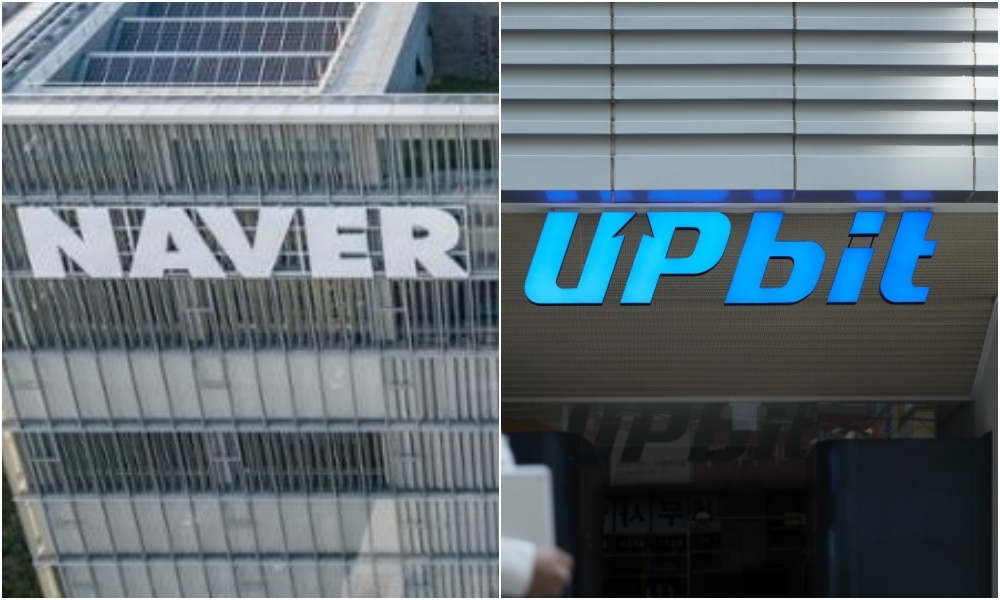
A long-anticipated merger between Naver Financial and Dunamu could take shape as early as this month, potentially marking one of South Korea’s most consequential fintech deals — though one clouded by valuation gaps and diverging shareholder interests.
According to industry sources Sunday, negotiations have accelerated in recent weeks, with the share swap ratio emerging as the central sticking point. The two unlisted firms differ sharply in corporate scale and profitability, complicating efforts to finalize terms.
Dunamu, operator of Upbit — Korea’s largest cryptocurrency exchange and the world’s fourth-largest by trading volume — is valued between 11 trillion won and 16 trillion won ($7.75 billion–$11.3 billion). Naver Financial, the fintech arm of internet giant Naver, is estimated at 3 trillion to 5 trillion won.
The profit gap is even wider. Dunamu logged 1.19 trillion won in operating income last year, nearly 12 times Naver Financial’s 103.5 billion won. Ratios ranging from 1:3 to 1:4 in Dunamu’s favor have reportedly been floated, while some brokerages suggest more conservative estimates of around 1:0.9. A higher ratio would dilute existing Naver Financial shareholders' stake while strengthening Dunamu shareholders’ post-merger influence.
Beyond the valuations, the deal’s complexity lies in the alignment of strategic interests among major stakeholders.
Dunamu’s top shareholders include Chairman Song Chi-hyung (25.5 percent), Vice Chairman Kim Hyoung-nyon (13.1 percent), Kakao Investment (10.5 percent), Woori Technology Investment (7.2 percent) and Hanwha Investment & Securities (5.9 percent). These investors are reportedly weighing whether to hold, sell or convert their stakes into Naver Financial shares, depending on the final terms.
Together, Song and Kim control 38.6 percent — a bloc large enough to sway a shareholder vote requiring a two-thirds majority. However, institutional investors may resist, citing doubts about the long-term synergy between a cryptocurrency powerhouse and the fintech arm of a tech conglomerate.
Hanwha Investment has already signaled caution, disclosing in a regulatory filing that it is “reviewing multiple options,” including a potential selloff or invocation of buyback rights.
Meanwhile, Mirae Asset Group — which owns 30 percent of Naver Financial, compared with Naver’s 69 percent — also faces dilution concerns if new shares are issued to Dunamu investors.
Despite such hurdles, the merger has fueled speculation about a potential Nasdaq listing. Market watchers estimate that a merged entity could command a valuation of 40 trillion to 50 trillion won, more than double Dunamu’s current worth.
Analysts say Naver could seek to consolidate the merged firm as a subsidiary by acquiring equity from Song and Kim. “If Song receives sufficient shares, he could even become Naver’s largest individual shareholder,” said Jeong Ui-hoon, an analyst at Eugene Investment & Securities. “That possibility may prompt Song and Kim to accept generous terms, though institutional investors might view them as excessive.”
Regulatory ambiguity adds another layer of uncertainty. The proposed merger could test Korea’s firewall rule separating industrial and financial capital. However, some analysts argue that neither company meets the legal definition of a financial institution under current law.
“Although Korea enforces the principle of financial-industry separation, Naver and Dunamu are not classified as financial firms under existing regulations,” said Choi Seung-ho, an analyst at DS Investment & Securities. “If legal ambiguities are clarified, the merger remains highly feasible.”
He added that even without a full merger, the two firms have already begun deepening cooperation through service integration and overseas expansion.
Still, regulatory review could prove decisive. A Financial Services Commission official said authorities will “review whether Naver’s incorporation of Dunamu violates the principles of financial-industry separation,” suggesting government intervention remains possible.
If completed, the deal would bring together Korea’s largest cryptocurrency exchange and its most prominent internet-backed fintech arm — a combination that could redefine the country’s digital finance ecosystem and set a precedent for big-tech participation in virtual asset markets.
yeeun@heraldcorp.com