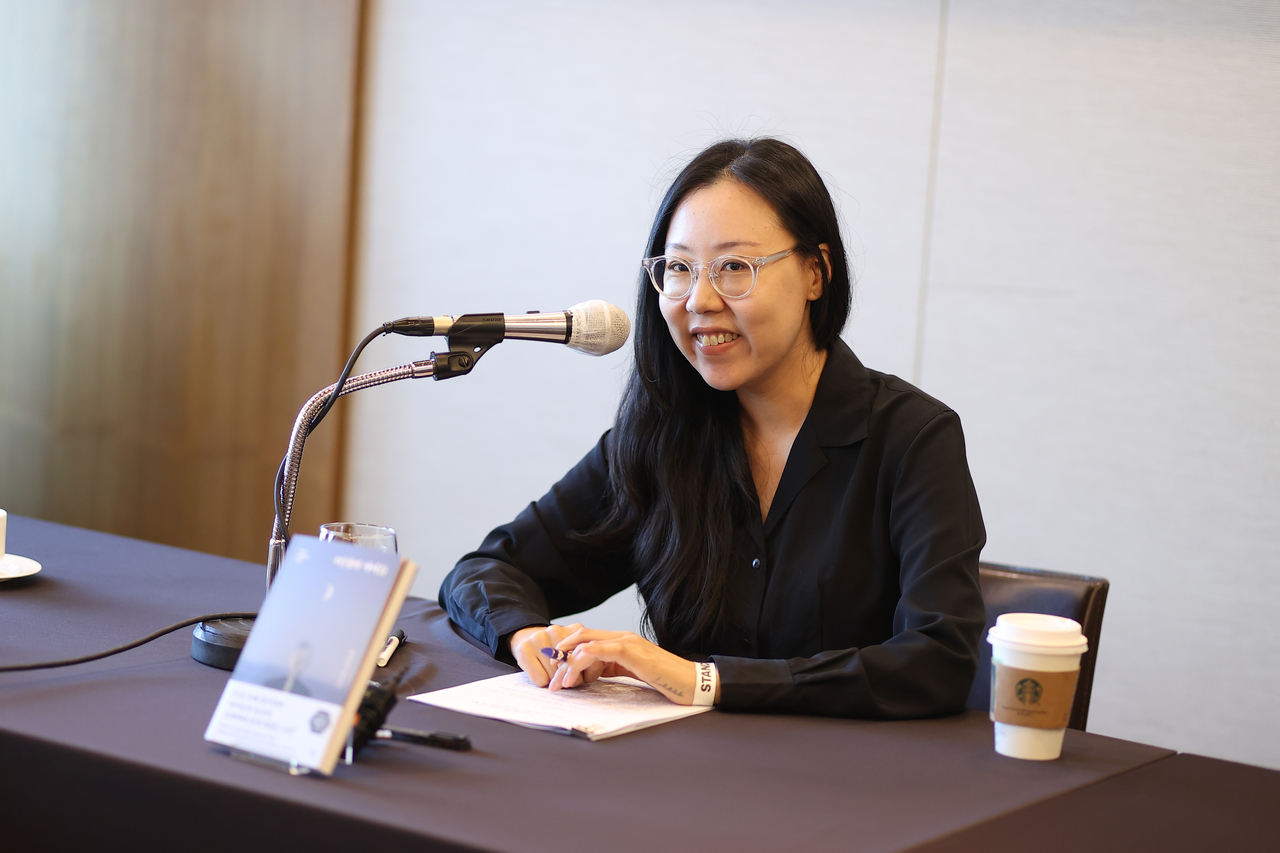
Author Kim Ana, who was announced as the winner of the 15th Honbul Literary Award earlier this month for her novel "Children of the Fourth Person," began writing the book as a way to reach out to those who might have lived through the same painful experiences she had.
The story begins with two children, Gwangji and Aurora, who grow up in a town called “P.” They are sent to an island facility named Happy Children's Welfare Foundation, also called “Haengabok,” which sounds similar to the Korean word for happiness, haengbok. There, they are promised a better life under the foundation’s care. What awaits them, however, is a regime of control and exploitation disguised as protection.
Cast out after enduring abuse, the children return to their hometown only to discover that they share the same recurring dreams, and that their memories and pain are mysteriously intertwined. Together, they set out in search of the elusive “we.”
“I went through a series of painful experiences that left deep scars, and since childhood, I’ve had recurring nightmares,” Kim said at a press conference in Seoul on Tuesday.
“Early last year, the nightmares came back. I suddenly wondered how many other women might have gone through similar things, how many of them might also be haunted in their sleep. I wanted to reach out to them, but I didn’t know how. So I wrote a novel.”
Kim employs the concept of the “fourth-person one,” a narrative perspective that extends beyond the conventional first, second and third person to encompass collective pain — voices that have been silenced or erased. The novel asks how these voices, when joined together, can become a plural “we” that speaks.
“When I finished my first draft, the idea of the fourth person didn’t exist,” Kim said. “It came up later in a discussion with fellow writers when one of them mentioned Olga Tokarczuk’s notion of a ‘fourth-person narrator,’ which I then began to apply consciously to the novel.”
Polish Nobel laureate Tokarczuk has described the “fourth-person narrator” as one that transcends individual perspectives and "manages to encompass the perspective of each of the characters."
Kim describes her version of the fourth-person one as a flexible, fluid community of people bound by shared experience.
“It’s a collective that communicates through pain, but also one that allows freedom. People come together, then drift apart. In the novel, the children gather at a place to heal, and eventually return to their own lives. That movement between solitude and togetherness is what the fourth person means to me.”
Reflecting on the book’s release on Tuesday, Kim admitted to feeling both anxious and exposed.
“It’s no longer mine. It will soon belong to the readers. That makes me afraid, restless. I can’t sleep, wondering where this story will go," said Kim.
"The person I spoke with most while writing was my younger self, the child who once felt despair. I used to think only the 'first-person one' could describe me, but at 38, I found a new pronoun for her, and it's a new way to speak through the language of imagination.”
Kim said she plans to begin another novel this winter, a lighter story about women who dance freely, unbound by convention.
The Honbul Literary Award was established in honor of the literary spirit of Choi Myung-hee (1947-1998), author of the epic novel "Honbul," which follows three generations of women under Japanese rule in the 1930s. The award recognizes works of full-length fiction with no distinction between new and established authors, and carries a cash prize of 70 million won ($48,800).
hwangdh@heraldcorp.com