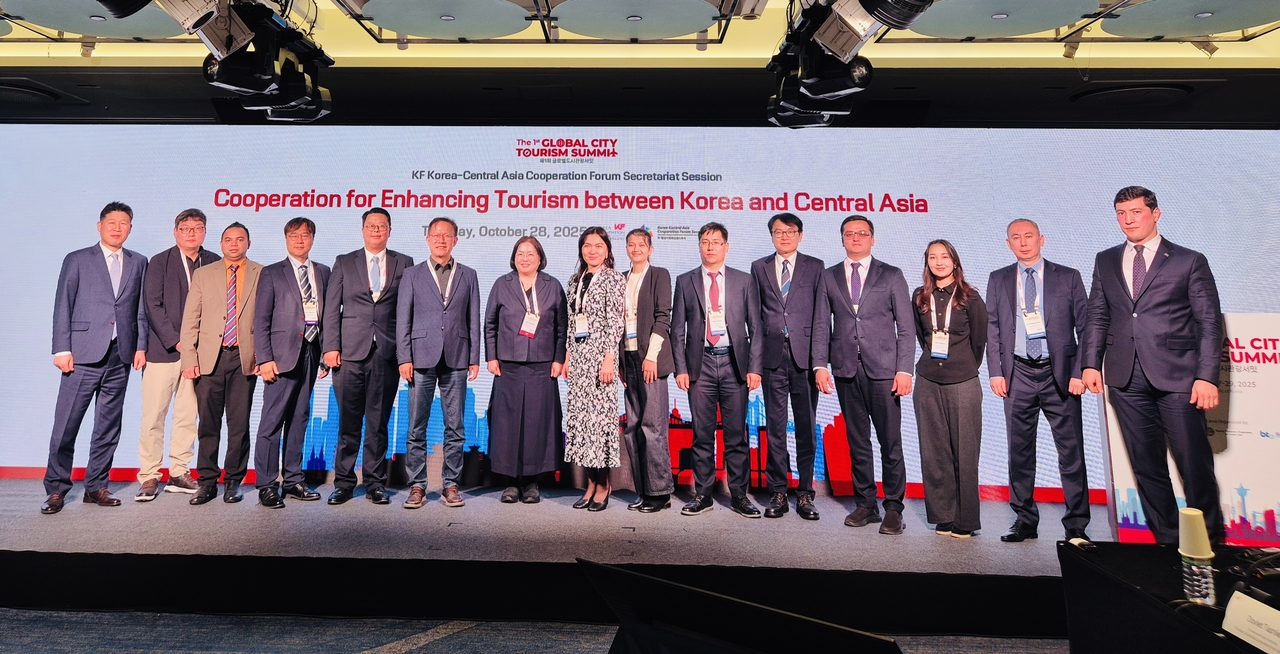
South Korea and five Central Asian nations discussed sustainable tourism at the Global City Tourism Summit in Busan on Tuesday.
The session, co-hosted by the Korea Foundation and the Tourism Promotion Organization for Global Cities, a Busan-based agency affiliated with the United Nations, sought to integrate Central Asia’s tourism resources with Korea’s industry expertise for a sustainable joint tourism network.
In her remarks, Lee Bang-bok, deputy secretary-general of the KF Korea-Central Asia Cooperation Forum secretariat, highlighted tourism in Korea-Central Asia ties and the ongoing efforts to build a cooperation framework since 2023.
She highlighted continued tourism cooperation since the 2023 Seoul roundtable, referring to new and expanded routes linking Incheon with major Central Asian cities.
“These developments mark a turning point for tourism and people-to-people exchanges between Korea and Central Asia,” Lee added.
During the session, Yoo Jin-ho of the Korea Tourism Organization presented Korea’s strong post-pandemic tourism recovery, noting a projected 19.5 million visitors in 2024 and growing K-culture influence, with women in their 20s and 30s dominating arrivals.
Korea ranks 14th globally and 4th in Asia for tourism competitiveness, he said, adding that Korea aims to attract 30 million foreign tourists and reach $30 billion in tourism revenue by 2027.
According to Yoo, KTO’s Almaty Office serves as a regional hub for tourism collaboration, promoting medical tourism, K-culture programs, MICE industries, and Muslim-friendly initiatives.
“Through closer tourism exchanges with Central Asia, we can create new synergies and achieve shared growth,” Yoo hoped.
The session also included presentations from Kazakhstan, Kyrgyzstan, Tajikistan, Turkmenistan, and Uzbekistan, as well as representatives from the Korea Tourism Association, Eastar Jet, Hana Tour, and embassy officials.
Speakers discussed problems faced by travelers and practical ways to enhance connectivity and tourism flows between Korea and Central Asia.
The discussion concluded with an agreement to establish the Korea-Central Asia Tourism Cooperation Council, a new institutional framework to boost long-term cooperation and policy dialogue in tourism.
sanjaykumar@heraldcorp.com

![[Contribution] Central Asia, on threshold of a new era](https://wimg.heraldcorp.com/news/cms/2025/11/16/news-p.v1.20251115.e2da24d2ca524b7eae970f781f1be542_T1.png?type=h&h=240)