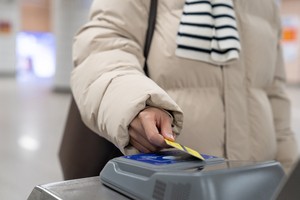
South Korea boasts one of the most advanced public transportation systems in the world, and passengers can save a substantial amount of money using the transfer system, particularly when traveling long distances within the greater Seoul area.
But navigating the extensive networks of multiple subway lines, city buses and intercity trains and buses can be challenging, particularly for those unfamiliar with the system.
Prepaid transit cards
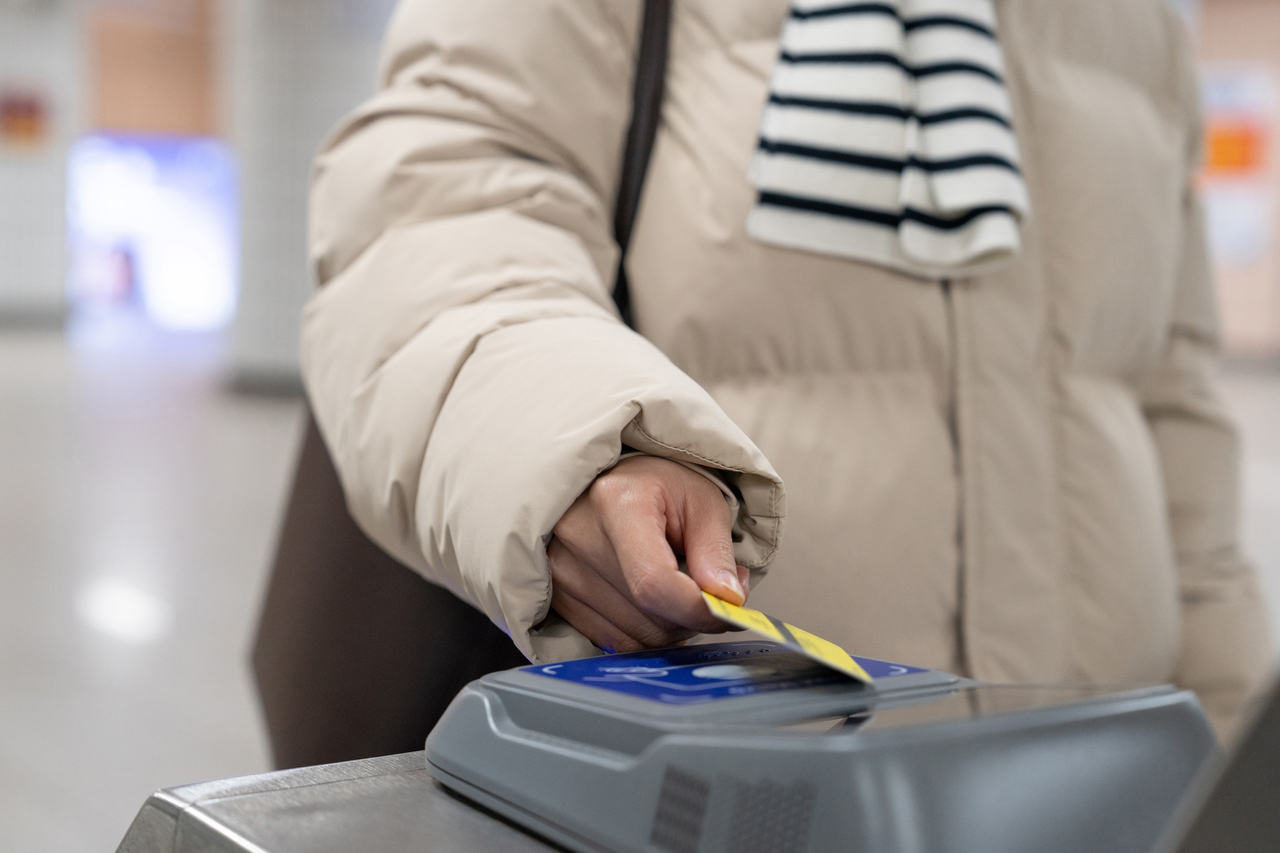
Transit expenditures can be settled at the end of the month using some credit cards, debit cards and student IDs, but prepaid transit cards are a good option for short-term visitors to pay as you go.
One of the most widely used ones is Tmoney, which can be purchased at ticket booths at subway stations or convenience stores across the country. Tmoney cards start at 4,000 won ($2.80), although some unique designs cost more, and they can be topped up at the point of purchase.
Transit cards work on almost all subway lines and metropolitan buses, and can even be used to purchase tickets for express intercity buses and trains. For train tickets, Tmoney only works at ticket booths run directly by Korail, and express bus tickets are sold through the Tmoney Go application.
Most Tmoney cards only work for subways and city buses. To make sure your Tmoney card can also be used for intercity trains and express buses, look for the "One Card All Pass" logo printed on both sides of the card.
All Tmoney cards can be used on the subway networks of Seoul, Incheon, Gyeonggi Province, Daejeon, Daegu, Busan and Gwangju. They also work on city buses in these regions, as well as in Sejong, Ulsan, Gangwon Province, Jeju Island, and most parts of the Chungcheong, Gyeongsang and Jeolla provinces.
Tmoney can also be used to pay tolls on expressways and bridges, although you need the One Card All Pass for some.
Visit www.tmoney.co.kr (Korean) for detailed information on where you can use Tmoney. Specific locations, including a range of non-transportation uses for Tmoney both online and offline, can be found here.
The page for foreign customers provides a basic guide for Tmoney in English, Japanese and Chinese.
Refunding your Tmoney balance is possible for a service fee of 500 won. Partial refunds are only available at Tmoney Town and Tmoney service centers located in subway stations, and only for amounts between 10,000 and 50,000 won, in units of 10,000 won.
EZL, another prepaid transit card formerly known as Cashbee, can be used and topped up on subway networks in the greater Seoul area, Busan, Daejeon, Daegu and Gwangju, though in Daegu a station agent has to top up your EZL card manually. It can also be used on city bus systems across the country -- except for certain regions in the Gyeongsang and Jeolla provinces -- and, like Tmoney, is valid for buying train tickets at Korail booths.
It cannot be used to buy express bus tickets.
Both Tmoney and EZL can be used to pay for taxi fares, provided the taxi is subscribed to their services. Both are available in most of the country, but not everywhere, so make sure to check with the driver first.
Check www.cashbee.co.kr for detailed information on where the EZL card can be used.
Stores accepting EZL as payment include convenience store chains 7-Eleven, CU, GS25 and E-mart 24; larger retailers Lotte Mart and Lotte Super; and franchises including Lotteria, Krispy Kreme, Paris Baguette, Dunkin Donuts, Baskin-Robbins, and coffee chains Angelinus and Caffe Pascucci.
Tmoney can be used at eight convenience store chains: 7-Eleven, CU, GS25, E-mart 24, Storyway, IGA Mart, C-Space 24 and Best All. Elsewhere, it is accepted at most branches of Home Plus, GS The Fress, Homeplus Express, Daiso, Paris Baguette, Dunkin Donuts, rice cake shop Bizeun, Starbucks, Angelinus, Caffe Pascucci, Ediya Coffee and Lotteria.
Navigation apps provide optimal routes, arrival information
Google Maps is a handy application in most parts of the world for finding your way around, but it's less functional in Korea. The government here has refused to allow the international company to export the country's high-resolution map data on multiple occasions, citing security issues.
It is an ongoing debate, but as it doesn't want to process the data in-country, Google is limited in the navigation information it can provide in Korea. As of now, both Kakao Map and Naver Map are better options when on Korean territory, and their distinct advantage is that they provide specific routes on public transportation, and for driving and walking.
For example, let’s say you want to get from Seoul Station to Gangnam Station and you don’t want to drive or take a cab. Both apps will tell you the best options to get there via bus, subway, or a combination of the two, and you can choose between the route that is the shortest in terms of distance, the one that is the fastest, the one that requires the least walking, or the one that requires the fewest transfers.
In this case, the apps show that the No. 402 and No. 421 buses involve the least walking and no transfers but they take the longest. On the other hand, taking Subway Line No. 4 and transferring to Line No. 2 is shorter but requires more walking.
They also display the transit fares for these routes. For example, taking the intercity bus No. 9003 could be marginally faster than the Seoul city bus route, but it costs 2,800 won instead of the usual 1,500 won, making it less optimal.
The apps even let you know when the bus or subway train is expected to arrive at your location, and exactly where you need to transfer to another means of transportation.
Tapping on a particular route allows you to see a map of it and where you are on your journey, so you can make sure you are going in the right direction.
Users of Naver Map can change the language setting from Korean to English, Chinese or Japanese, and Kakao Map provides an English option. Some services may be limited in languages other than Korean.
For more information on useful mobile apps for traveling in Korea, check out "On Korea‘s streets, Naver beats Google," and "Apps that help travelers get around Seoul," also in Survive & Thrive series.
Keep in mind that transferring by tapping a transit card on your way in and out makes getting around metropolitan areas much more efficient than paying a fare each time you get on a bus or subway. Seoul, Incheon and Gyeonggi Province have established a unified transit system where passengers who tap out can transfer to other buses and subway services for reduced or no fees in the greater Seoul region.
Express buses and intercity trains such as KTX do not offer reduced transfers, however, and there is a limit to how many times you can transfer on one journey in each city's transit system.
Transfers are covered in more detail in the article "Transportation (1): Free transfers within 30 minutes" in this same series. Information about Seoul’s nighttime buses can be found in “Getting around at night.”
As for taxis, you can book a ride via the Kakao T app, which offers the choice of a regular taxi, the more expensive Kakao T blue, or a larger “venti” cab to your destination. It also lets you know the estimated fare and distance of the route.
Why some seats are off-limits
On Korea's public buses, there are seats with a yellow or pink cover on the top, which are priority seats for the "mobility disadvantaged persons," according to the Act on Promotion of the Transportation Convenience of Mobility Disadvantaged Persons. A yellow cover indicates that a seat is reserved for senior citizens, pregnant women, children and those carrying infants.
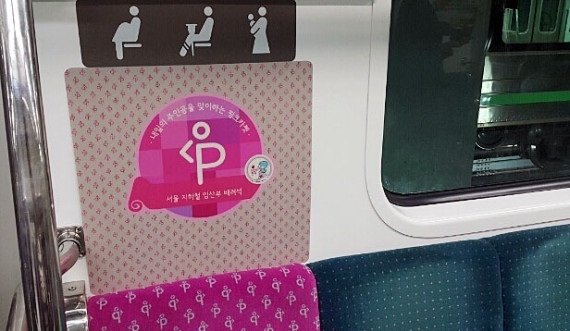
Seats with pink covers are specifically reserved for pregnant women. The priority seats are usually those closer to the exit.
Priority seats on the subway are usually located on the far ends of each car, and have labels indicating they are reserved for those who have difficulty getting around. Seats for pregnant women are at the ends of the car's main bench seating, marked in pink.
It is technically not against the law for anyone to sit in the priority seats — the law only mandates designation of the seats for the traffic authorities — but it's frowned upon to use them if you don't need to.
Women who are pregnant but not visibly so can indicate their condition to other passengers by wearing a pregnancy badge, which is available free of charge at public health centers and some subway stations' customer service centers. Anyone, including foreign nationals, can apply for the badges with documentation showing they are currently pregnant.
Applications for pregnancy badges can also be submitted via the government24 website, a state-run civil service portal. Not all subway stations provide the badges, so it is advisable to call the customer service center in advance.