Korea’s semiconductor clout and manufacturing base put it at the center of the physical AI race

South Korea has emerged as a magnet for major US technology companies in recent months, with Nvidia, OpenAI and Amazon Web Services pouring billions into investments and clinching strategic partnerships to expand the country’s AI infrastructure.
Observers say the country offers a rare combination of advantages as Washington and Beijing battle for tech supremacy. Home to top-tier chipmakers and automakers, South Korea — a key US ally and Asia's fourth largest economy — provides manufacturing prowess, semiconductor supply, digital readiness, strong government backing and a strategically positioned base to establish robust artificial intelligence supply chains in the Asia-Pacific region.
“Few countries can match Korea’s mix of software capability, manufacturing power and strong government commitment,” said Choi Byung-ho, a professor at Korea University’s Human-inspired AI Research Lab.
“That makes Korea especially valuable in today’s AI race.”
Investments, partnership boom
The investment rush became apparent when AWS announced plans to, over the next six years, invest an additional $5 billion in building AI data centers in Incheon and Gyeonggi Province during a meeting between AWS CEO Matt Garman and South Korean President Lee Jae Myung on the sidelines of APEC CEO Summit last month.
The new commitment adds to AWS’ earlier $4 billion investment in June to a build hyper-scale AI data center in Ulsan with SK Group, bringing the total figure to a whopping $9 billion by 2031.
Culminating the wave of partnerships, Nvidia CEO Jensen Huang announced it will supply around 260,000 of its latest Blackwell graphics processing units to South Korea in a deal worth up to $10 billion on Oct. 31.
In one of the largest deployments of Nvidia’s coveted AI chips outside the US, 50,000 units will go to the South Korean government to establish a national AI cloud facility, while Samsung, SK and Hyundai will each receive 50,000 units and Naver will acquire 60,000.
In October, Samsung Group and SK Group inked an initial agreement to supply chips and other equipment to Open AI’s Stargate, a US-led mega-scale AI infrastructure project. Under the deal, Samsung Electronics and SK hynix will provide memory chips for the project, with the demand expected to reach 900,000 DRAM wafers per month.
The ChatGPT operator also agreed to build two data centers in Korea with Samsung Electronics in Pohang, North Gyeongsang Province, and with SK hynix in South Jeolla Province.
Why Korea?
What makes South Korea an attractive destination? Tech leaders' answers are remarkably similar.
“Korea has all the ingredients to be a global leader in AI — incredible tech talent, world-class infrastructure, strong government support, and a thriving AI ecosystem,” said OpenAI CEO Sam Altman in a statement when announcing the deal.
After unveiling the GPU rollout, Huang praised South Korea as one of the very few countries with three capabilities that are “fundamental, essential, necessary” qualities for success in AI: software expertise, deep technical and science capability, and manufacturing.
“When you combine software, AI technology and manufacturing, you have the opportunity to really take advantage of robotics," which is the future of AI, said Huang.
Semiconductor edge
A major draw for investors is Korea’s semiconductor ecosystem. The country is home to chipmakers Samsung Electronics, a major memory chip producer that also runs a foundry, and SK hynix, which dominates the high-bandwidth memory market — a specialized DRAM chip essential for powering GPUs, which power AI computing.
Together, the chip duo controls about 70 percent of worldwide DRAM production and close to 80 percent of the HBM market, according to industry data.
As AI infrastructure scales up and requires enormous numbers of GPU, heavily dependent on HBM and advanced packaging, maintaining proximity to a reliable supply chain has emerged as a key strategic edge.
SK Group Chair Chey Tae-won recently noted that HBM demand is rising so fast that even leading suppliers like SK hynix are struggling to keep pace.
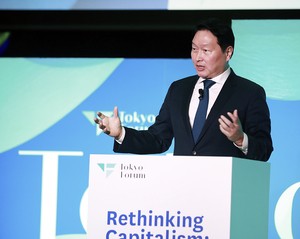
“Nowadays, we have been receiving requests for memory chips from many companies, and I am seriously concerned about how to meet all the (demands),” Chey said at the SK AI Summit last week, citing OpenAI’s recent request for SK hynix to provide 900,000 high bandwidth memory wafers per month for the Stargate project. This, Chey noted, is roughly twice the total global monthly production capacity of HBM at all companies.
Government's ambition: top three AI powerhouse
The Korean government is aggressively backing AI infrastructure, hoping to secure a place as a distant third in the global AI race led by the US and China.
Under the so-called “AI highway” project, the Lee administration seeks to set up large-scale AI data centers nationwide and connect them through ultra-high-speed networks by 2030. The government also plans to build a national AI computing center with private sector collaboration.
It is simultaneously supporting companies to develop homegrown AI foundation models tailored to Korean language and culture, offering companies access to GPUs, data and talent.
To fuel this vision, the government is establishing a National Growth Fund of over 100 trillion won ($69 billion) via private-public joint financing activities.
In recent years, the government has introduced measures to attract more global investors, such as tax incentives, relaxed regulation and power-supply support.
Physical AI testbed
Physical AI, systems that extend intelligence into the real world through robots, machines and autonomous vehicles capable of sensing, deciding and acting, is widely viewed as the defining trend for AI’s next era.
Global tech giants are also pouring billions of dollars into physical AI, including Nvidia. CEO Huang has even predicted that the “ChatGPT moment” for general robotics and physical AI is just around the corner.
Developing physical AI requires multiple components, including massive real-world data, sensors, mechanical hardware and specialized processors like NPUs and AI accelerators to handle fast computations.
Huang underscored Korea’s advantage in this area, citing the country’s strong industrial base spanning ships, cars and semiconductors.
“I think the opportunity for Korea for physical AI and robotics is very significant, because Korea has the expertise, the technology as well as the market,” Huang told reporters in Gyeongju, North Gyeongsang Province, on Oct. 31.
Analysts agree that Nvidia’s deep partnership with Korean conglomerates aim to leverage the country’s software and manufacturing capabilities to pioneer physical AI.
“Korea, with its software and manufacturing power, is particularly well-suited as a testbed for physical AI,” said professor Choi.
“The country is compact, densely populated and has world-class telecom networks and urban infrastructure, which are all ideal conditions for testing physical AI. In contrast, the US is vast, making real-world testing much harder and it doesn’t have the same combination of software power and manufacturing capability.”
Many of Nvidia’s latest partnerships with some of South Korea's biggest companies appear to have physical AI as a central theme. With Hyundai Motor Group, the company is collaborating across multiple areas of physical AI, including autonomous vehicles, smart factories and robotics. The two firms and the South Korean government also announced plans to jointly build a national physical AI cluster valued at around $3 billion.
Nvidia is likewise working with Naver to develop a physical AI platform that could be used in key industrial sectors, including semiconductors, shipbuilding and energy.
Together with Samsung, Nvidia is creating an AI megafactory, embedding AI throughout the entire manufacturing process of semiconductors, mobile devices and robotics. It has also joined forces with SK Group to set up an AI factory, while its telecommunication arm, SK Telecom, is rolling out an industrial AI cloud to advance physical AI and robotics development.
sahn@heraldcorp.com