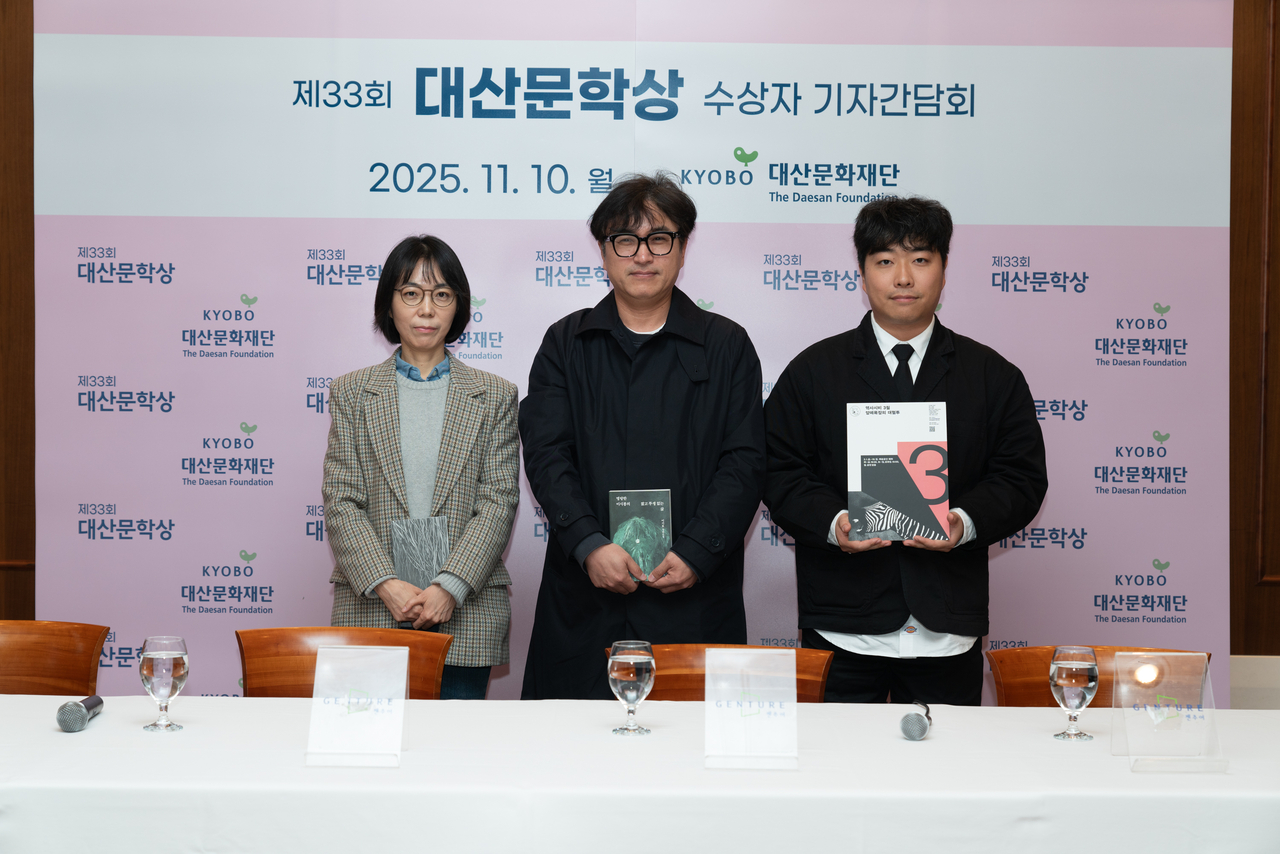
Novelist Lee Ki-ho has won the fiction category at the 33rd Daesan Literary Awards for his novel “The Cheerful, Struggle-Free Life of Lee Sibong,” the Daesan Foundation announced Monday during a press conference at Kyobo Tower in Seoul.
The novel follows a young man named Lee Si-seup and his grieving family, whose lives become intertwined with their pet, a Bichon Frise named Sibong. Together, they embark on an unlikely odyssey of loss, guilt and healing.
Lee said the story was inspired by his own experience living with a dog named Sibong.
“About eight years ago, I started living with a dog for the first time,” Lee said at the press conference. “Being a dog owner is full of joy, but there are also times when you have to do things your pet doesn’t like. I tried my best to care for him, but sometimes I felt he didn’t love me back as much. Out of that bittersweet feeling, I thought, as a writer, the best way to show my sincere love would be to write a book about him. That’s how the novel began, half playfully.”
Lee received the Daesan Creative Writing Funds in 2003, a form of early support that he said helped him through a difficult period when “no publisher wanted my manuscripts.”
“In my fourth year after debut, I had no commissions and no publisher interested in my work,” Lee recalled. “Winning that grant allowed me to pursue my literary career and even to get married with that money. To receive the Daesan Literary Award now, for my longest and most personal novel, feels like the greatest encouragement.”
The foundation also honored poet Shin Hae-uk, playwright and director Joo Eun-gil and translator Chi-Young Kim as this year’s winners.
Shin received the poetry award for her collection “The Edge of Nature and Natural History.”
“When I start a poem, it often begins with something deeply personal — with pleasure, curiosity or obsession,” she said. “But as I write, I am reminded that I am part of a community, connected to the world. This award, I believe, is a signal for me to stay more deeply connected and responsible to that world.”
At 31, Joo became the youngest-ever Daesan winner for “The Great Battle at the Sheep Ranch.”
“When I staged the play in a 50-seat theater, it was hard even to draw an audience. I often wondered if my effort meant anything. Receiving this award makes me think maybe it did,” said Joo.
In the translation category, Kim was recognized for her English translation of Cheon Myeong-kwan’s “Whale,” which was shortlisted for the International Booker Prize in 2024.
“The news came as a surprise,” Kim, who could not attend the conference, said in a written acceptance statement. “But it’s no surprise that the prize went to ‘Whale.’ Anyone who loves this novel knows how brilliantly it blends fable-like characters, vivid storytelling and social satire to reveal a new vision of Korean literature. My task was simply to re-pave the road Cheon had already built.”
Kim also reflected on her long connection with the foundation, recalling that she also began her career with a Daesan grant nearly two decades ago, when she translated Lee Dong-ha’s “Toy City” in 2005.
“That early grant made it possible to publish Korean literature in the US, at a time when few American readers even knew it existed. It not only helped shape my career but also laid a foundation for the global reach of Korean writing.”
Founded in 1993, the Daesan Literary Awards honor outstanding works in poetry, fiction and translation each, while the drama and literary criticism categories are awarded biennially.
The award ceremony will take place Dec. 5 at the President Hotel in central Seoul. Each winner will receive 50 million won in prize money, and the three Korean-language winners’ works will be considered for translation and overseas publication.
hwangdh@heraldcorp.com