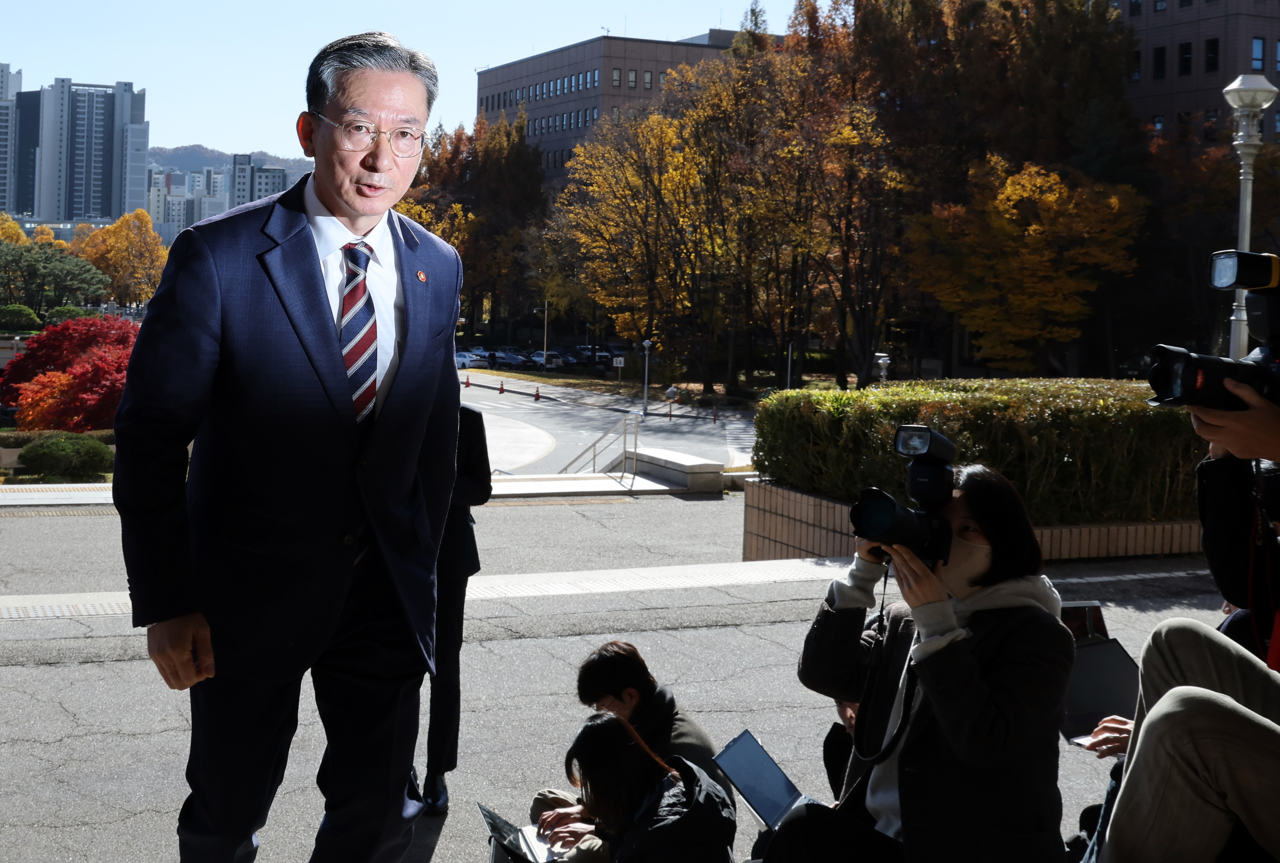
Justice Minister Jung Sung-ho on Monday defended the prosecution’s decision not to appeal the verdict in a land development corruption case, saying the move was “legally sound” and reached after “careful consideration of all circumstances.”
The case, one of South Korea’s most politically charged in recent years, centers on a housing development project in Seongnam, Gyeonggi Province. Prosecutors had accused five key private developers and former city officials of colluding to divert massive profits from the project, but chose not to contest parts of a district court ruling that acquitted them of major charges such as bribery and breach of trust.
The Seongnam development scandal has long cast a shadow over President Lee Jae-myung's political career. As Seongnam mayor at the time of the project’s launch in the mid-2010s, Lee authorized the public-private partnership that enabled insiders to reap massive profits while leading to losses for the city-run developer.
Though the court handed down prison terms of four to eight years to five defendants, its verdict did not suggest that Lee was involved in their crimes. The prosecution’s decision not to appeal now effectively seals the verdict of the initial trial.
Speaking to reporters on his way to work at the government complex in Gwacheon, Gyeonggi Province, Jung said, “We judged that there is no problem even if the prosecution does not appeal. The sentences handed down already exceeded the prosecution’s own recommendation and the sentencing standards used in appeal decisions.”
He emphasized that the Ministry of Justice had not issued any directive or pressure regarding the decision, saying only that the ministry “received various reports but did not provide guidelines.” According to Jung, his office merely advised the Supreme Prosecutors’ Office to make a “rational decision after considering all factors.”
“From a procedural standpoint, this was a successful investigation and a successful trial,” Jung said. “The prosecution had already achieved a higher sentence than it requested, and in that respect, it was reasonable not to appeal.”
Jung added that while the ministry examined the sentencing in detail — notably that of Yoo Dong-gyu, former planning director of the Seongnam Urban Development Corp. — it found no legal grounds requiring an appeal. He also cited the testimony of Nam Wook, one of the private developers, who made remarks on the final day of the appeal deadline that Jung said could have “fueled political controversy” had the case been prolonged.
“When the prosecutor general indicated that a local office intended to appeal, I asked them to consider the matter comprehensively and carefully,” Jung explained. “But given the highly politicized atmosphere, continuing the case could have created unnecessary turmoil.”
Jung also rebuked former Justice Minister Han Dong-hoon, who said that the prosecution had “committed suicide” by giving up the appeal.
“I cannot accept that such a statement is something a former minister should make,” Jung said, pointing to past instances where the ministry, under Han’s leadership, also dropped appeals in politically sensitive cases.
He further dismissed speculation that the move was intended to protect Lee, stressing that “the president’s ongoing trial is unrelated to this case.”
Acting Prosecutor General Noh Man-seok remained tight-lipped Monday over allegations that the prosecution’s decision to drop the appeal came under instructions from the Justice Ministry’s top leadership.
Asked by reporters outside the Supreme Prosecutors’ Office in Seoul whether he had been directed by the minister or vice minister to abandon the appeal, Noh replied only, “I will speak about it another time,” before entering the building without further comment.
He also did not answer when asked if he stood by his earlier statement that the decision was reached independently.
Meanwhile, prosecutor Kim Young-seok of the Supreme Prosecutors’ Office wrote on the organization’s internal bulletin board that the move “handed billions in criminal profits to private developers,” calling it “unprecedented in prosecutorial history.”
Other prosecutors, including Kang Baek-shin and Cheon Young-hwan, accused the Justice Ministry of undermining the prosecution’s independence and demanded the resignation of its leadership. They warned that the decision could have ripple effects on related trials, including that of Jeong Jin-sang, the former deputy chief of staff to Lee, facing bribery charges connected to the same project.
The controversy erupted after prosecutors failed to meet the Nov. 7 appeal deadline following an Oct. 31 district court ruling. The court’s verdict — which included several acquittals and sentences lighter than the prosecution’s recommendation — was widely expected to be appealed, especially given that the bench itself acknowledged “there is no relevant Supreme Court precedent” on certain legal issues.
mkjung@heraldcorp.com