A Chihuahua on the run and a good Samaritan who stepped in. So, what happens, really, after a pet is found in Korea?
It was supposed to be an ordinary morning commute at Gupabal Station in northern Seoul. Then, out of nowhere, a small dog came sprinting through traffic — leash dragging behind it, no owner in sight.
“I was at Gupabal Station waiting for my friend Sam at a bus station. We were going to go hiking. And then I saw a small dog, a Chihuahua, running in the middle of the road," said Nelson Cho, 36. "My initial reaction was to run after it.”
Little did he know that this small rescue, a simple good Samaritan act, would lead him down a trail of phone calls, online postings, and troubling discoveries about what happens to lost animals.
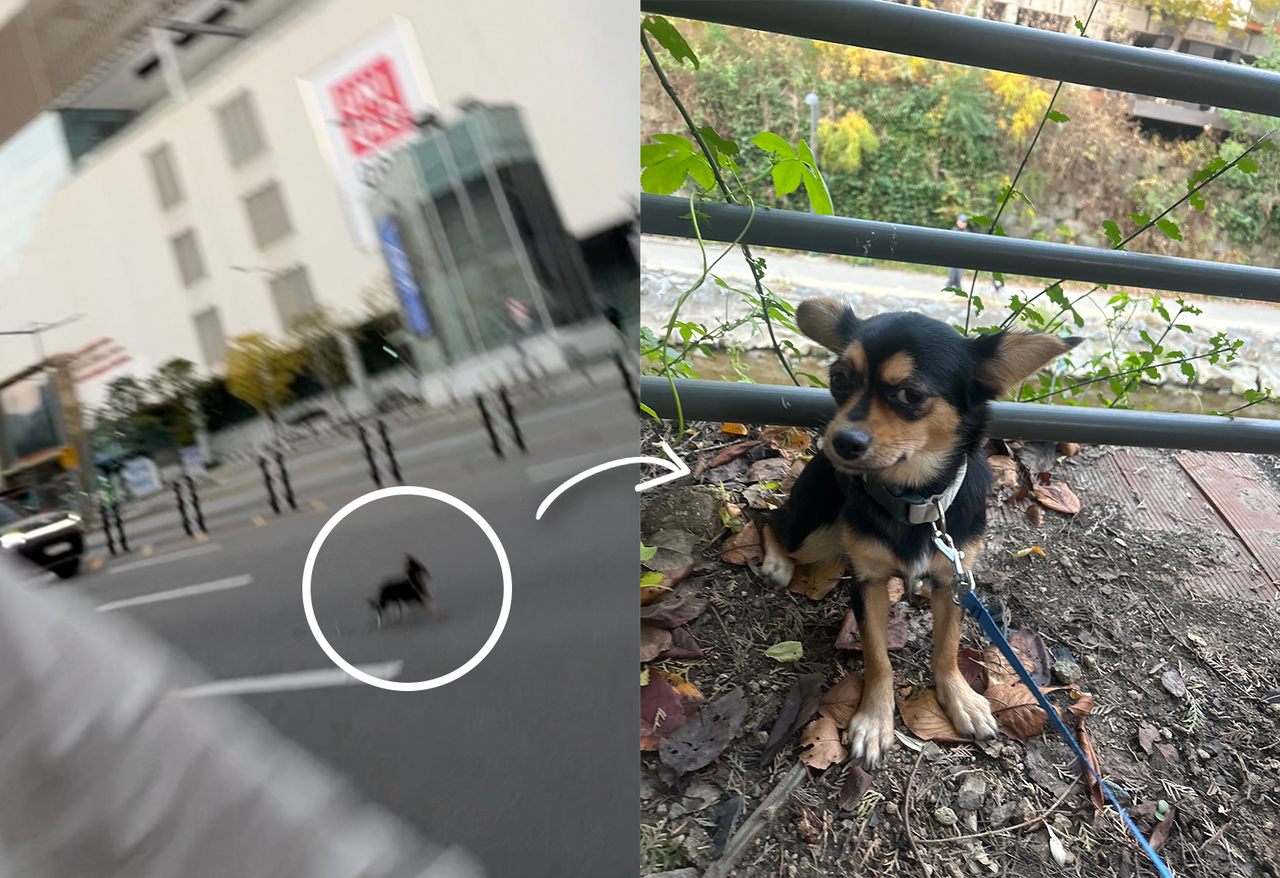
Having lost his own dog before, Cho said he knew the panic that comes with that moment. “I didn’t even look at whether there was an owner — I was just running after it, hoping that the owner would be looking for it. But then because it was running between the cars, and I think because I was chasing it as well, it just kept running even faster.”
After several tense minutes, the dog bolted into an apartment complex, allowing him to corner her and grab her. The Chihuahua was clean and wearing a leash, but the strap was torn and there was no name tag.
Unsure of what to do next, he called the police.
“I called the cops because I don't know who to call, and the cops forwarded me to the district office. They had a branch that was specific for lost pets and they instructed me to leave the dog at a police station or a firefighter station so that they would come pick it up.”
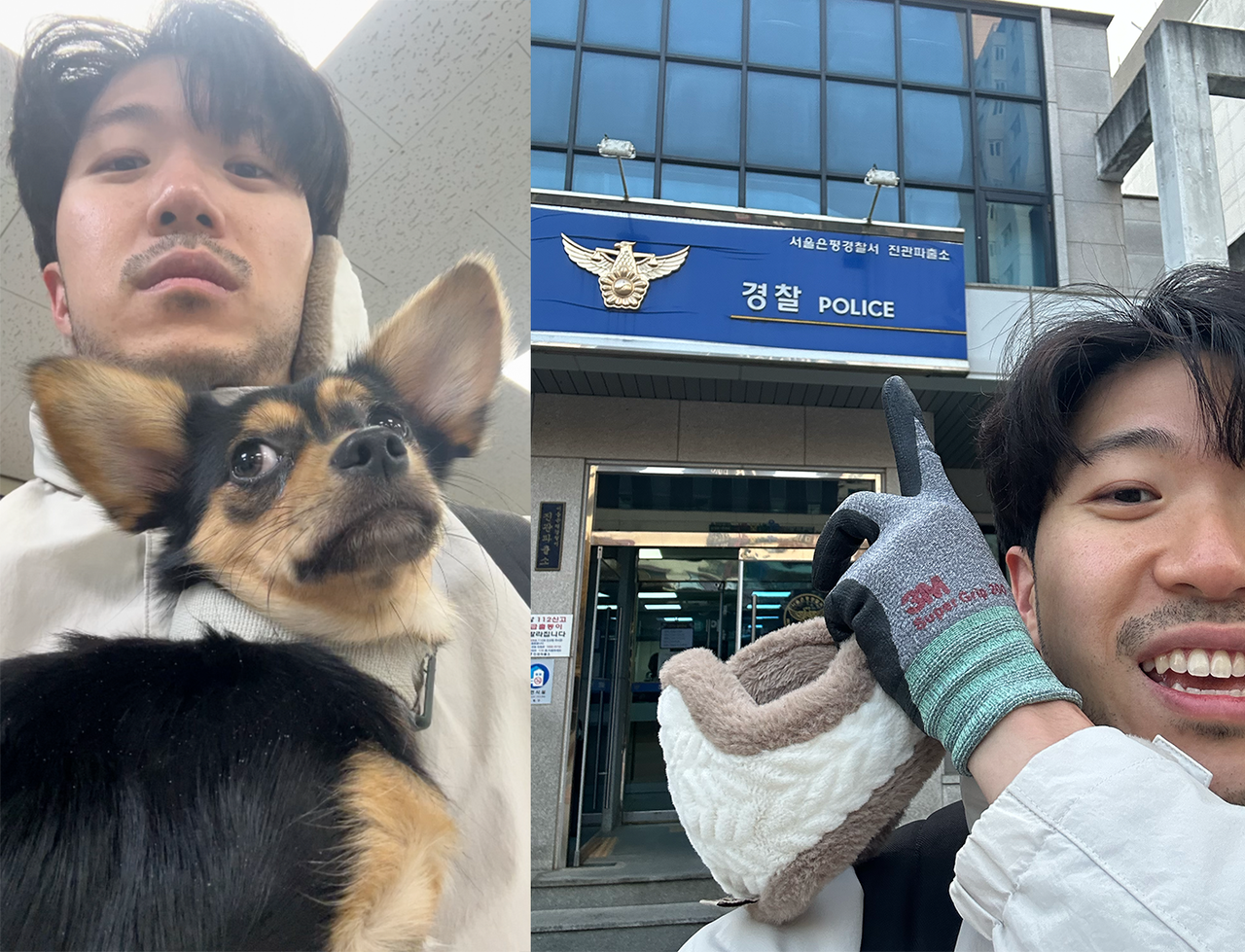
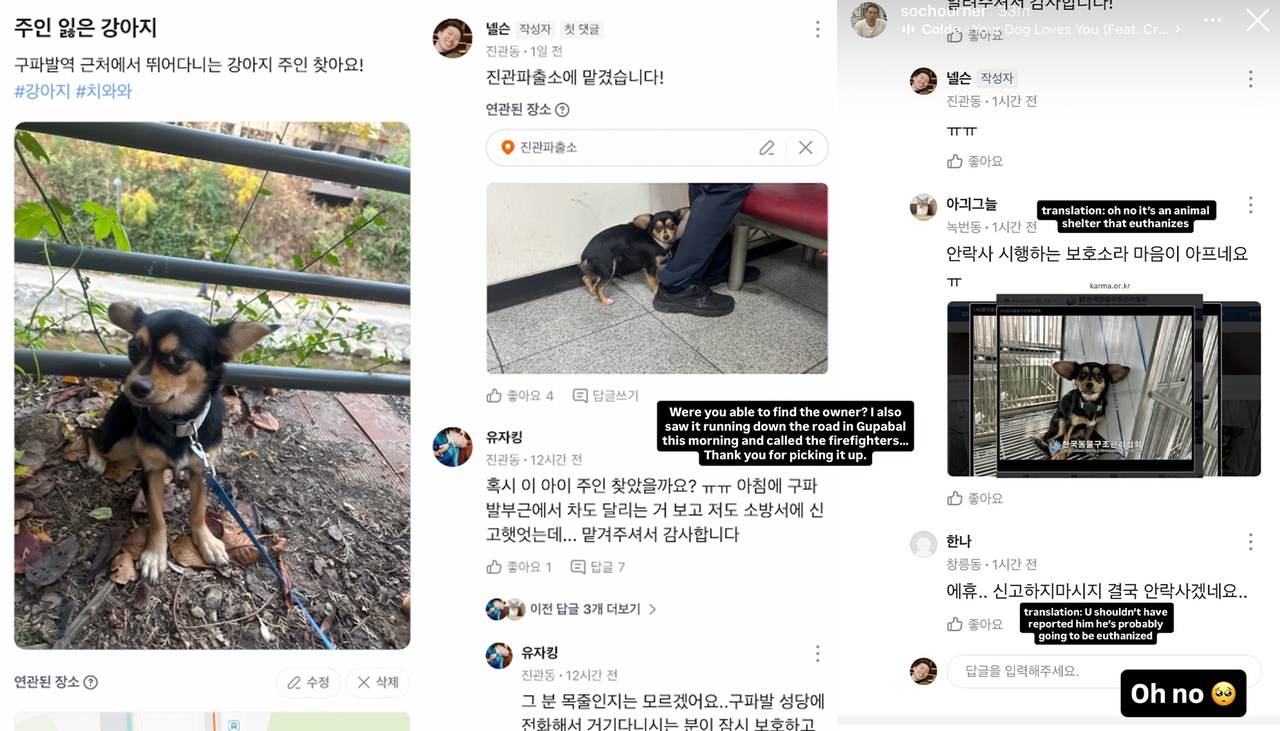
At the police station, Cho was told the dog would be kept there for 24 hours. If nobody came to claim her, she would then be sent to an animal shelter. Hoping to help track down the owner, Cho also posted about the dog on Karrot, also known as Danggeun in Korean, a community-based secondhand market app that includes neighborhood forums and community alerts.
When no owner appeared, Cho learned that the dog had been transferred to the Korea Animal Rescue & Management Association, where she would stay while waiting to be claimed.
He continued posting updates on Karrot, but reactions from the community were divided. While some shared a sigh of relief, others expressed concerns about what might happen next.
“Oh no, it’s an animal shelter that euthanizes,” one commenter wrote.
Another added, “You shouldn’t have reported the dog. … She’s probably going to get euthanized.”
What happens to an impounded dog?
Worried about the dog's fate, Cho and The Korea Herald contacted the shelter directly.
A shelter official confirmed that the dog would be kept for one week to give the owner a chance to claim her. If unclaimed, she would be listed for adoption. This means even if Cho wanted to take the dog, he could not do so until the required holding period had passed.
Although the official did not say so explicitly, under current regulations, animals that remain unadopted after a certain period are often eventually euthanized. The exact timeframe for this varies depending on the jurisdiction and the shelter’s capacity. According to the 2024 Pet Protection and Welfare Survey by the Korean Animal Welfare Information System, the average holding period is about 28 days, but in Seoul, the window is often as short as 14 days.
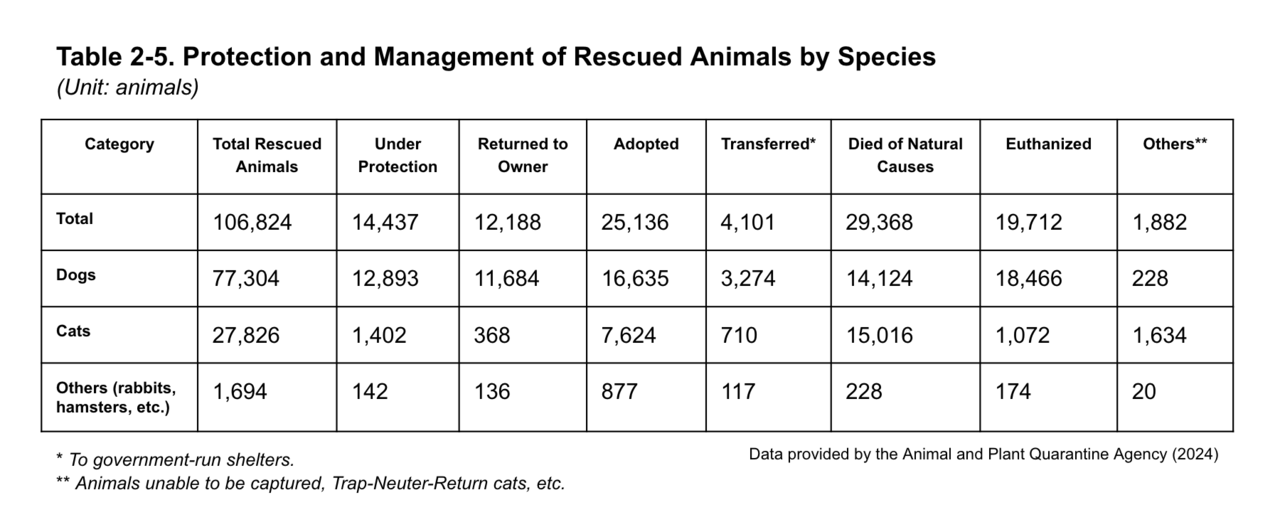
Nationwide statistics paint a sobering picture of a reality facing impounded animals.
According to a 2024 report by the Animal and Plant Quarantine Agency, Korea has 231 animal protection centers, including 75 run directly by local governments. Around 107,000 lost or abandoned animals — 77,300 of them dogs — were reported and rescued nationwide last year, marking a 5.5 percent drop from the previous year. During the same period, shelter operating costs rose by 31.4 percent, and staffing increased by 1.5 percent.
Of all rescued animals, 18.5 percent were euthanized and 27.6 percent died of natural causes, meaning nearly half (45.9 percent) did not make it out of the shelters alive.
Focusing only on the 77,300 dogs, 18.3 percent died naturally, while 23.9 percent were euthanized.
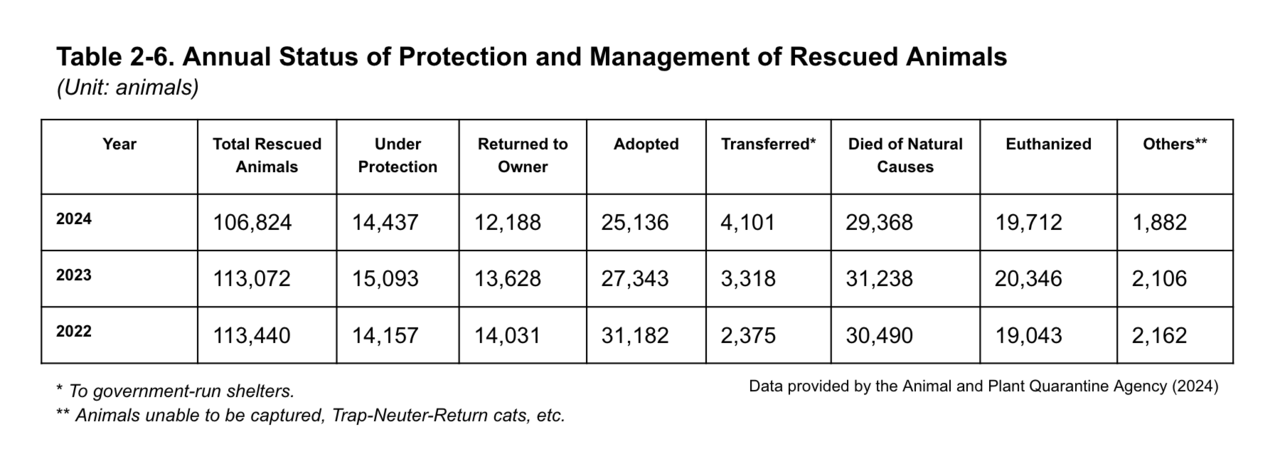
Despite Seoul city government's pledge to pursue "zero euthanasia" through better registration and care, the number of animals that die in shelters has crept higher in recent years — 43.7 percent in 2022 and 45.6 percent in 2023. Outsourced shelters with reports of poor management have shown death rates exceeding 90 percent in some cases.
Pets don’t have to face shelter stays
The issue of poor conditions and lax oversight at some shelters remains a persistent point of tension among local authorities and animal rights groups. But, setting aside that, even well-managed shelters face limits to how many animals they can take in, and many across the country are already operating near full capacity.
One city initiative is microchipping. The Seoul city government has been promoting an Embedded Animal Registration System to prevent pet loss and abandonment. Since 2019, citizens can have their pets microchipped for about 10,000 won at more than 900 animal hospitals across the capital. The chip links a unique serial number to the owner's contact details in the National Animal Protection Management System, helping authorities reunite pets with owners, thereby reducing the number of "unidentifiable" animals.
Unfortunate for the Chihuahua found that morning, a missing microchip meant there was no easy way back home.
This leaves virtually only two hopes for the animal: Either she will be reclaimed by her owner, a slim chance if the person is not actively checking posts about found dogs, or that she will be adopted by a new owner.

As of Nov. 11, the Chihuahua has not been reunited with her owner. The shelter listing shows that the dog will become available for adoption on Nov. 15. If she is not adopted within the shelter's required holding period, the animal's fate will follow the shelter's standard procedure which could include transfer, extended care, or in some cases, euthanasia if capacity or health issues force a decision.
What do you do when you find a lost pet?
As Cho's experience shows, figuring out what to do next after finding a lost dog can be confusing and daunting, especially if it isn't clear whether handing them over to the police was the right thing to do.
Several nonprofit organization and official government websites explicitly state that the first line of action should indeed be to hand the animal over to a shelter through local authorities. This allows the shelter to register the animal in the national database and gives the owner a better chance of being reunited with their pet.
A representative from a non-profit animal rights group said, "If an animal isn't officially registered, it cannot be promoted for adoption through our platform." Once animals are handed over to shelters, "we can help publicize them for adoption based on the shelter's official listing."
Although the process is meant to improve reunions and accountability, the fear that shelters are a ticking clock for unclaimed animals still lingers among many pet owners and rescuers.
One expat who has long been involved in Korea’s animal rescue community, said that’s what makes these choices so difficult.
“The police is not the wrong thing,” she said. “It’s just sometimes the riskier option, especially if the pet was purposely abandoned.”
She added that people respond differently — some start at a vet to check for microchips, while others follow official procedures — reflecting the uncertainty many feel in such moments.
She observed that community platforms like Karrot, which Cho also turned to, have proven to be helpful.
“If you ever lose a pet, the first place to check is Karrot. So many people find their dogs on Karrot,” she said.
What will happen to the Chihuahua next?
Despite the uncertainties, there are glimmers of hope. Several shelters dedicate sections of their website to photos of animals that have either been successfully reunited with their families or pets that have found new homes through adoption.
Song, a Seoul resident who heard Cho’s story, shared how her family adopted their dog, Rosie, under similar circumstances.
“This is also how we saved Rosie,” Song said. “She too was running around in the middle of the street.”
According to the animal rescue association’s post, the Chihuahua is a healthy, approximately 2-year-old female, described as calm, gentle and a bit timid.
Once the required holding period for the original owner ends on Nov. 15, she will be available for adoption, though it is not yet clear how long she might remain in the shelter.
As for Cho, although he cannot currently adopt the Chihuahua, he said he is willing to help spread the word and actively support efforts to locate the dog's owner — or if needed, find a new one.
tammy@heraldcorp.com