

“Do you think (Immanuel) Kant knows? That centuries later he is inflicting so much pain on students in an East Asian country? In the Korean, English and electives sections. Do you think Kant knows?” read a post uploaded by a test-taker to Orbi, an online community for college admissions, on Thursday after the annual College Scholastic Ability Test, or Suneung, ended.
Immanuel Kant is the 18th-century German philosopher whose work on ethics, metaphysics and human reason fundamentally reshaped modern Western philosophy. And he appeared four times on this year’s exam -- tormenting students with some of the most abstract and conceptually demanding passages.
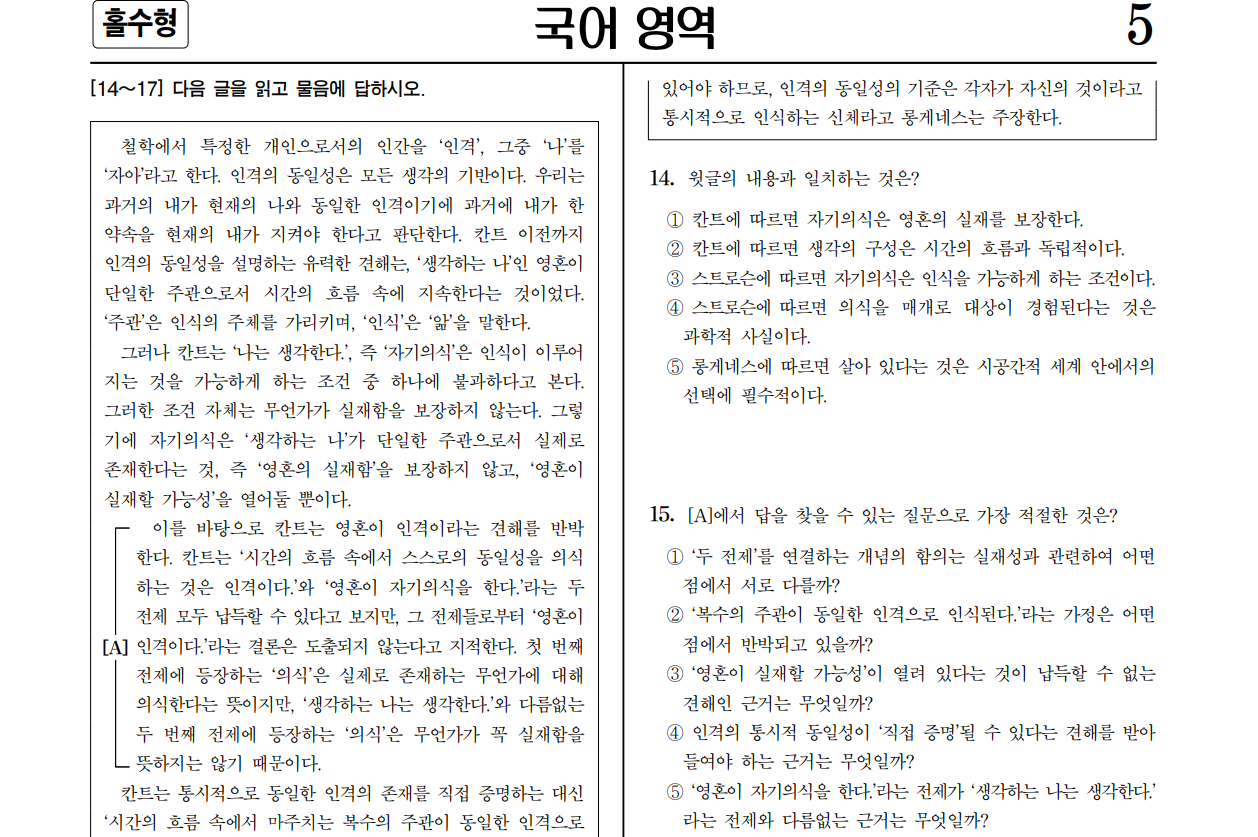
Self-consciousness does not prove soul's existence: Kant in the Korean section
Kant first showed up in the Korean language section, which began at 8:40 a.m.
Questions 14 to 17 required students to interpret arguments about personal identity presented by Kant and other modern philosophers from Britain and France. The long passage compared how Kant, Peter Frederick Strawson and Beatrice Longuenesse explain personal identity over time.
Kant rejected the idea that an enduring soul guarantees identity. Instead, Kant argues that self-consciousness merely enables knowledge and cannot prove the soul’s existence.
Still, Kant holds that a unified person within the continuity of time must be presupposed for any empirical or moral judgment to take place. Strawson, by contrast, criticizes Kant for neglecting the role of the body, arguing that continuity in the spatiotemporal world grounds personal identity. Longuenesse criticizes both, claiming that a unified self must already exist for experience to begin at all.
Many students said the abstract topic -- especially whether the soul can be considered identical to the person -- made the passage extremely challenging.
"I didn't understand much from the passage. I still don't understand why I got number 16 wrong. I don't even want to read the passage again," read a student's post on Orbi.
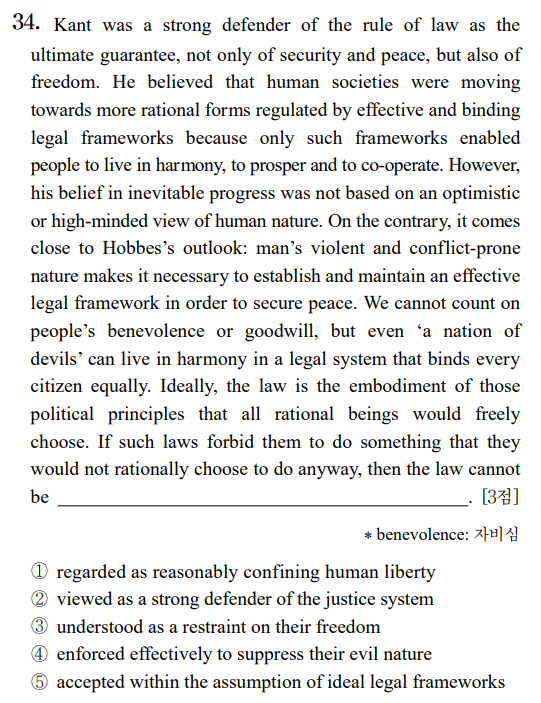
Human prosperity and legal frameworks: Kant in the English section
Kant reappeared in Question 34 of the English section, identified by EBS as one of the section’s most difficult items.
The passage explained Kant’s view that the rule of law provides the essential foundation for security, peace and genuine freedom, enabling societies to progress toward more rational and legally regulated forms of coexistence. Rather than relying on human goodness, Kant believed that universal law is necessary precisely because humans are prone to conflict. A binding legal framework, he argues, even for “a nation of devils,” can ensure harmony.
Ideally, such laws express principles that all rational beings would choose and therefore embody freedom rather than restrict it.
The question was a fill-in-the-blank requiring students not only to understand the passage’s main point but to choose an answer that was opposite of the correct conceptual fit. The blank appeared in the sentence: “If such laws forbid them to do something that they would not rationally choose to do anyway, then the law cannot be _________.”
Because the phrase “cannot be” inverted the logic, students had to select the option that did not align with Kant’s main argument, adding to the difficulty.
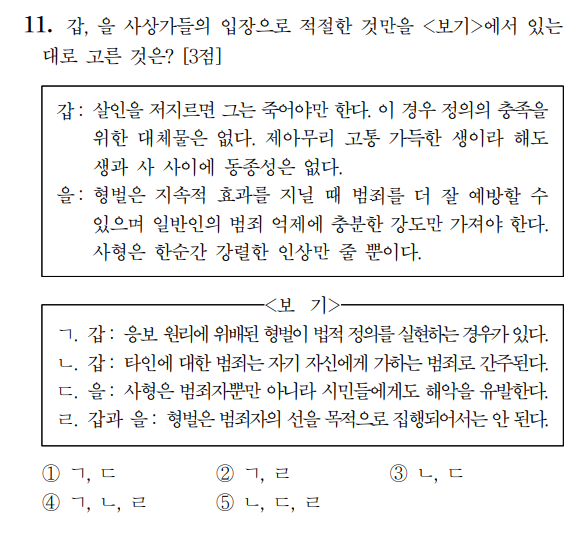
Punishment must be imposed, simply because crime is committed: Kant in the Life and Ethics section
“I cried after reading Kant’s passage in the Life and Ethics section. It was so moving, but most people probably didn’t read until the end because it was so easy,” a student wrote on Orbi.
Kant made a third appearance in the Life and Ethics section, an elective part of the exam taken by 224,552 students.
Question 11 introduced two unnamed philosophers with opposing views on the justification for punishment. Though Kant was not explicitly named, students recognized the first philosopher as echoing Kant’s retributivist theory.
The passage stated: “If a person commits murder, he must die. In this case, there is no substitute that can satisfy the demands of justice. No matter how painful a life he might be forced to live, there is no equivalence between life and death.”
Retributivism holds that wrongdoers deserve punishment proportionate to the moral gravity of their actions, and that punishment is justified not by deterrence of crime but by justice itself. This item was considered one of the section’s easier questions.
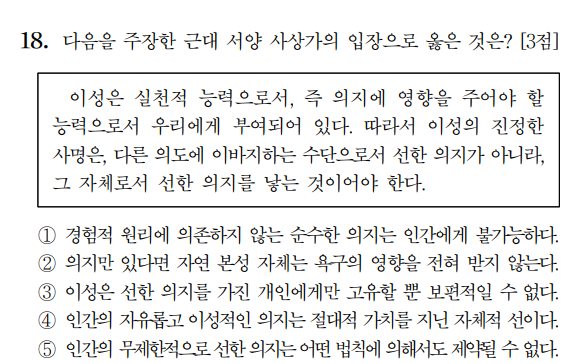
The true vocation of reason is to produce good will: Kant in the Ethics and Philosophy section
Kant surfaced for a final time in the Ethics and Philosophy section, another elective taken by 54,014 students.
He was again not named directly, but Question 14 presented his ideas on the metaphysics of morals:
“Reason is given to us as a practical faculty -- that is, as a capacity meant to influence the will. Therefore, the true vocation of reason is not to produce a good will as a means toward some further ends, but to generate a good will in and of itself,” the question read.
Kant argues that reason’s purpose is not to secure happiness or external outcomes, but to guide the will toward acting from duty. The moral worth of an action, he maintains, comes from the intention shaped by reason, not from its consequences. Students were asked to select the answer choice that best summarized these ideas.
'Kant took Suneung, too'
“At this point, it’s like Kant took Suneung, too,” one student wrote, noting how frequently the philosopher appeared. “The day began with Kant and ended with Kant,” another added.
Born in 1724, Kant synthesized rationalism and empiricism, arguing that human understanding structures the laws of nature that frame experience. He maintained that faith, freedom and morality derive from human reason.
His work laid the foundation for many 19th- and 20th-century thinkers and continues to shape debates in metaphysics, epistemology, ethics, political philosophy and aesthetics.
This was not the first time a philosopher unsettled Suneung test-takers. In 2021, a “killer question” in the Korean section included a passage on Hegelian dialectics, which many students described as terrifying.
Although this year’s Suneung did not include such “killer questions,” EBS and educators noted that more sophisticated wrong answer choices heightened the test’s ability to distinguish top performers.
seungku99@heraldcorp.com