Global copolyester leader looks to upgrade heat-tolerance brand Ecozen

SK Chemicals is doubling down on recycling and advancing its copolyester technology, as the Korean green chemical firm seeks to maintain and expand its lead in the global market.
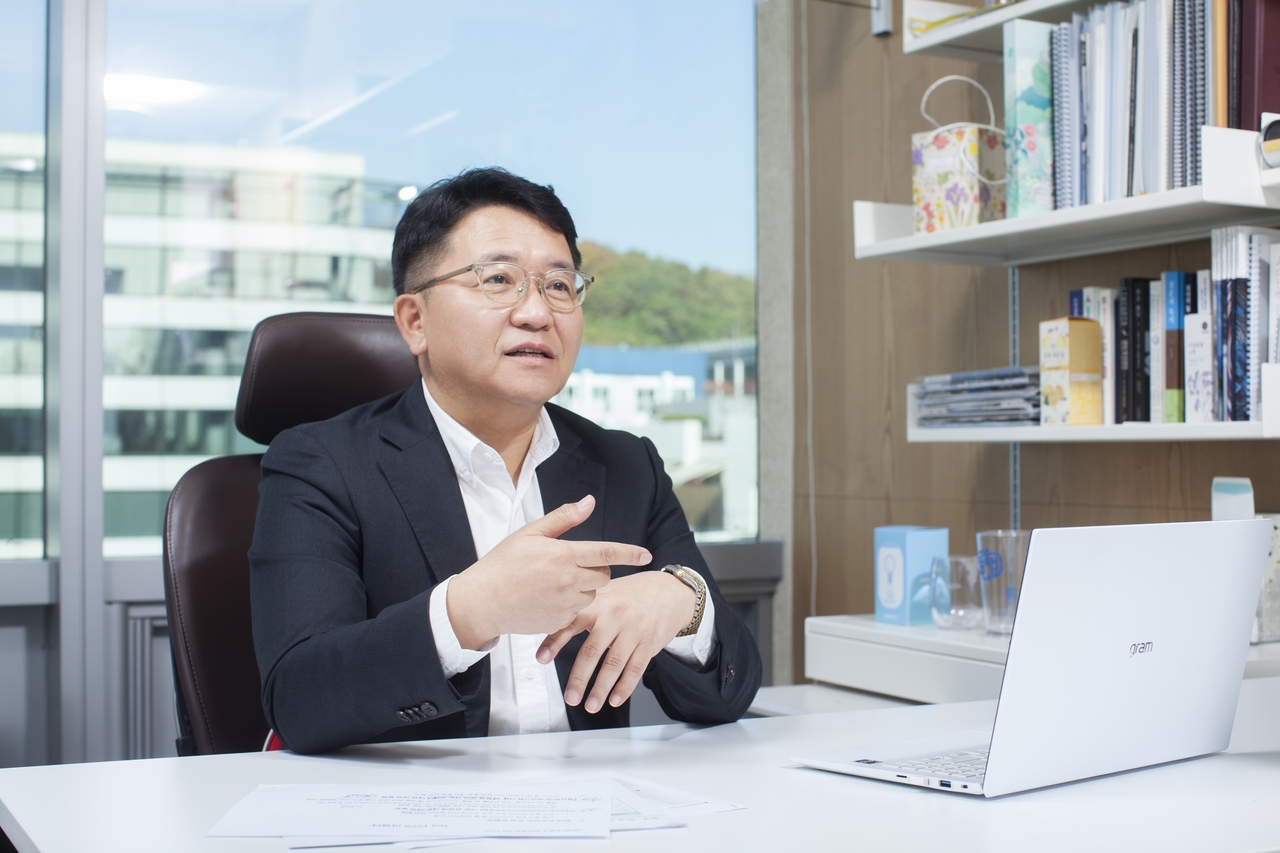
“We collect polyester waste, break down polyester from such waste into raw materials and polymerize them. In other words, advancing our chemical recycling business is the most important next step for us,” said Kim Eung-soo, head of SK Chemicals’ Green Materials Business, in an interview with The Korea Herald at the company’s headquarters in Seongnam, Gyeonggi Province, Wednesday.
SK Chemicals became the first in the world to commercialize depolymerization technology and rolled out recycled polyethylene terephthalate, or PET, in 2022.
The Korean company acquired the chemically recycled bis-hydroxyethyl terephthalate, BHET, and chemically recycled PET division from China’s Shuye Environmental Technology in 2023 for about $98 million to set up SK Shantou to expand its recycling business.
“The designed production capacity of (SK Shantou) is about 70,000 metric tons (per year), and we bring the recycled materials to our Ulsan plant to supply products using the recycled materials,” said Kim.
“We are moving into the direction that most products turn into recyclables, and we are in the process of advancing our recycling technology so that we can recycle wastes that are extremely difficult to reuse.”
To this end, SK Chemicals announced in February this year that it will establish a depolymerization technology-based recycling innovation center at its Ulsan plant.
The company said the new facility, which is expected to begin operations next year, will not only produce recyclable plastic raw materials from plastic wastes, but also test various recycling technologies to expand the range of recyclables from the conventional, transparent plastic bottles to fibers, films and automotive parts.
Noting the example of the European Union mandating that all single-use plastic beverage bottles must incorporate a minimum of 30 percent recycled plastic from 2030, Kim said, “They are going to have to pick a material that can be recycled, and more are selecting our copolyester. Such a trend is giving us an opportunity.”
On top of the drive towards more efficient and effective recycling, Kim pointed out that the next step is to enhance the product's special properties.
“At first, we evolved from PET to PETG, and when PETG was not enough, we came up with Ecozen,” he said. Ecozen is a biomass-based transparent copolyester with high heat resistance that does not contain any traces of Bisphenol-A, or BPA, a chemical compound widely used in the manufacturing of various plastics that could harm human health.
“Even if it’s little by little, we have to develop products with higher added value that others find difficult to make and that is why we are trying to upgrade the properties of Ecozen so that it could be used in more applications,” said Kim.
Market watchers estimate that SK Chemicals accounts for about 40 percent of the global copolyester sector, making it the second-largest player behind Eastman. The United States copolyester pioneer dominated global demand for about 20 years until SK Chemicals began exporting its first polyethylene terephthalate glycol, or PETG, product in 2001.
SK Chemicals logged 609.9 billion won ($416 million) in revenue and 15.1 billion won in operating profit in the third quarter of this year to turn to a profit, as its revenue went up by 43 percent on year.
According to Verified Market Reports, the global copolyester market, valued at $2.5 billion last year, is projected to reach $4 billion by 2033 with a compound annual growth rate of 5.5 percent.
hwkan@heraldcorp.com





![[Exclusive] SK On fast-tracks pilot output in all-solid-state battery race](https://wimg.heraldcorp.com/news/cms/2025/11/18/news-p.v1.20251117.611a51c182b546348b32ccc3233f6193_T1.png?type=h&h=240)