Solid Power’s rapid testing enables SK On to launch pilot line within weeks, advancing mass production to 2029
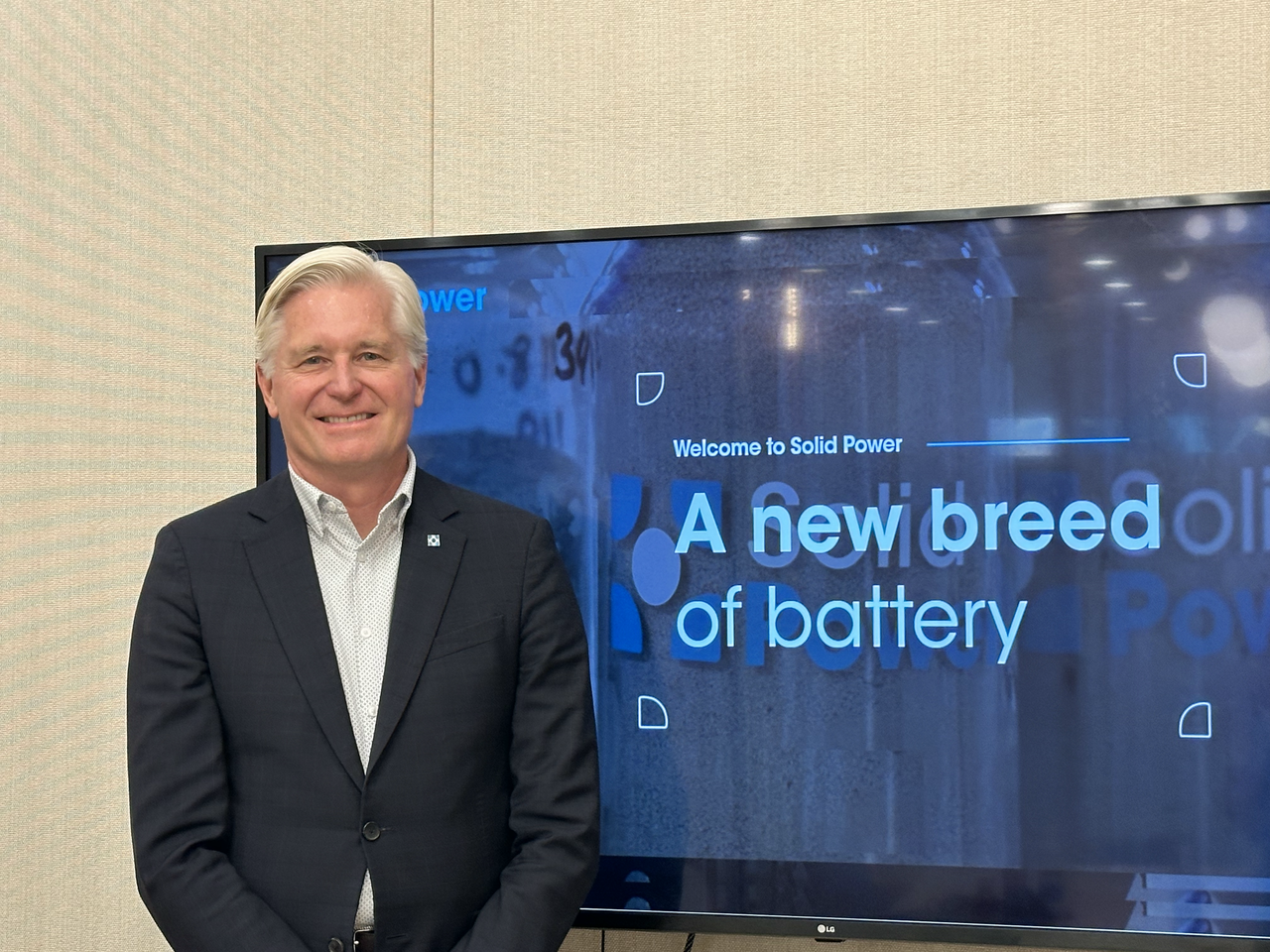
SK On is moving faster than expected toward commercializing next-generation all-solid-state electric vehicle batteries by 2029, with its pilot line in Daejeon set to begin operation before the end of the year, as key partner Solid Power completes the final round of on-site equipment testing.
“We’re on batch three right now of the Site Acceptance Testing (SAT) of the planned six batches at SK On’s Daejeon pilot line. … We’ll have that completed by the end of November,” Solid Power CEO John Van Scoter said in an interview with The Korea Herald at the company’s Seoul office on Thursday. “(After that) it’ll be like the official start of the pilot line’s operation.”
All-solid-state batteries are widely viewed as a potential game-changer for the EV industry, replacing the flammable liquid electrolyte used in conventional lithium-ion cells with a solid electrolyte that enables higher energy density and dramatically reduces fire risk.
SAT is the final on-site verification that ensures newly installed equipment operates as intended, with the six batches representing full test cycles needed for consistent output. Solid Power is supplying and validating the material-manufacturing equipment. Once testing concludes, SK On will take over the line and begin cell-level production and in-house validation.
The rapid ramp-up is notable. SK On held the completion ceremony for the pilot line just two months ago, and all-solid-state battery pilot lines typically require more than six months — sometimes up to a year — to reach operational readiness because of complex electrolyte processes and highly customized machinery. SK On has also advanced its mass-production from 2030 to 2029, signaling growing confidence in its technology road map.
The accelerated timeline underscores the strengthening technical synergy between SK On and Solid Power, whose collaboration began in 2021 through a memorandum of understanding and joint development agreement. SK On parent company SK Innovation committed $30 million to Solid Power at the time.
Solid Power has deepened its footprint in Korea.
On Oct. 31, Solid Power entered into a three-way collaboration with Samsung SDI and BMW for next-generation batteries. In this partnership, Samsung SDI will manufacture prototype cells using Solid Power’s sulfide-based solid electrolyte to BMW’s specifications. While no mass-production schedule has been disclosed, the alliance reflects the intensifying race among global battery-makers to commercialize all-solid-state batteries.
BMW, one of Solid Power’s earliest strategic investors alongside Ford, began evaluating Solid Power electrolytes in 2018. As BMW sought to accelerate development, the collaboration naturally expanded to add Samsung SDI, which aims to commercialize all-solid-state batteries by 2027, faster than many rivals.
Van Scoter said maintaining separate partnerships with two Korean competitors — Samsung SDI and SK On — is not unusual, given the urgency among battery-makers to secure cost-effective, scalable solid-state technology. “Korean battery companies are collaborating more with external technology players to tackle long-standing pain points like high production costs,” he said.
A major advantage, he emphasized, is Solid Power’s price competitiveness. The company’s sulfide-based solid electrolytes are compatible with roll-to-roll electrode-coating equipment already used in lithium-ion battery production. This means battery makers can upgrade existing lines with minimal adjustments, avoiding the heavy capital investment often associated with transitioning to solid-state batteries.
“People had talked about using existing (battery) equipment, but nobody had really done it at the EV scale. … Our first demonstration program with BMW really did that,” Van Scoter said.
Solid Power is also working to reduce material costs by advancing production methods for its solid electrolytes. It currently produces 30-ton batches at its facilities in Colorado, but with US government support it is shifting to a continuous-flow production process — a method that produces material in a constant stream and offers greater scalability. The project, set for completion in 2026, is designed to help the company reach the thousands of tons needed for commercially viable all-solid-state batteries.
Positioning itself as a key partner in Korea’s next-generation battery ecosystem, Solid Power is also exploring cooperation with LG Energy Solution and Hyundai Motor Group, which is developing its own all-solid-state chemistry.
Since Van Scoter took the helm in June 2023, Solid Power has sped up its global expansion. The company opened its first overseas office in Seoul in January 2024 — a deliberate strategy to embed itself deeper in the Korean battery supply chain and the country’s fast-advancing solid-state development efforts.
hyejin2@heraldcorp.com



![[Exclusive] SK On fast-tracks pilot output in all-solid-state battery race](https://wimg.heraldcorp.com/news/cms/2025/11/18/news-p.v1.20251117.611a51c182b546348b32ccc3233f6193_T1.png?type=h&h=240)