Reversal in corruption case fuels opposition fury, revolt within prosecution service
The decision by the prosecution to drop its appeal in one of Korea’s biggest real estate corruption cases appears to be spiraling into a full-blown political and judicial crisis.
What began as a dispute over a single prosecutorial decision has ballooned into accusations of political interference, turmoil within the judicial services and a widening debate over whether the rule of law is being undermined by political power.
The chain reaction stems from the prosecution’s unexpected announcement earlier this month that it would not appeal the Oct. 31 court rulings in the Daejang-dong corruption scandal — a case that has shadowed President Lee Jae Myung’s political career for years.
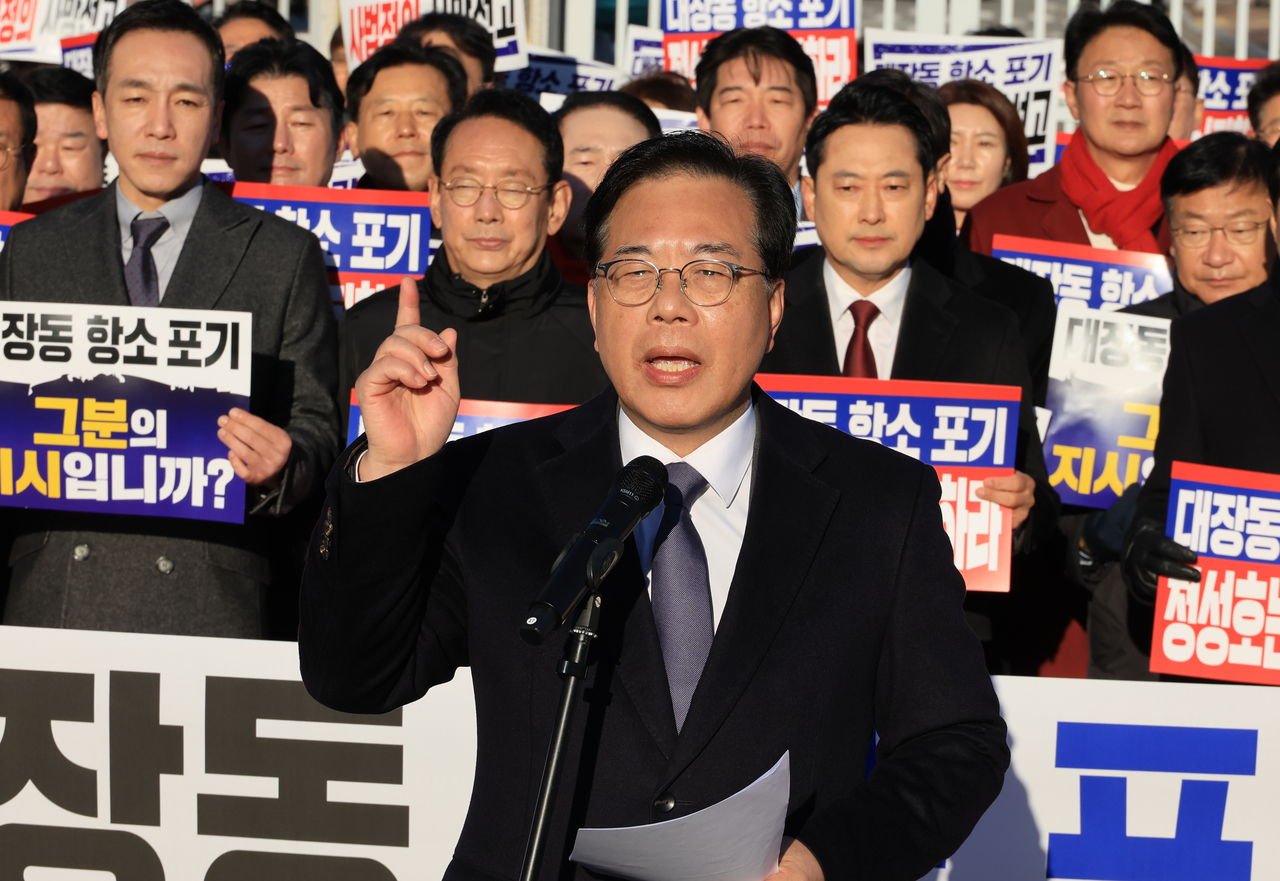
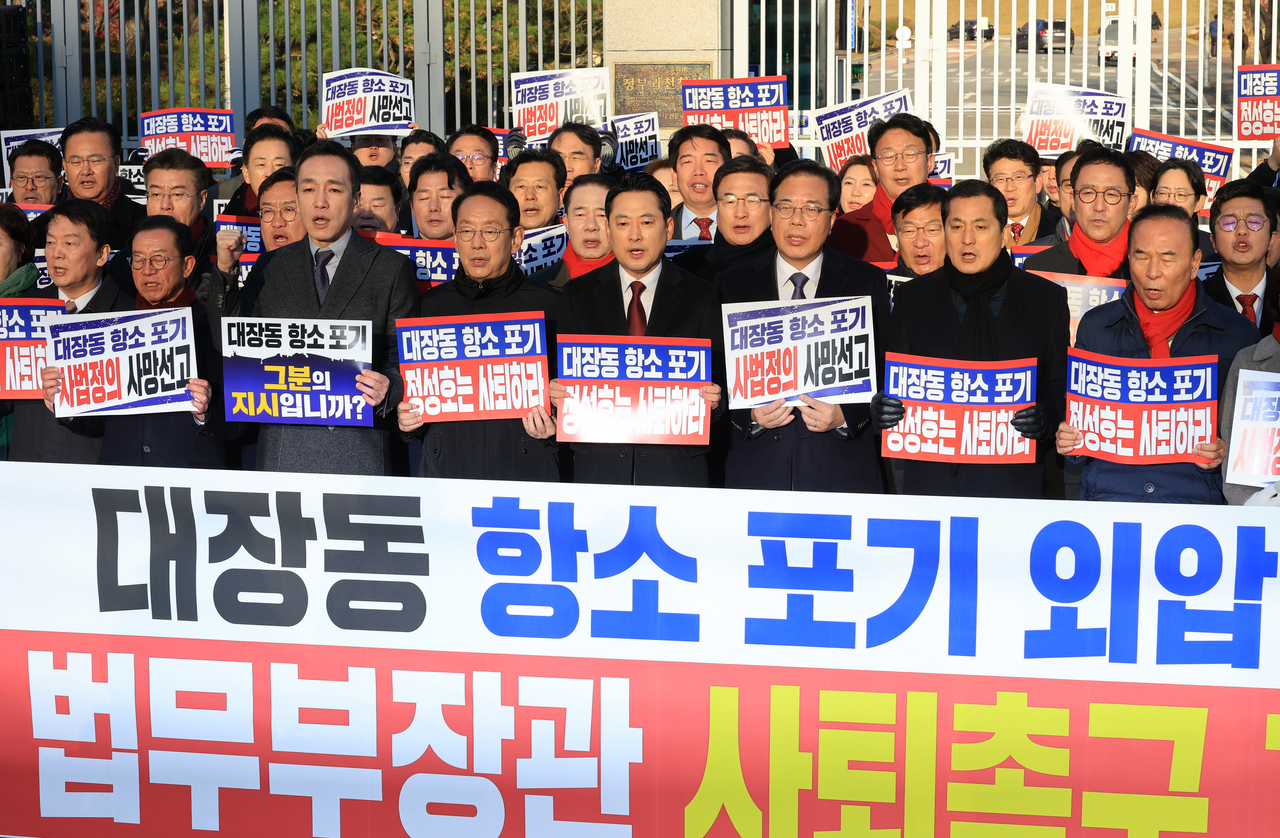
The conservative opposition People Power Party stepped up its attack Tuesday, accusing the Justice Ministry of shielding the president and interfering with judicial independence.
Party Chair Jang Dong-hyeok called Justice Minister Jung Sung-ho and Vice Minister Lee Jin-su “the worst minister and vice minister in history,” urging them to resign immediately, at a morning rally held in front of the ministry’s headquarters in Gwacheon, Gyeonggi Province.
“Justice does not belong to any particular administration,” said People Power Party Floor Leader Song Eon-seog. “The Justice Ministry is becoming a shield for criminals and a guard for the president.”
People Power Party lawmakers alleged that ministry officials pressured prosecutors by urging them to “decide carefully” or suggesting investigative command authority could be exercised.
They also criticized reports that ministry officials held a celebration after the decision not to appeal, arguing it symbolized the trivialization of wrongdoing that allegedly caused billions of won in losses to taxpayers.
The conservative party later filed a police complaint against Minister Jung and the vice minister, accusing them of abuse of authority over their alleged role in the prosecution's decision to drop its appeal.
The decision not to appeal also triggered dissent within the prosecution service.
Jung Jin-woo, head of the Seoul Central District Prosecutors’ Office, offered to resign on Nov. 8 after reportedly failing to persuade acting Prosecutor General Noh Man-seok to appeal. A group of 18 chief prosecutors posted a joint statement demanding an explanation, saying Noh’s justification lacked any factual or legal detail.
Soon after, Noh admitted he had consulted Justice Minister Jeong Sung-ho before finalizing the decision — fueling allegations of political pressure. Noh himself resigned days later, on Friday.
Two senior prosecutors, Park Jae-eok of the Suwon District Prosecutors’ Office and Song Kang of the Gwangju High Prosecutors’ Office, have tendered their resignations as of Monday. Park was among the signatories to the joint statement, while Song was reportedly discussed as a candidate to succeed Noh. More resignations are expected among prosecutors in the coming weeks, observers say.
On Monday, multiple reports claimed that the Justice Ministry was considering reassigning the 18 prosecutors who protested the appeal reversal to positions normally held by rank-and-file prosecutors. Legally, prosecutors have only two ranks — prosecutor general and prosecutor — meaning such a move would count as a posting change, not a formal demotion.
But within the prosecution service, the move is widely seen as punitive and unprecedented. Traditionally, those who reach the chief prosecutor level continue to receive senior postings for the remainder of their career.
The long-running scandal centers on a 2015 public-private redevelopment project in Daejang-dong in Seongnam, a city in Gyeonggi Province of which President Lee was mayor at the time. The Seongnam Development Corp., working with Hana Bank, approved a structure that awarded several politically connected private firms, including Hwacheon Daeyu, a disproportionate share of the profits.
Although the private consortium contributed only about 350 million won ($240,000) to the project, it earned about 788.6 billion won in profits. Prosecutors argued that SDC should have received roughly 490 billion won more, based on the principle that 70 percent of profits should have gone to the municipal developer.
In the first trial, Hwacheon Daeyu owner Kim Man-bae and former SDC acting President Yoo Dong-gyu were sentenced to eight years in prison each for breach of trust. Other key figures — lawyer Nam Wook, accountant Jeong Young-hak and former SDC official Jeong Min-yong — also received multiyear prison terms.
Prosecutors further alleged that Jeong Jin-sang, then a senior aide to President Lee, had been informed of illegal campaign contributions tied to the developers. Jeong, who is currently on trial in a separate corruption case, denies wrongdoing.
The Oct. 31 ruling applied only the general breach-of-trust clause under the Criminal Act, declining to recognize it as an aggravated offense under the Specific Economic Crimes Act. The court said prosecutors failed to prove SDC’s entitlement to 70 percent of profits.
By dropping the appeal, prosecutors forfeited the opportunity to challenge that reasoning — a move with major legal implications. The aggravated charge could have carried life imprisonment, and its omission narrows potential exposure for all defendants, including President Lee, if related cases proceed after his term ends.
mkjung@heraldcorp.com