Deal ends talks but opens battles over ratification, steel tariffs and $350b investment plan
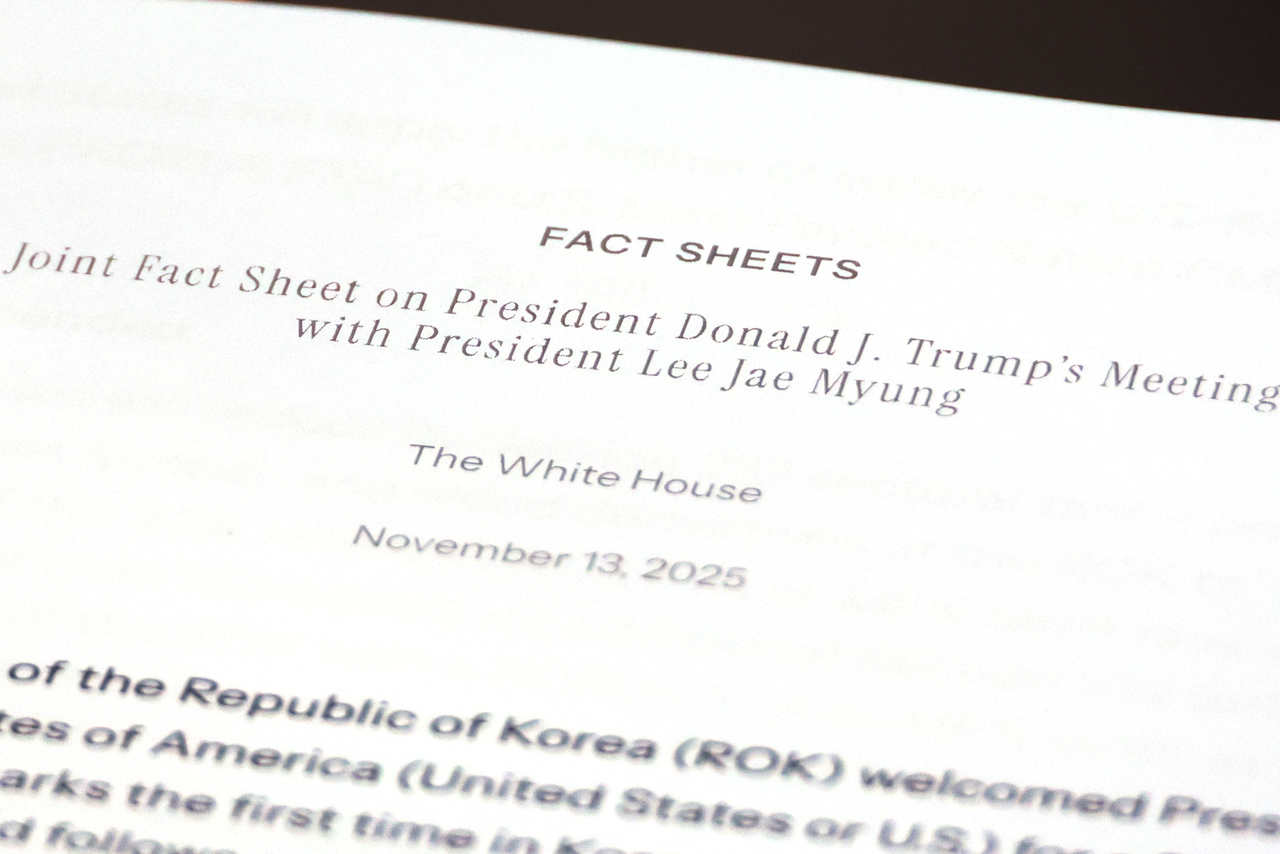
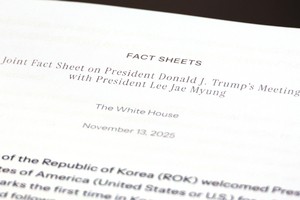
After months of negotiations, South Korea and the US released their long-delayed joint fact sheet Friday, detailing trade and security agreements and alleviating some uncertainties about tariffs that had weighed on the export-dependent country.
The document, released by the White House, put into writing guidelines that the two countries broadly agreed upon in July and finalized during the Oct. 29 summit between South Korean President Lee Jae Myung and US President Donald Trump.
The fact sheet formalizes the long-sought-after cut of US tariffs on Korean goods, including autos and auto parts. Down from 25 percent to 15 percent, the new figure brings Korean carmakers on par with Japanese and European rivals. The fact sheet also outlines the structure of Korea's $350 billion package for planned investment in the US, with $200 billion set aside for unspecified strategic industries and $150 billion earmarked for shipbuilding. The $200 billion cash portion will be distributed over ten years and capped at $20 billion a year to prevent financial instability.
While the agreement removes the worst uncertainties around tariffs and delivers headline gains on auto and nuclear cooperation, major questions remain, observers say. From still-high steel tariffs and the implementation of Korea’s promised $350 billion in US investment to a political rift over whether the deal must be ratified in Korean parliament, the real work starts now.
Ratification conundrum
Following the announcement, political division has intensified as rival parties clash over whether the document requires ratification by the National Assembly.
The Lee administration and the ruling Democratic Party of Korea argue the document is a non-binding memorandum of understanding, not a treaty, and therefore is exempt from the constitutional requirement for ratification. Meanwhile, the main opposition People Power Party counters that, considering the enormous fiscal implications of the $350 billion investment, parliamentary approval is essential.
Seoul officials warn that ratifying a non-binding MOU could tie Korea’s hands. Industry Minister Kim Jung-kwan, who led the negotiations, warned that forcing ratification could bind the country into unfavorable clauses in the memorandum, even when Washington is not seeking congressional ratification.
“There are concerns that (ratification) can become a shackle while negotiations are continuing,” Kim told a parliamentary committee on Monday, adding that key terms such as a 50-50 profit-sharing structure between the two countries are still open for discussion.
Finance Minister Koo Yun-cheol echoed these concerns, warning that delays could cause financial harm. “Auto tariffs could fall starting Nov. 1, but the longer ratification takes, the more costly the delay could become,” he told the lawmakers.
Under the deal, the US will apply the reduced auto tariffs retroactively from the first day of the month in which a bill is submitted to the National Assembly to implement the MOU.
Arguing that ratification could slow tariff cuts and add burden on companies, the Democratic Party is pushing to introduce special legislation establishing the legal framework and operational structure for a $350 billion investment fund as soon as possible.
The People Power Party on Wednesday sharply contested the government's stance.
“Even the 1.5 trillion won (1.02 billion) Korea-US defense cost-sharing agreement goes through National Assembly ratification,” said Rep. Kim Seok-ki, who chairs the parliament’s foreign affairs and unification committee, during a press conference.
“How can the government justify bypassing parliamentary consent on an agreement that carries a national burden of nearly 500 trillion won, roughly 330 times larger? It’s difficult to imagine any Korean citizen accepting that logic.”
Toughest challenge: $200 billion investment execution
Beyond the political conflict, experts say the greatest challenge lies in operating and executing the investment package, particularly the $200 billion in cash investment.
“With a $200 billion investment on the table, what matters most is building a governance structure that ensures Korea has real input,” said Heo Yoon, professor of international studies at Sogang University.
“How we shape the management and consultation structure of this investment and how we can influence decisions on investment targets, size and timing, will be one of the biggest tasks going forward.”
Lee Jae-min, professor of law at Seoul National University, agreed that “How to effectively implement the $200 billion investment is the biggest challenge.”
“The $150 billion shipbuilding portion would be manageable, as the Korean companies will effectively control it, but the $200 billion cash investment needs to be newly designed from scratch, and Korea and the US need to continue to coordinate with each other.”
Lee cautioned that despite Seoul chairing the consultation committee, key decisions still rest with the investment committee, led by US Secretary of Commerce Howard Lutnick, with final approval from President Trump.
“It’s still unclear whether the consultation committee’s views will be reflected in the investment committee’s decisions,” he said. “They will listen, but there is no guarantee it will be adopted. Going forward, we need to clearly define how the investment opinions of the consultation committee are reflected in the investment committee and who will reflect them.”
Lee recommended establishing a pre-agreed pool of candidate industries and companies to invest in to limit uncertainty.
“If the US decides case-by-case, we have no visibility into how decisions will be made,” he said. “Given this will run for ten years, defining a preliminary list of potential investment targets would reduce risk and give Korea more predictability.”
Steel unresolved
While the deal offered clarity on autos and pharmaceuticals, steel — the sector bearing the heaviest tariff burden of 50 percent — was again left off the negotiating table, deepening concerns across Korean mills already hit by repeated tariff hikes this year.
Under the Trump administration, the US imposed tariffs of 25 percent on steel earlier this year on national security grounds, and then raised them to 50 percent in June.
Industry officials fear Washington may expand tariffs across more than 1,000 product categories containing steel, as it is currently reviewing whether to add roughly 700 additional steel-containing goods.
Recent export data highlights the pressure facing steelmakers. Steel exports totaled $2.14 billion through August, down 10.1 percent from a year earlier, with monthly shipments plunging 21.6 percent in July and 28.7 percent in August, according to the Korea Iron and Steel Industry.
Companies are absorbing rising costs, with data submitted to parliament showing POSCO and Hyundai Steel expect to pay nearly 400 billion won in US tariffs this year alone.
Observers believe it is less likely that the high tariffs on Korean steel will change in the near future, stressing the need for Seoul to establish support measures for steelmakers.
“It looks less likely the 50 percent steel tariff will be revised for now,” said professor Lee. “But if part of the $200 billion investment is directed into Korean companies’ US steel subsidiaries and other operations, that could generate mutual benefit. Under that scenario, even companies hit by the 50 percent tariff could see some relief.”
sahn@heraldcorp.com