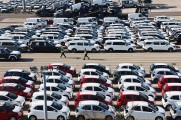
Korea could be overtaken by China across 10 major export industries in 5 years
South Korean companies forecast that Korea could be overtaken by China across all of its top 10 export industries within the next five years, according to a survey of domestic firms conducted by the Federation of Korean Industries.
Korea has already been overtaken by China in half of its top 10 export sectors — steel, general machinery, secondary batteries, displays and automobiles and auto parts — and is expected to fall behind China in semiconductors, electrical and electronics, shipbuilding, petrochemicals and bio-health.
China’s rise is nothing new, but if Korea is overtaken by China in all of its major export sectors and the gap widens, the country’s exports and growth could fall into a long slump.
Korea should take this bleak outlook seriously and find a way to boost its industrial competitiveness.
In terms of product branding, Korea was also evaluated to be a step ahead of China in six industries, but it is projected to lose its advantage to China in all six of those fields within five years.
These forecasts are shocking because they are based on the information and accumulated experience that Korean companies have gained through fierce export competition.
Survey figures showed Korea has an advantage over China in five industries, but the word "advantage" rings hollow on the ground at industrial sites. Petrochemicals are a case in point. With Korea at a baseline of 100, China was rated 96.4, trailing by just a small margin.
Korea's petrochemicals industry is undergoing restructuring, affected by China's facility expansion and mass supply of its products at cheap prices. Korea's factory utilization rate has fallen to the 60 percent range.
Korea also faces a strong challenge in semiconductors. In the third quarter of this year, China's SMIC took third place with 5.1 percent of the global foundry market, encroaching on Korea's Samsung Electronics, in second with 7.3 percent.
Particularly in the emerging field of artificial intelligence, China is galloping forward.
Kimi K2 Thinking, a new model developed by Beijing-based startup Moonshot AI, outperformed OpenAI's GPT-5 across a number of metrics, generating buzz about another DeepSeek moment and end to American AI supremacy. DeepSeek is the Chinese AI startup that created a sensation with its highly cost-effective AI model.
Meanwhile, Korea tumbled nine spots from sixth last year to 15th this year in the World Digital Competitiveness ranking released by the Institute for Management Development in Switzerland. The country fell behind Singapore, Hong Kong and Taiwan, not to mention the US and China.
Korea's talent ranking plunged 30 notches to 49th, and in terms of regulatory framework, it fell 20 spots to 38th. The urgency of developing digital and AI talent is nothing new, but Korea's nosedive on the index over the last year is a grave signal.
In the FKI survey, 62.5 percent chose China as the biggest competitor of South Korea in the global trade market. In terms of corporate competitiveness, the US and China were expected to pull far ahead of South Korea, while Japan was forecast to narrow the gap with South Korea over the next five years.
China is no longer a "fast follower." It is a leading player not only in semiconductors and automobiles — the industries that drive South Korea's exports — but also in such advanced fields as artificial intelligence, robotics and batteries.
China’s rise has been driven by strong, government-led investments in strategic industries. In contrast, South Korea is falling behind, stuck with anti-business regulations and entrenched labor market rigidity, among other factors.
Potential growth of a nation depends on its industrial competitiveness. These days, the AI revolution is changing the world.
The government should remove systemic obstacles, especially in the country’s major export sectors. The ruling Democratic Party of Korea should back up government efforts to enhance industrial competitiveness.
The five years to 2030, when the current government's term ends, are crucial to the country's future. The government and politicians must make changes now.
khnews@heraldcorp.com