KG Mobility has posted an operating profit for a fourth consecutive quarter, with its aggressive push into overseas markets offsetting a weakening position at home and stabilizing the automaker after years of volatility.
According to its latest business report, the SUV maker returned to the black in the third quarter of 2025 with a 1.4 billion won ($1 million) operating profit, up from a 40 billion won loss a year earlier. Its cumulative operating profit for the January–September period reached 15.1 billion won, extending a recovery that began with its first full-year profit in six years in 2023.
The turnaround comes despite a decadelong slide in annual sales — from over 150,000 units to roughly 100,000 — and a persistent decline in domestic demand. To counter the slump, KG Mobility has leaned heavily on exports and updates to its aging lineup, including diversified powertrains.
Exports have been the company’s strongest growth engine. Overseas sales from January to October jumped 18.1 percent on-year to 57,436 units. October alone saw a 26.1 percent surge in exports, making KG Mobility the only one of Korea’s three mid-tier automakers — KG Mobility, Renault Korea and GM Korea — to post on-year growth that month.
The company’s expansion has been powered by government partnerships and new-market entries. It is participating in Indonesia’s state-led national car and electric bus initiative and supplying Rexton SUVs to public fleets in Spain and Italy. Europe has emerged as its largest export region, with 30,601 units sold in the first three quarters of 2025 following a brand relaunch and new model introductions.
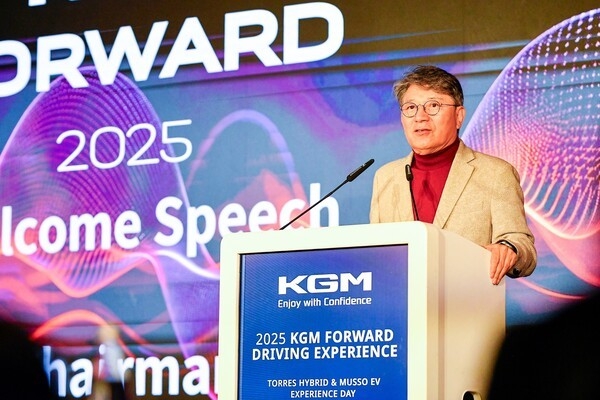
“KG Mobility is marking its strongest export performance in ten years,” Chairman Kwak Jae-sun said at the global launch of the Torres Hybrid and Musso EV in Germany in September.
Stronger exports have also supported production at its Pyeongtaek plant, where the operating rate remained at 76 percent in the third quarter despite a nearly 20 percent drop in domestic sales.
But experts say the momentum will be difficult to sustain without deeper technological investment. Kim Pil-su, an automotive engineering professor at Daelim University, said the group must move beyond its reliance on Chinese powertrain suppliers.
“Export growth is the right strategy in a limited domestic market,” Kim said. “But the company needs a stronger, group-level investment in research and development if it hopes to secure long-term competitiveness.”
forestjs@heraldcorp.com