There comes a time when anyone may need to seek the help of authorities, including when facing the complications of immigration policy.
To support foreign nationals, the Korean government provides multiple channels, such as dedicated websites, call centers and free legal consultations. Still, the process can be challenging without guidance from someone familiar with it.
This guide introduces the main resources available in South Korea and explains how to use them effectively to manage administrative and civil affairs.
Administrative forms at government agencies
Residents from other nations are frequently required to fill out forms at community service centers and related government organizations.
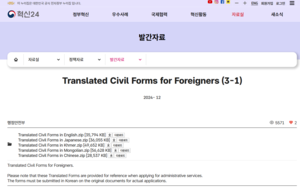
Since January, the Ministry of Interior and Safety has been providing the 235 most frequently used civil forms in 10 additional languages: Russian, Mongolian, Vietnamese, English, Uzbek, Japanese, Chinese, Tagalog, Thai and Khmer.
The forms are distributed to regional and central government agencies, public institutions and multicultural centers that address foreign residents' issues. They can also be downloaded online at Innovation 24 or via the Naver Band community Easy Civil Forms for Foreigners.

When using the Innovation 24 website, search “Translated Civil Forms for Foreigners (in English)” on the Korean version to find the forms.
The translated forms include matters of family relations, childbirth, marriage, immigration, employment, housing and place of residency registration, as well as other general petitions.
One should note that the translated forms are only for reference, to assist applicants in better understanding the information, while the actual applications must use the official forms in Korean.
Government24
South Korea's official government portal Government24 is a platform where residents can access information about administrative services. It is available in Korean, English and Chinese.
Go to the homepage and click on "For foreigners" in the top-right corner to select either English or Chinese options, or go directly to the English page or Chinese page. One can access a wide range of information on general services such as visa or stay and adaptation support for foreign workers, marriage migrants or foreign students.
Go to this page in English or this page in Chinese to see what kind of services are available.
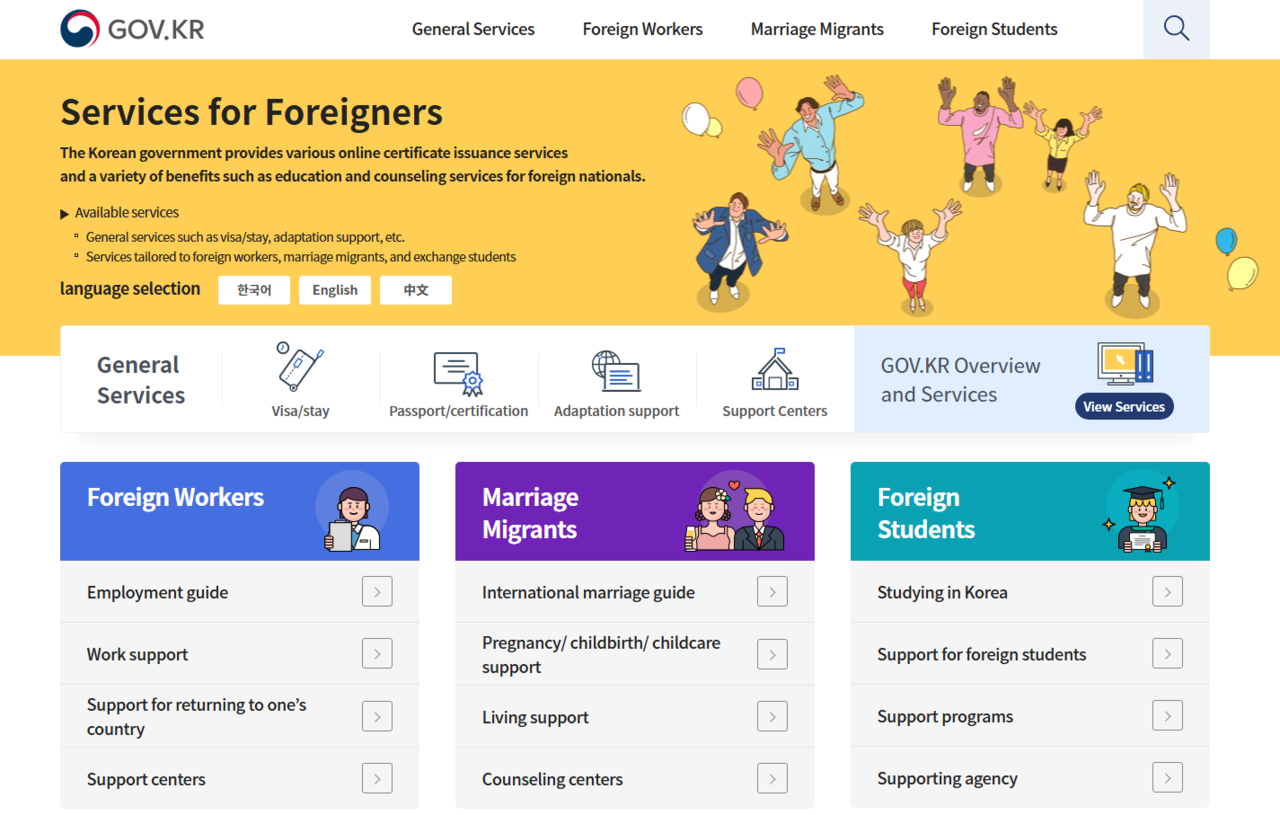
Click on "view details" at the guide pages to access the page specifically for the listed services. Specific guides on issuing certification of alien registration, declaration of residence in Korea, residence registration and income declaration come with step-by-step guides available at each of the English and Chinese guide pages.
One should note that actual applications for the services are available only in Korean, and the full extent of the Government24 portal is also only accessible via the Korean version.
The web portal is accessible on the internet and via a mobile application for both the iPhone and Android smartphones.
Hi Korea
The Hi Korea website is dedicated specifically to petitions and administrative needs related to immigration issues, run by the Seoul Immigration Office. It has English and Chinese pages, and requires users to log in.
Users can check the validity of their residence card or employment, along with information on immigration offices by jurisdiction. Join Hi Korea and log in, click on petition application, click e-application and attach your documents and pay any required fee.
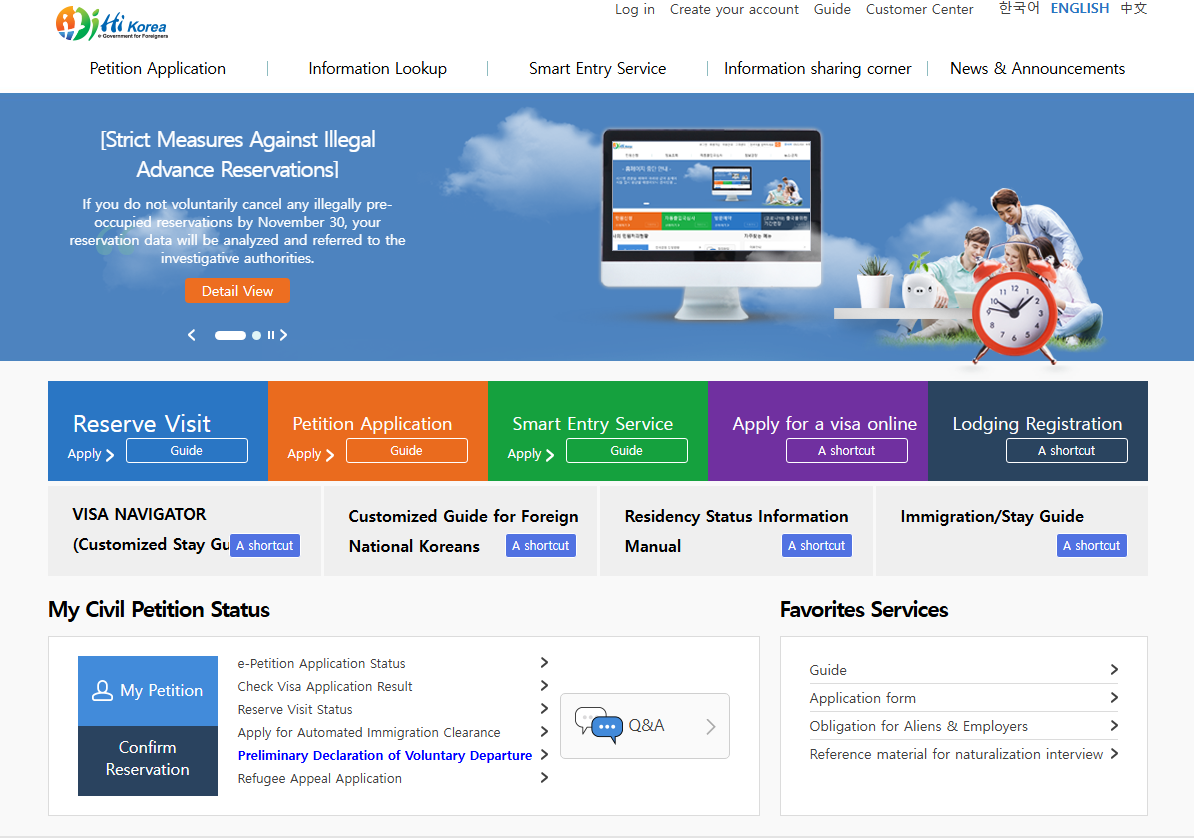
The list of petitions available at the page includes temporary extension of stay for departures of registered foreigners, extension of stay for short-term visa holders, part-time work permission and change of workplace for E-9 visa holders, reentry permit (single entry), initiate work by H-2 holders, address change declaration, change of employment information, change of stay status and change of passport information.
Download the "Guide to Immigration Petitions" issued by the Seoul Immigration Office on specific ways to use the Hi Korea webpage.
Immigration Contact Center 1345
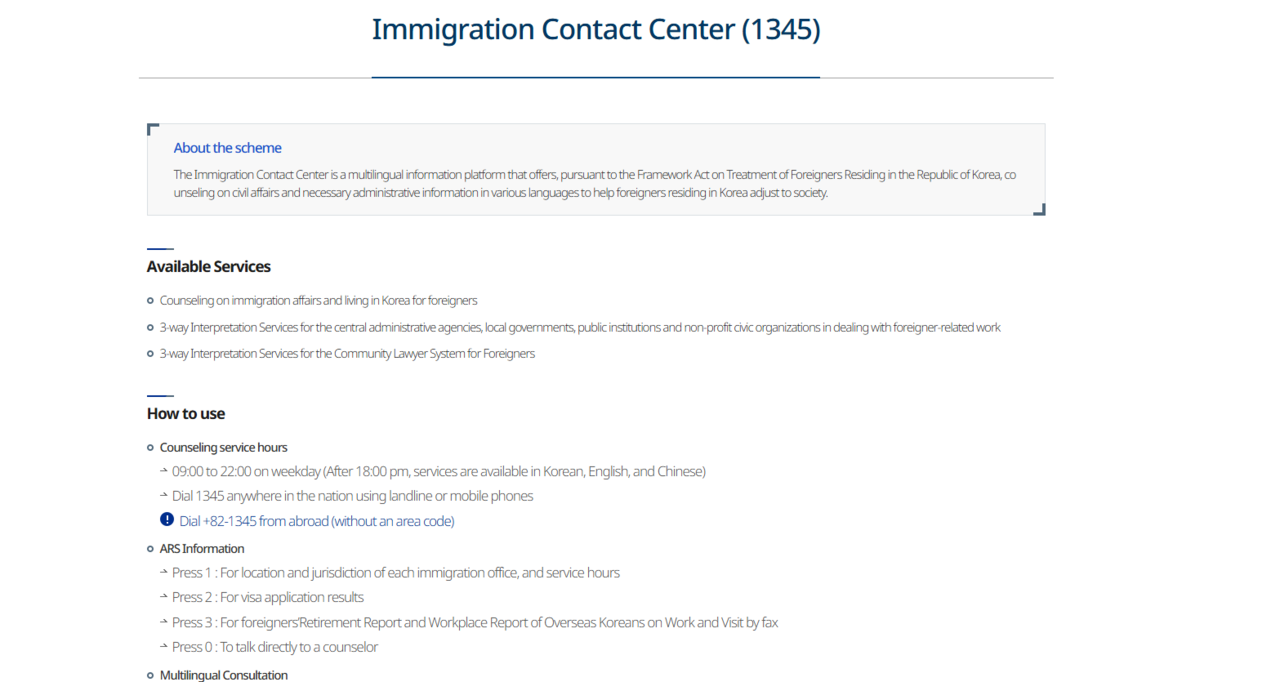
The 1345 call center is the main contact point for the Korean government for administrative help, civil affairs including legal issues and consultancy for foreigners, provided in 20 languages. Consultations on immigration affairs and living in Korea, three-way interpretation services for government agencies related to work and the Community Lawyer system are available.
Community lawyers are state-designated legal professionals who provide free legal consultation to those who apply via their local community service centers.
Hours for the 1345 call centers are 9 a.m. to 10 p.m. on weekdays, with services after 6 p.m. only available in Korean, English and Chinese. Dial 1345 anywhere in the nation using a landline or mobile phone, or dial +82 1345 from abroad.
Certain sensitive information may be provided only to the person directly related to the matter at hand.
In September, the Seoul Immigration Office said the 1345 call center is now providing services for foreigners related to unpaid wages and crime.
One should be aware that there have been crimes perpetrated by those falsely claiming to be workers from the 1345 call center.
The Ministry of Justice in May issued a public notice that people posing as officials of immigration offices, the ministry, police or Immigration Contact Center have been contacting foreigners for the purpose of voice phishing, requesting personal information or attendance at the prosecution or to install certain applications on one's phone.
It should be noted that the call center for the Justice Ministry -- (02) 2110-3000 -- is used exclusively for incoming calls, and does not make outgoing calls. Calls from 1345 do not appear as numbers like (02) 6908-1345 on caller ID, and this number is not used to contact foreign residents in Korea.
E-People
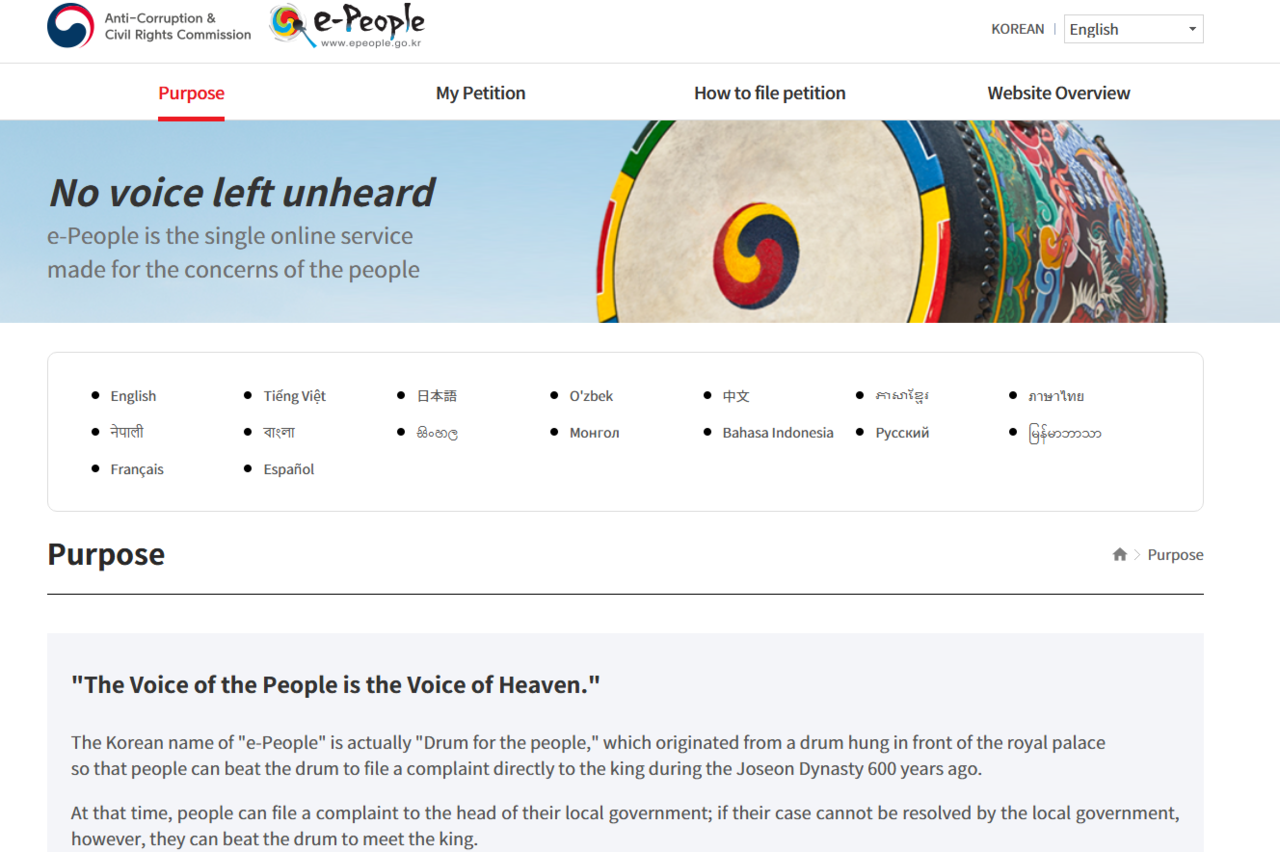
Another option is to submit a public petition through the E-People page, ranging complaints related to the administrative process, reporting unjust actions by other civilians or civil servants or even for policy suggestions.
Foreigners can go on the page and click on the languages option in the top right corner to submit petitions in 16 languages including English, Vietnamese, Japanese, Uzbek, Chinese, Khmer, Thai, Indonesian, Mongolian, Russian, French and Spanish.
Foreigners submitting a petition should enter their name, nationality, address, email, and password and attach a file, if necessary, by using the downloaded form. The name, email and password can be used to check petition results later.
Petitions are assigned to the relevant organization, the staff of which will answer and send the results by email.
One should note that petitions are not recognized if 1) the petitioner who has concluded a legal contract with administrative agencies request an administrative agency to take certain action in direct connection with such legal contract, 2) unclear or invalid personal information (alias, fake address) has been provided or 3) a person working for a certain administrative agency or public organization requests an administrative agency to take certain actions with regard to public affairs.
While it is possible to submit a wide range of petitions, the answers tend to be general in nature and often end up advising as to what government agency to contact to specifically address the issue. The process should be expected to serve more as a guide of which actions to take in a specific situation, rather than having the organization directly address one’s issue.
There are numerous routes to make a complaint to the government, but foreign residents may feel an extra burden in navigating the bureaucratic structures to find the specific person or group to help them. One would be prudent to have some knowledge of the related law and regulations related to the issue at hand. Being prepared to do the required research and possessing the basic Korean language skills necessary would also likely help the case significantly.