
Amid a global slowdown in electric vehicle demand, China has tightened its grip on cost-efficient lithium iron phosphate, or LFP, batteries, while Korea — long focused on premium nickel-cobalt-manganese — has only recently begun scaling up LFP output.
Yet the CEO of a leading battery inspection equipment-maker says Korea is closing the gap far faster than many assume and could even gain an edge as Chinese battery exports face mounting tariff pressure.
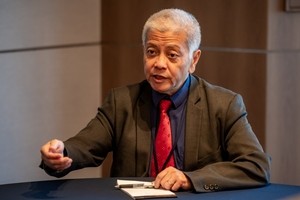
“If you look at LFP mass-production capabilities alone, China is still ahead. But that gap is likely to narrow sharply by next year,” Innometry CEO Lee Gab-soo said in an interview with The Korea Herald on Oct. 18. “Korean firms are already producing very thick, large-format prismatic cells, which help boost capacity in lower-energy-density chemistries like LFP.”
Lee added that Korea’s significantly higher production yields are a key advantage. “From what I’ve seen indirectly, Korea’s yields are often more than 10 percentage points higher. That yield advantage is a major reason Korean cell-makers have weathered the EV downturn and continued expanding globally.”
Founded in 2008, Innometry is a leading manufacturer of nondestructive inspection systems for lithium-ion and next-generation batteries. It supplies advanced X-ray and 3D inspection equipment to major global cell-makers, including Korea’s LG Energy Solution, Samsung SDI and SK On, helping them boost yields, detect defects and strengthen quality control.
Lee said demand for Innometry’s inspection systems is rising because they “scale across all major chemistries from LFP and NCM to advanced batteries and across every form factor, including prismatic, cylindrical and pouch cells.”
The industry’s shift toward much thicker LFP cells is also accelerating demand for higher-resolution CT-based X-ray systems, which can detect internal structural issues far more accurately than traditional alignment inspections that merely verify whether anode and cathode layers are properly stacked.
Innometry’s proprietary system, the first in the world to combine gap inspection and foreign-particle detection in a single machine, has gained strong traction. The equipment not only checks whether internal components are evenly positioned within the cell casing, but also identifies metallic contaminants generated during charge-discharge cycles. Such particles are a major safety risk because they can trigger internal short circuits and fires.
To support these capabilities, Innometry operates a wide range of specialized demo labs across optical, X-ray and CT technologies. Engineers continuously test customer samples under different angles and conditions to improve accuracy. “That’s how we’re able to detect defects and measure gaps down to just a few micrometers, a level others can’t match,” Lee said.
With battery-makers increasingly targeting energy storage systems for AI-driven data centers, Innometry has already begun supplying its new ESS inspection device to Korean battery companies. While cell-level inspections are similar to those for EV batteries, ESS systems require additional module-level checks to verify that the assembled unit remains safe even if each cell passes individual inspection.
As Korean battery firms expand in the US, North America now accounts for 50 percent of Innometry’s overseas sales, followed by Europe at 30 percent and China at 20 percent. The company currently operates branches in Texas, Hungary and Shanghai.
Lee said Innometry is also developing three new business portfolios to drive future growth. The first is Through-Glass Via (TGV) inspection equipment for semiconductor glass substrates, for which it has already secured initial orders from a major electronics component maker, with deliveries starting this month. The second is semiconductor package inspection, aimed at localizing X-ray and CT systems now dominated by costly foreign suppliers. The third is a defense-related inspection for ammunition and aircraft components.
hyejin2@heraldcorp.com




![[Exclusive] SK On fast-tracks pilot output in all-solid-state battery race](https://wimg.heraldcorp.com/news/cms/2025/11/18/news-p.v1.20251117.611a51c182b546348b32ccc3233f6193_T1.png?type=h&h=240)