Hanwha Aerospace takes lead for first time, as Korea shifts Nuri from state-run project to commercial-ready launch system
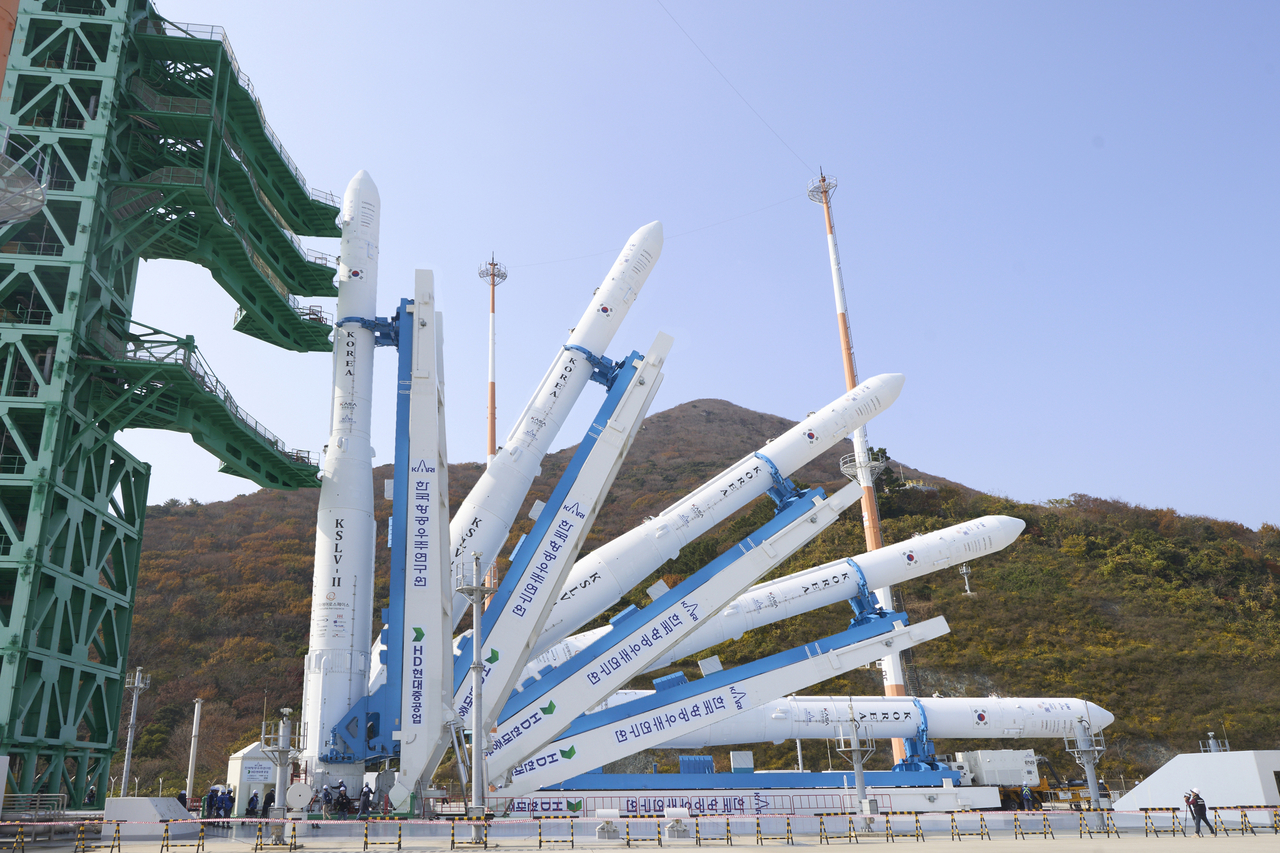
South Korea was set to launch its fourth Nuri rocket, or KSLV-II, early Thursday, marking a pivotal moment in the country’s bid to transition from a state-led space program to the commercially driven “New Space” model.
After three successful missions between 2021 and 2023, the fourth flight represents more than a routine deployment.
It is the first launch in which Hanwha Aerospace — not the government — is leading rocket production, assembly and supply-chain management, using technology formally transferred from the state-run Korea Aerospace Research Institute.
The move positions Hanwha to eventually operate Nuri launches on a fully commercial basis, opening the door for Korea to compete in a global industry dominated by Elon Musk’s SpaceX.
First nighttime liftoff
The three-stage, 200-ton Nuri rocket was scheduled to lift off at 12:55 a.m. Thursday, the first nighttime launch in Korean space history. Its liftoff window was to be finalized just hours prior, but officials said the schedule was unlikely to shift.
The timing has been dictated by its primary passenger — the Compact Advanced Satellite-3, a next-generation midsized satellite built to conduct highly light-sensitive science missions, such as imaging faint auroras, monitoring airglow and analyzing plasma in Earth’s magnetosphere. To avoid sunlight interference, it must be inserted into a 600-kilometer sun-synchronous orbit at a specific time in the night.
To accommodate the late hour, engineers strengthened lighting systems around the launchpad and installed more than 30 high-resolution cameras to document the launch and satellite separation.
How Nuri mission unfolds
Once Nuri leaves the pad, a tightly choreographed sequence begins:
2 minutes, 5 seconds: First and second stages separate.
13 minutes, 27 seconds: At 600.2 km altitude, Nuri deploys its main payload, the Compact Advanced Satellite-3.
Thereafter: 12 CubeSats separate in six pairs, roughly every 20 seconds.
21 minutes, 24 seconds: The launch completes.
With 13 satellites on board — nearly double last year’s payload — this is Nuri’s most complex mission yet.
What counts as 'successful' launch?
A Nuri mission is considered successful if:
All three rocket stages ignite and separate cleanly.
The satellites are put into their exact target orbit with a tight tolerance.
Each payload begins operating normally after separation.
The most decisive factor is orbit insertion. The primary satellite must reach its 600-kilometer orbit with a margin of error no greater than 35 km and an inclination between 97.7 degrees and 97.9 degrees. KARI says this performance requirement matches the standard used in the third launch.
If all 12 CubeSats deployed from Nuri’s third stage reach the same orbit and power up as expected, the fourth mission will be declared a full success.
Weather remains a variable, though conditions this time were forecast to be favorable. In 2022, poor weather forced nearly a weeklong delay, from June 15 to June 21.
Hanwha takes helm
The biggest difference between Nuri’s earlier launches and its fourth mission lies in management. For the first time, Hanwha Aerospace is overseeing rocket manufacturing, assembly, supply-chain coordination and ground preparations, while KARI is serving in a supervisory role, preparing for a long-term shift toward industry leadership.
This structure mirrors the US model in which NASA is transferring launch responsibilities to private firms like SpaceX, Rocket Lab and Relativity Space.
Hanwha is expected to take over nearly all launch operations by Nuri’s sixth flight in 2027. Beginning with the seventh launch, it will assume full responsibility for commercial services — from production to marketing to customer contracts — marking the birth of Korea’s first commercial launch provider.
Why this matters
According to Kim Jeong-soo, a space engineering professor at Pukyong National University, the global space industry has fundamentally changed. Once dominated by governments and military priorities, the sector is now driven by satellite communications, low-earth-orbit internet constellations, data services and downstream applications.
This shift — fueled by SpaceX’s dramatic success with Falcon rockets and the Starlink network — has made commercial launch services the central pillar of the global space economy.
“Space was once about science and national security,” Kim said. “Today, the real value lies in satellite-based communications and global internet coverage. SpaceX proved that a dense constellation of small satellites could generate massive, recurring revenue.”
Rare global window of opportunity
SpaceX now dominates the commercial launch market. Japan’s H3 rocket suffered delays and early failure. Europe’s Ariane 6 is years behind schedule. Russia, once a major competitor, faces crippling restrictions on technology imports due to sanctions stemming from the invasion of Ukraine.
The result is a global supply shortage in medium and large launch services — a gap Korea hopes to help fill.
If Nuri consistently performs over the next few missions, particularly by the seventh launch, Kim said, Korea will become a credible option for US, European and Asian satellite operators seeking alternatives to SpaceX.
Largest, most diverse payload yet
This fourth launch carries the heaviest and most varied payload in Nuri’s history, totaling about 960 kilograms. The primary payload is the Compact Advanced Satellite-3, a 500-kg class satellite equipped for aurora and airglow imaging, ionospheric plasma and magnetic field measurements and space bioprinting and 3D cell-culture experiments.
It is built using Korea’s domestically developed midsized satellite platform and will advance long-term scientific and engineering capabilities.
12 CubeSats for next-gen technologies
The CubeSats from universities, startups and research institutes include missions that conduct space-medicine experiments (Space Liin Tech’s BEE-1000); demonstrate Korea’s first satellite-deorbiting technology (Uzuro Tech’s Cosmic); test the world’s first rollable solar array on a CubeSat (Inha University’s Inha RoSat); and explore Earth observation, 6G communications and navigation technologies.
To support the expanded manifest, engineers added a multipayload adapter, upgraded cameras inside the third stage and installed a noise-reducing structural cowling.
What's next
The fourth Nuri mission is more than a technical exercise — it serves as a test of Korea’s readiness to enter the global commercial launch market. The program now follows a defined transition timeline.
In 2026, the fifth launch is intended to demonstrate that Nuri can deliver repeatable, reliable launch performance.
In 2027, the sixth launch will focus on verifying whether the rocket can be produced at scale, marking the final evaluation stage of the government-led development program.
After 2027, beginning with the seventh launch, Hanwha Aerospace will assume full responsibility for Nuri’s production, operation and commercial launch services, completing Korea’s shift toward a privately led space-launch ecosystem.
If Korea can establish reliability and meet demand in a supply-constrained market, Nuri could become the country’s first globally competitive launch vehicle and a stepping-stone to larger, reusable rockets in the future.
hyejin2@heraldcorp.com