Decrees of 'Yellow Envelope' law should unify trade unions' bargaining channels
The Ministry of Employment and Labor on Monday disclosed an amendment to the enforcement ordinances of the "Yellow Envelope" law that refer to revised Articles 2 and 3 of the Trade Union and Labor Relations Adjustment Act.
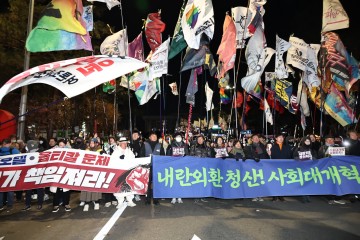
The amended ordinances will be open until Jan. 5 for public review and opinion collection. The Yellow Envelope bill stirred strong backlash from businesses, but the pro-labor ruling party pushed it through in August with its significant parliamentary majority. The law is scheduled to take effect in March next year.
As expected when the bill was proposed, its decrees cause unavoidable chaos.
The Yellow Envelope law enables trade unions belonging to subcontractors to demand direct bargaining with their contractors. This is without parallel anywhere in the world.
With business opposition to the bill mounting, the ministry vowed to supplement it with revised enforcement ordinances, but the revised decrees turned out to be fraught with the sort of problems that had worried companies when the bill was presented.
The key issue of the decrees is to unify multiple unions of subcontractors into a single bargaining channel, yet they put companies in a bind. Particularly, contractors that have to work with many subcontractors face many negotiations with the many trade unions.
The current law stipulates that when there are two or more trade unions in a business, they should unify their negotiation channels. Under the Yellow Envelope law, negotiations could be fragmented because subcontractors may number in the hundreds or the thousands. The decrees have significantly eased conditions for separate negotiations, even though the government made it a rule to unify negotiation channels. To justify the easing of conditions, the government argues that trade unions should be guaranteed the right to negotiate.
The ordinances allow trade unions of subcontractors to select a representative who will negotiate with contractors, but this is not mandatory.
Requirements for subcontractor unions' demand for direct negotiations are related to working conditions, negotiation agenda, job characteristics, employment status and even characteristics of each union. In a nutshell, unions can demand negotiations as they like. Unifying negotiation channels will then become a principle in name only.
Those contractors recognized by the National Labor Relations Commission as employers to be engaged in collective bargaining must accept subcontractor trade unions' demand for direct negotiations. If contractors violate this clause, they will be punished on charges of unfair labor practices.
After all, companies that work with many subcontractors will be doomed to yearlong negotiations with trade unions.
Hyundai Motor Co. has more than 8,500 subcontractors. Shipbuilders and construction companies have subcontractors in the thousands.
Even if all the trade unions of subcontractors do not demand direct bargaining with their contractor, the burden of negotiations would be heavy.
Also, if the trade union of a minor subcontractor goes on strike, the entire production lines of the contractor could stop. If unions of small subcontractors join umbrella groups such as the Federation of Korean Trade Unions, their strikes could spread to industrywide collective action. Smaller trade unions with weak bargaining power are likely to join the upper-level groups.
Increased negotiations are not a problem limited to subcontractors. Trade unions in main contractors could split, too. This is utter chaos.
Even before the law takes effect, the trade unions of some subcontractors are already calling on their main contractors to resolve labor issues through direct negotiations.
A sudden increase in negotiations is not the only problem. The Yellow Envelope law restricts employers' right to demand compensation for damages or losses due to illegal strikes. This could induce excessive actions, such as workplace occupation on the part of the trade unions of subcontractors.
It is desirable to scrap the Yellow Envelope law, but the ruling Democratic Party of Korea will never do so. Then, in a bid to prevent industries from falling into a swamp of chaos, the government must ensure ways to unify unions' bargaining channels substantially.
khnews@heraldcorp.com