South Korea's central bank kept its benchmark interest rate unchanged Thursday to safeguard financial stability amid a weakened local currency and an unstable housing market.
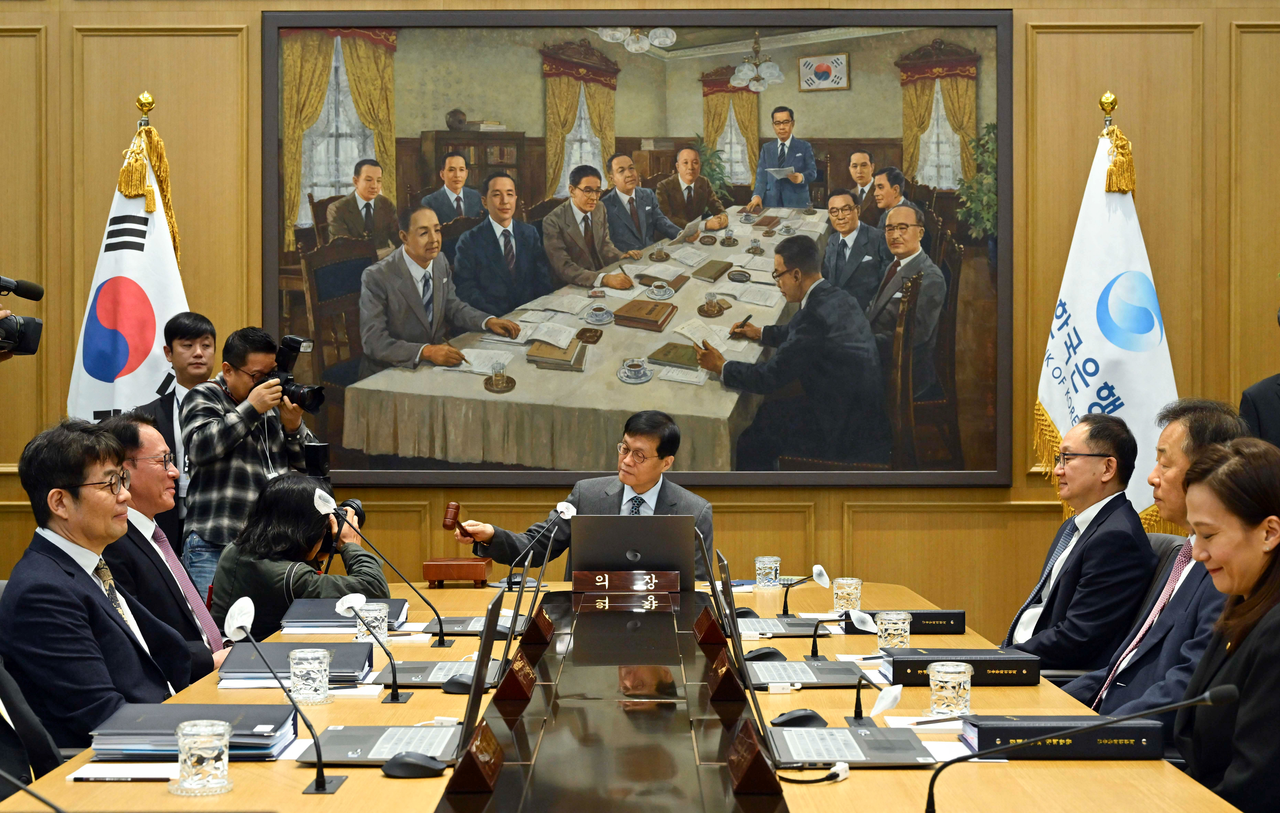
In a widely expected decision, the Monetary Policy Board of the Bank of Korea kept the key rate steady at 2.5 percent at its rate-setting meeting in Seoul.
It marked the fourth straight on-hold decision, even as the central bank remains in an easing cycle. Since October last year, the BOK has cut the key rate by a cumulative 100 basis points from 3.5 percent in an apparent move to support economic growth.
Local experts noted the BOK can afford to take a wait-and-see approach before delivering an additional rate cut and focus more on stabilizing the foreign exchange market as the economy remains on a recovery path.
The central bank presented an upbeat outlook on the day, raising this year's economic growth forecast by 0.1 percentage point to 1 percent and upgrading its projection for next year to 1.8 percent from 1.6 percent.
"Along with inflation having risen somewhat, the economy continues to improve, driven by consumption and exports, while uncertainty in the growth outlook continues, and risks to financial stability also remain. The Board, therefore, judged that it is appropriate to maintain the current level of the base rate and to assess domestic and external policy conditions," the BOK said in a released statement.
The won's sharp slide has been a primary concern for policymakers as a rate cut may trigger capital outflows, which in turn may further weaken the currency.
The local currency has remained well below the psychologically crucial 1,450-won level per dollar in recent weeks due mainly to heavy equity selling by offshore investors amid valuation concerns, as well as increased US stock investment by local investors.
On Monday, the won closed at 1,477.1 against the greenback, marking its weakest level since April 9, when it ended at 1,484.1 won. The April level was the lowest since March 12, 2009, when the currency finished at 1,496.5 won per dollar due to the global financial crisis.
In response, the finance ministry, the BOK, the National Pension Service and the welfare ministry that oversees the pension fund launched a four-way consultation body, holding their inaugural meeting Monday to discuss ways to balance the NPS' investment returns with stability in the foreign exchange market.
Delivering a strong message, Finance Minister Koo Yun-cheol told a press conference Wednesday that foreign exchange authorities are closely monitoring speculative trading and herd-like behavior in the market, vowing firm responses to excessive volatility.
Another key focus for the BOK is the widening interest rate gap with the United States. A larger gap could trigger foreign capital outflows and place further downward pressure on the won.
The Federal Reserve is expected to lower its policy rate at the Federal Open Market Committee meeting next month.
Currently, the policy rate gap between the two countries stands at 1.5 percentage points.
The BOK also appeared to have chosen to take more time to assess the impact of the government's successive measures to cool the overheated property market and curb rising household debt.
Most recently, on Oct. 15, the government announced its decision to designate 21 additional districts in Seoul as speculative zones, bringing all 25 districts in the capital under tougher regulations.
It also tightened lending rules, lowering the mortgage loan cap to as little as 200 million won ($136,000) from the 600 million won limit introduced in June. Tighter debt service ratio regulations have also been applied to nearly all types of household debt since July.
Despite the strengthened regulations, the average selling price of apartments in Seoul rose 0.2 percent in the third week of November from a week earlier, the first increase in four weeks, while the number of home transactions declined over the past month, according to the Korea Real Estate Board.
"It is necessary to remain cautious about risks associated with housing prices in Seoul and its surrounding areas, with household debt and the impact of heightened exchange rate volatility," the BOK statement said.
"While leaving room for potential rate cuts, the Board will decide whether and when to implement any further Base Rate cuts while closely monitoring changes in domestic and external policy conditions and examining the resulting impact on economic growth, inflation and financial stability," it added.
Thursday's meeting was the central bank's final policy session of the year. (Yonhap)