Russian assistance could speed Pyongyang’s nuclear submarine ambitions, despite lingering technological gaps
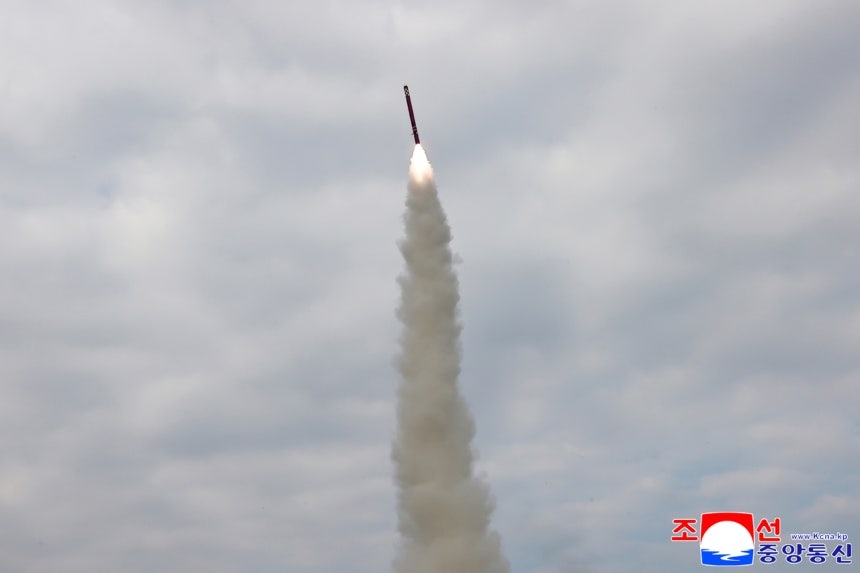
North Korea’s nuclear arsenal may be far larger — and expanding far faster — than widely believed, potentially reshaping the strategic landscape on the Korean Peninsula within the next two decades, according to new assessments by South Korean defense researchers.
At a forum hosted by the Korea Institute for Defense Analyses on Wednesday, Lee Sang-kyu, head of KIDA’s nuclear security research division, assessed that Pyongyang likely possesses between 127 and 150 nuclear weapons. The estimate — based on North Korea’s known fissile-material production rates and recent facility expansion — is more than double the figures commonly cited by other global institutes, which place the stockpile at about 50.
Lee projected that the North’s arsenal could grow to around 200 weapons by 2030 and surpass 400 by 2040, should Pyongyang continue its current trajectory of expanding uranium enrichment and plutonium production.
“North Korea has been broadening and modernizing its sites to enhance its ability to manufacture nuclear material,” Lee said, noting that Kim Jong-un’s order to “exponentially” increase warhead production continues to drive a sustained push for more enrichment capacity.
According to Lee’s internal analysis, the North may already hold 115-131 uranium-based warheads and 15-19 plutonium-based weapons, producing a total inventory far beyond previous assumptions. International bodies such as the Congressional Research Service, continue to estimate the North’s arsenal at around 50 warheads — a gap that underscores how opaque and contested assessments of Pyongyang’s nuclear program have become.
KIDA researchers argue that the rapid acceleration is partly explained by North Korea’s newly expanded enrichment infrastructure. International Atomic Energy Agency reports from August noted a newly identified building at Yongbyon that appears suited for uranium enrichment, raising concerns that the regime may be preparing to broaden production capacity.
Lee also cautioned that North Korea’s ongoing nuclear-powered submarine project — unveiled publicly for the first time this year — is likely incomplete in critical areas. The reactor, combat systems, launch tubes and sonar equipment are all unlikely to be fully integrated at the current stage, he assessed.
Developing a compact, submarine-compatible nuclear reactor with enrichment levels of 20 percent or greater would take at least a decade, Lee said. But he added that this timeline could shift if Russia provides covert technological help.
He pointed to a “possibility” that Moscow may supply designs, materials, components or know-how required for submarine construction — a concern that has grown amid deepening military cooperation between North Korea and Russia following their September 2023 summit.
Despite Pyongyang’s escalating rhetoric about being able to mount a second-strike threat against the US, KIDA analysts cautioned against overestimating the North’s operational readiness.
Jeon Gyeong-ju, a research fellow at KIDA, noted during the Wednesday event that while the North is clearly trying to field forces capable of waging a limited nuclear conflict, the underlying systems remain far from mature.
“Outwardly, North Korea has assembled the appearance of such a capability,” he said. “But substantial improvements and further development are still needed for real military effectiveness.”
Meanwhile, recent satellite monitoring by the US website 38 North indicates that the North’s nuclear sector has been undergoing continuous upgrades in 2025. The group reported that imagery from October and November shows ongoing modernization and enlargement across the Yongbyon Nuclear Scientific Research Center — the heart of North Korea’s fissile-material production.
One suspected enrichment complex northeast of the radiochemical laboratory — first spotlighted earlier this year — has emerged as the most active subsite in the area. Exterior work on new support buildings is reportedly complete, with paved surroundings added and six potential heat exchangers installed along the main building, equipment typically used to cool centrifuges.
According to 38 North, “activity over the course of 2025 reflects these directives,” referring to Kim Jong-un’s January orders to accelerate production of weapons-grade material. The group noted steady operation of the 5-megawatt reactor and preoperational testing of the experimental light-water reactor as evidence of an intensified push.
“These improvements all serve to help fulfill Kim’s call for exponential growth of its nuclear weapons arsenals,” the report said.
mkjung@heraldcorp.com