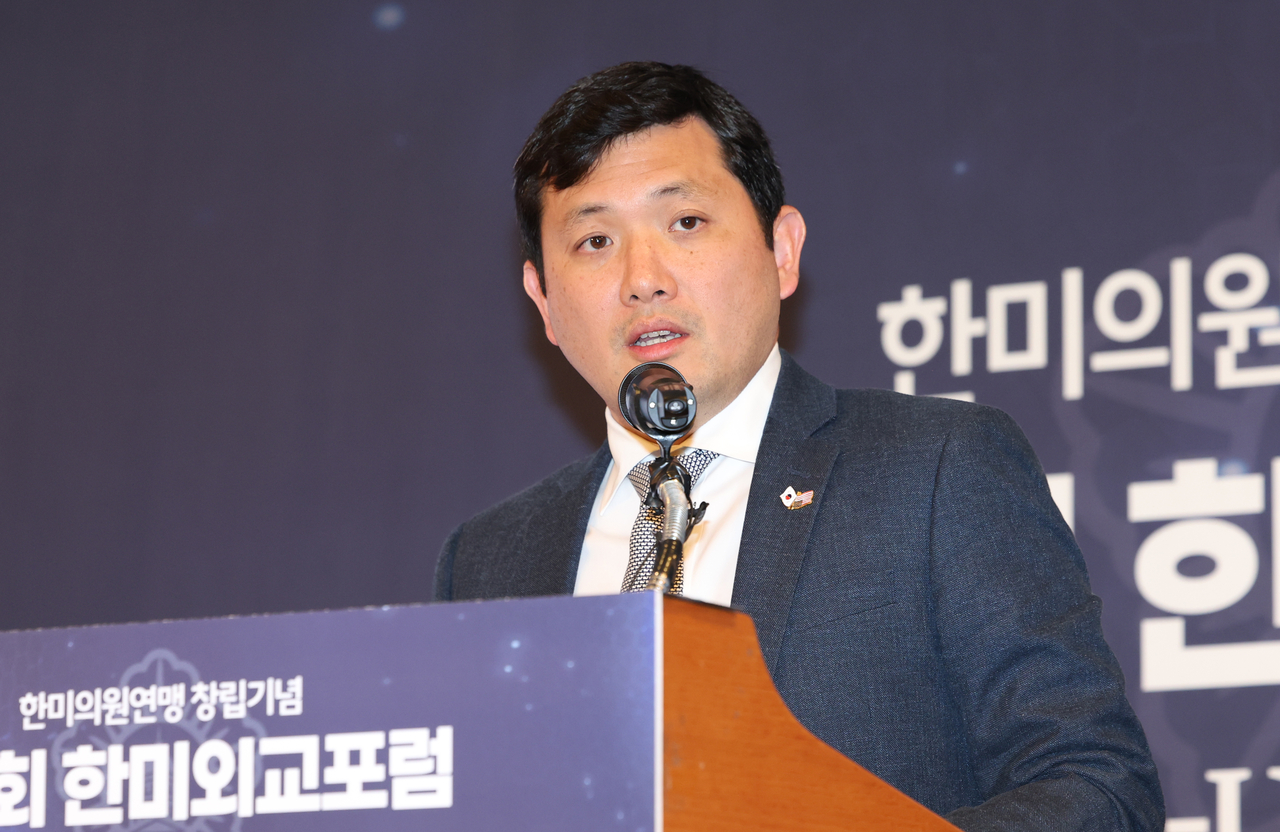
Acting US Ambassador to South Korea Kevin Kim said Friday that South Korea and the United States need to address "common challenges" they face on the Korean Peninsula and the Indo-Pacific region, as the allies seek to modernize the decadeslong alliance.
Kim made the remarks as Seoul and Washington are pushing to modernize their alliance to better respond to a changing security environment, defined by China's increasing assertiveness and continued North Korean nuclear and missile threats.
"First and foremost, addressing the common challenges on the Korean Peninsula, as well as the Indo-Pacific region, first starts with having a shared assessment of the threats that we face," Kim said in a forum hosted by the Korea-US Alliance Foundation when asked about how the allies should cooperate on security issues.
"Ultimately what matters is that we strengthen deterrence on the Korean Peninsula and the Indo-Pacific region," Kim said. "What matters is that peace and stability is preserved so that prosperity can be pursued for our respective peoples, and that's what the fact sheet is focused on."
Calling the joint fact sheet detailing the outcome of the recent summit talks between President Lee Jae Myung and US President Donald Trump a document that is "so special" and "so historic," Kim stressed that Washington remains committed to the full implementation of the agreement.
The fact sheet, released earlier this month, includes Seoul's commitment to investing $350 billion in the US in return for Washington's lowering of "reciprocal" tariffs on South Korean products to 15 percent from 25 percent and the US' support for Seoul's push to acquire nuclear-powered submarines.
It also includes Seoul's pledge to hike its defense spending to 3.5 percent of the gross domestic product and acquire advanced US weapons systems, a move seen as reflecting Washington's push for its allies to do more for their own defense.
"Every single element, every single commitment, is important to the United States, and we will be focused on ensuring and implementing every element of that fact sheet," the US envoy said.
Against such a backdrop, Kim called South Korea a "model ally" for the US not only for security but also in areas of economy and trade, as the US seeks to ramp up its manufacturing capabilities.
"The ROK is a model ally, because it takes care of its own defenses, shoulders its own burdens. And who better to work with, to address our core issues than the Republic of Korea," he said, referring to South Korea by its formal name.
"And of course, from the president's perspective, he's willing to take any measure necessary to ensure that the United States can become a manufacturing powerhouse. But we will be doing so, holding hands with the Republic of Korea, moving forward."
When asked about speculations over a possible Chinese takeover of Taiwan in 2027, the US envoy declined to address such possibilities but noted that the Chinese military is in the middle of what he called a historic buildup.
"Whatever happens, I know that the president is interested in preserving peace and stability in the Taiwan Strait, as well as the Indo-Pacific region," he said.
Kim called Trump a "peacemaker," noting how the US president can take approaches that have not been tried before in engaging with North Korea, saying that options should not be taken off the table for Trump.
The US envoy's remarks came amid views that Trump's envisioned visit to Beijing in April next year may serve as an occasion to rekindle his personal diplomacy with North Korean leader Kim Jong-un. (Yonhap)