Korea’s two largest automakers, Hyundai Motor Co. and Kia, announced Friday that they will invest 1.2 trillion won ($816 million) to build their first battery-dedicated research and development facilities, signaling a stronger commitment to developing batteries for their own vehicles, future mobility and robotics.
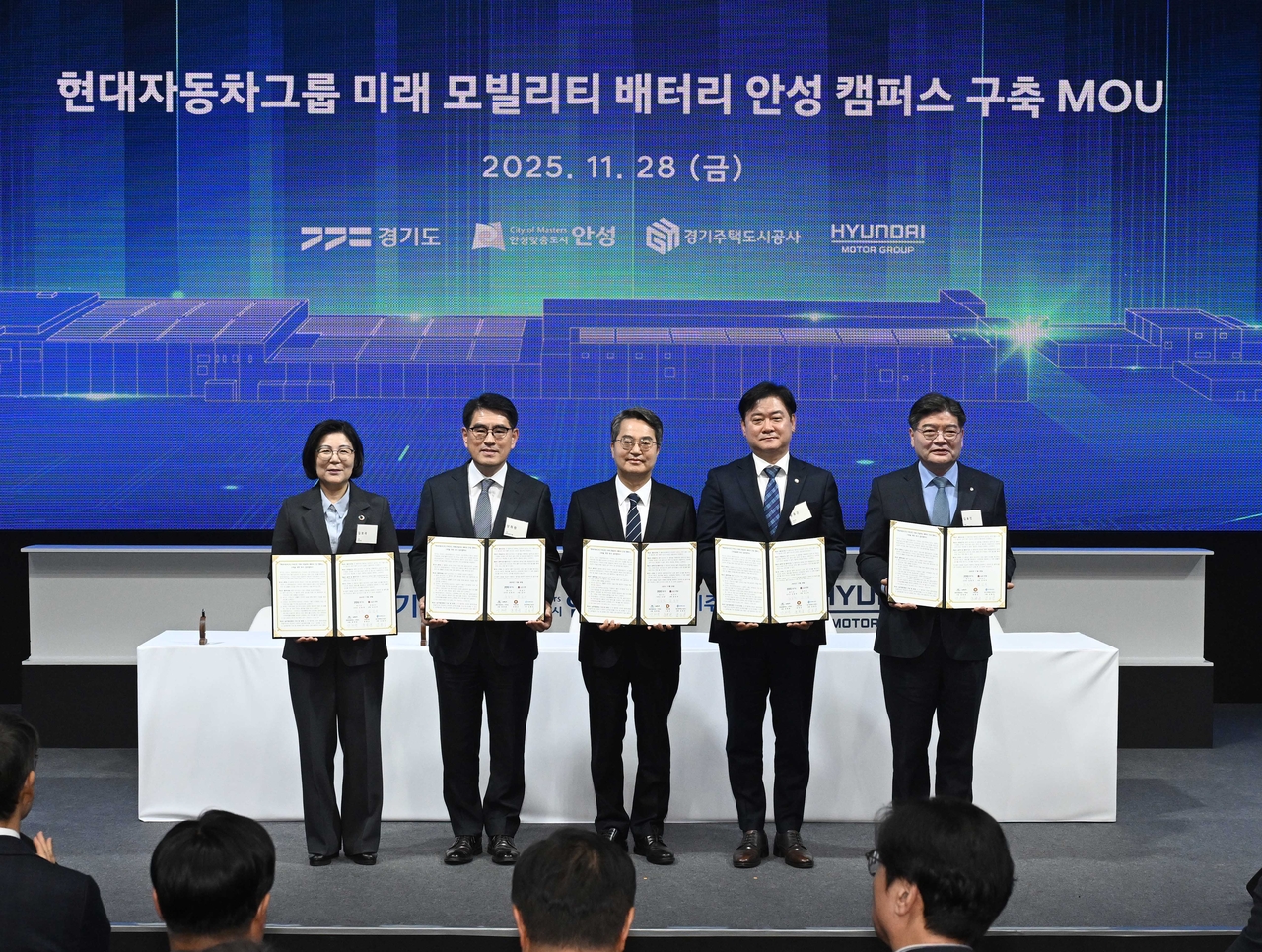
The two Hyundai Motor Group affiliates held a ceremony wishing the safe completion of the Future Mobility Battery Anseong Campus, marking the first official confirmation of the project, which is being built in Anseong, Gyeonggi Province.
Attendees included Hyundai Motor and Kia executives and government officials, including Yang Heui-won, head of Hyundai-Kia R&D, and Gyeonggi Province Governor Kim Dong-yeon.
“The battery campus will serve as a hub that organically connects Korea’s battery industry, facilitating collaboration across sectors and accelerating technological advancement,” Yang said.
“We believe the campus will become a core engine that strengthens national competitiveness and positions Korea to lead the global electrification market.”
Scheduled for completion in 2026, the facility will cover a total floor area of 111,000 square meters and serve as the automakers’ platform for a comprehensive battery development process.
By integrating advanced facilities capable of handling every step of cell production, the companies plan to establish an internal development system spanning the full battery lifecycle, from materials and cell manufacturing to module packaging and functional integration in vehicles.
The campus will also include an artificial intelligence-based testbed to analyze data and improve product quality after development, the automaker said.
Until now, their in-house work has been largely limited to early-stage efforts such as basic cell design, battery materials and unit-level processes.
Hyundai Motor and Kia will initially focus on high-performance lithium-ion battery cells for electric and extended-range electric vehicles. Over time, they plan to broaden their work to include robotics and advanced air mobility, reflecting market needs and emerging technologies.
Analysts say the unveiling of the battery-dedicated campus reflects the companies’ confidence in their in-house battery capabilities, noting that their technology is approaching the level of major cell manufacturers.
“The large-scale ceremony, following years of silence regarding their own battery development, can be interpreted as a declaration that they now have comparable capabilities and are ready to secure a stronger leadership position in the field,” said Park Cheol-wan, an automotive engineering professor at Seojeong University.
“As Hyundai and Kia’s direction for in-house battery development becomes clearer, cell makers will face intensifying competition. The facility’s proximity to Seoul will also be appealing to battery technology talent in Korea.”
Construction of the campus began in January. Industrial sources had previously suggested that the automakers were preparing a combined R&D and battery manufacturing complex in Anseong, but the companies had maintained that details had not been finalized.
Park added that Hyundai Motor and Kia’s move toward in-house battery production is an inevitable step, noting that companies such as Tesla and Toyota already produce or plan to produce their own batteries, while expanding into areas like energy storage systems and battery recycling.
“Greater bargaining power with cell companies can give Hyundai and Kia a stronger position in the global market and potentially create opportunities beyond electric vehicles,” Park said.
“It will also serve as a wake-up call to Korea’s cell makers, sending a message that collaboration among them is essential for their long-term viability.”
forestjs@heraldcorp.com