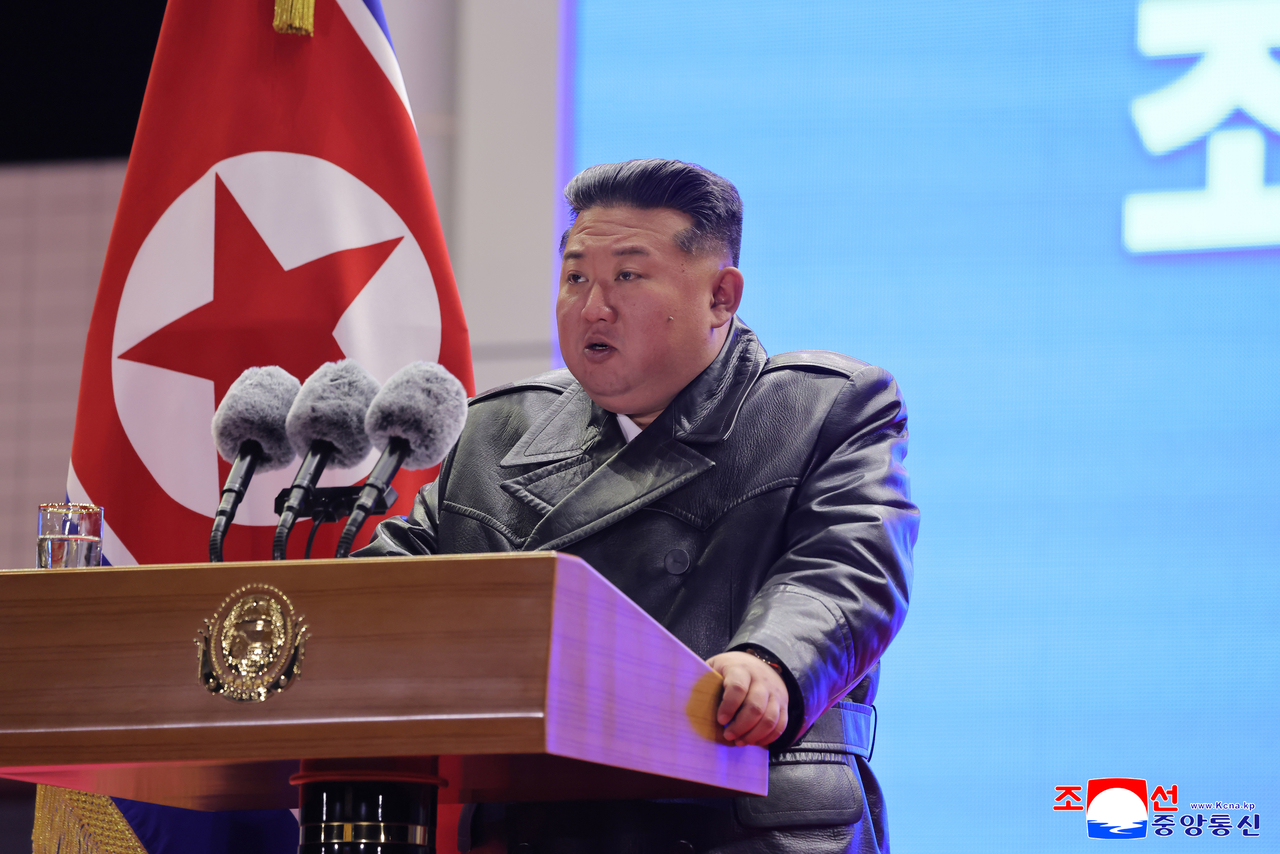
North Korean leader Kim Jong-un emphasized the growing role of the country’s air force and stated that the branch would be given "new strategic assets," as he marked the service’s 80th anniversary, state media reported Sunday.
Kim presided over a large-scale celebration Friday at Kalma Airport in Wonsan, Kangwon Province, home to the 59th Kil Yong Jo Hero Flying Group under the 2nd Air Wing, according to the Korean Central News Agency.
His daughter, Kim Ju-ae — widely viewed by North Korea watchers as his heir — accompanied him, making her first public appearance since traveling to China in early September for a military parade in Beijing.
State media photographs released by the Rodong Sinmun showed Kim, dressed in a long leather coat and accompanied by Ju-ae, observing an air show and touring a display of assets, including uncrewed aircraft, mobile missile launchers and an airborne early-warning and control aircraft first unveiled earlier this year.
During his address, as quoted by the KCNA, Kim said the air force "would be given new strategic military assets and entrusted with a new important duty,” though he did not specify the nature of the new capabilities. He emphasized that “the expectations ... for the air force, which will play a role in the exercise of the nuclear war deterrent, is very great,” stressing that the service must “resolutely repulse and control all sorts of espionage acts and possible military provocations of the enemies to encroach upon the sovereign airspace.”
KCNA also quoted Kim as highlighting the air force’s expanding responsibilities in “the exercise of the nuclear war deterrent,” underscoring Pyongyang’s intent to diversify the platforms supporting its nuclear strategy.
North Korea has stepped up efforts in recent years to modernize its conventional military forces. This year, the country conducted its first live-fire air-to-air drill involving fighter jets in May and revealed a domestically produced airborne early-warning and control aircraft in March.
Friday’s ceremony also featured an aerial demonstration flight viewed from an observation platform, an art performance and the awarding of the Order of Kim Jong-il — the country’s highest decoration — to the air force.
Kim noted that additional “new strategic assets” would be provided to the service, but did not elaborate, signaling continued investment in advanced air capabilities as Pyongyang sharpens both its nuclear posture and air defense priorities.
Experts say the anniversary ceremony is Pyongyang’s latest demonstration of its post-nuclear-force modernization drive.
“After completing its nuclear force development, North Korea showcased naval enhancement early this year and is now highlighting the expansion of its airpower at year’s end,” said Yang Moo-jin, a professor at the University of North Korean Studies.
Yang noted that ahead of the Ninth Party Congress, expected early next year, the regime appears intent on presenting a balanced portfolio — not only nuclear and missile deterrence, but also an upgraded conventional force structure. He added that the new fighter aircraft and platforms hinted at by Kim are plausibly linked to Russian support, recalling that Pyongyang historically sourced MiG fighters from the Soviet Union through equidistant diplomacy.
Kim’s field guidance at Kalma — also a coastal resort zone — likely combined military oversight with a brief family retreat, Yang said, portraying it as an attempt to consolidate public sentiment ahead of the party congress. He noted that Ju-ae’s presence may become more selective as Pyongyang gauges external reactions to her growing visibility.
Analysts also pointed to displays of new long-range precision strike capabilities.
The event included North Korea’s first public display of what analysts describe as a Taurus-type long-range air-to-ground missile. Photos released by state media showed a cruise-missile-class weapon mounted on a Su-25K attack aircraft.
“This is the first time North Korea has unveiled a domestic variant resembling the German Taurus or the Russian Kh-59MK2,” said Hong Min, a senior analyst at the Korea Institute for National Unification.
Hong said the missile’s square cross-section, aerodynamic design and rear propulsion system make it technically closer to the Russian Kh-59MK2, with an estimated range of 200 to 500 kilometers. It likely uses guidance systems combining GPS and inertial navigation system with terrain-matching. Its folding wings and sleek body suggest low-altitude, glide flight capability, enabling long-range standoff precision strikes designed to bypass South Korea-US air defenses.
He added that the missile could eventually be integrated onto MiG-29 fighters, while the deployment of the new air-to-air missiles showcased by North Korea hinges on whether Pyongyang can modernize the aging radar and sensor suites of its front-line aircraft.
According to Hong, Kim’s reference to “new strategic military assets” likely includes advanced air-launched cruise missiles, precision-guided bombs, medium-range air-to-air missiles similar and Hellfire-type guided munitions.
Kim’s emphasis on the air force’s role in “the exercise of the nuclear war deterrent,” Hong added, could imply dual missions: deterring South Korean and US strategic assets or preparing for the future integration of air-launched nuclear warheads.
Both analysts said the display reflects broader structural changes in North Korea’s force posture.
Yang said the country is aiming for comprehensive conventional modernization ahead of the party congress, while Hong assessed the latest parade of assets as demonstrating the strategic elevation of the air force as a pillar of nuclear deterrence, expansion of uncrewed assets capable of strike, reconnaissance and suicide missions and a more offensive posture toward US-South Korea intelligence, surveillance and reconnaissance assets.
mkjung@heraldcorp.com