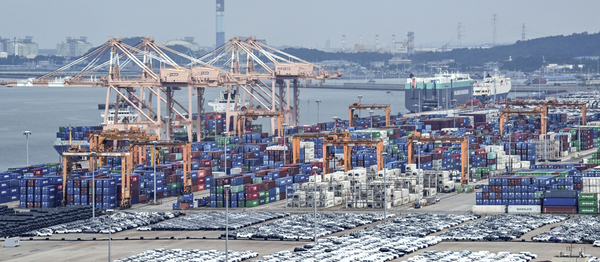
South Korea's exports increased 8.4 percent from a year earlier in November to over $61 billion, marking the sixth consecutive month of increase on the back of strong demand for semiconductors, government data showed Monday.
Outbound shipments came to $61.04 billion last month, the highest for any November, according to the data compiled by the Ministry of Trade, Industry and Resources.
Imports gained 1.2 percent on-year to $51.3 billion, resulting in a trade surplus of $9.73 billion.
Accumulated exports in the January-November period reached $640.2 billion, a record high for the cited period, raising expectations that the country's annual exports will surpass the $700 billion mark for the first time in its history this year.
Semiconductor exports soared 38.6 percent on-year to an all-time monthly high of $17.26 billion last month, led by a continued rise in memory chip prices sparked by strong demand for high-value products for data centers.
It marked the ninth consecutive month chip exports posted an on-year increase.
Auto exports climbed 13.7 percent to $6.41 billion on the strong performance of internal combustion vehicles and hybrid cars, marking a turnaround from a 10.5 percent drop in October.
In the January-November period, accumulated exports of semiconductors and automobiles both reached the highest figures for the cited period, coming to $152.6 billion and $66.04 billion, respectively.
Shipments of wireless communication devices added 1.6 percent to $1.73 billion, and shipments of secondary batteries went up 2.2 percent to $670 million, snapping a six-month losing streak.
Exports of electrical equipment, agro-fisheries products and cosmetics expanded 5.2 percent, 3.3 percent and 4.3 percent, respectively, to $1.27 billion, $1.04 billion and $950 million.
But exports of petroleum products dipped 10.3 percent to $3.28 billion, while exports of petrochemical products dropped 14.1 percent to $3.06 billion amid a global oversupply.
Steel exports slid 16 percent to $2.3 billion as new orders were limited due to the US administration's hefty tariff measures and slowdown in global demand.
By region, exports to the United States slipped 0.2 percent on-year to $10.35 billion in November.
In detail, semiconductor and auto exports to the US advanced 39 percent and 11 percent to $1.1 billion and $2.2 billion, respectively, in the first 25 days of the month. But shipments of steel products to the US plunged 24 percent on-year to $200 million, with machinery exports contracting 18 percent to $800 million.
Exports to China gained 6.9 percent to $12.07 billion on strong demand for semiconductors, petroleum and machinery products.
Shipments to the Association of Southeast Asian Nations rose 6.3 percent to $10.42 billion, led by semiconductors, and shipments to the Middle East jumped 33.1 percent to $2.18 billion.
Shipments to the European Union decreased 1.9 percent to $5.34 billion on weaker steel and ship demand.
Industry Minister Kim Jung-kwan said Korea's exports are showing an upward trend thanks to the strong performance of semiconductor, automobile and bio-health products, as well as the diversification of export items, vowing efforts to continue the growth momentum even amid global trade uncertainties.
With the recent submission of a special bill on Seoul's $350 billion investment commitment to the US under a bilateral tariff deal, the conditions have been met for the US administration's lowering of tariffs on Korean cars and auto parts, he added. (Yonhap)