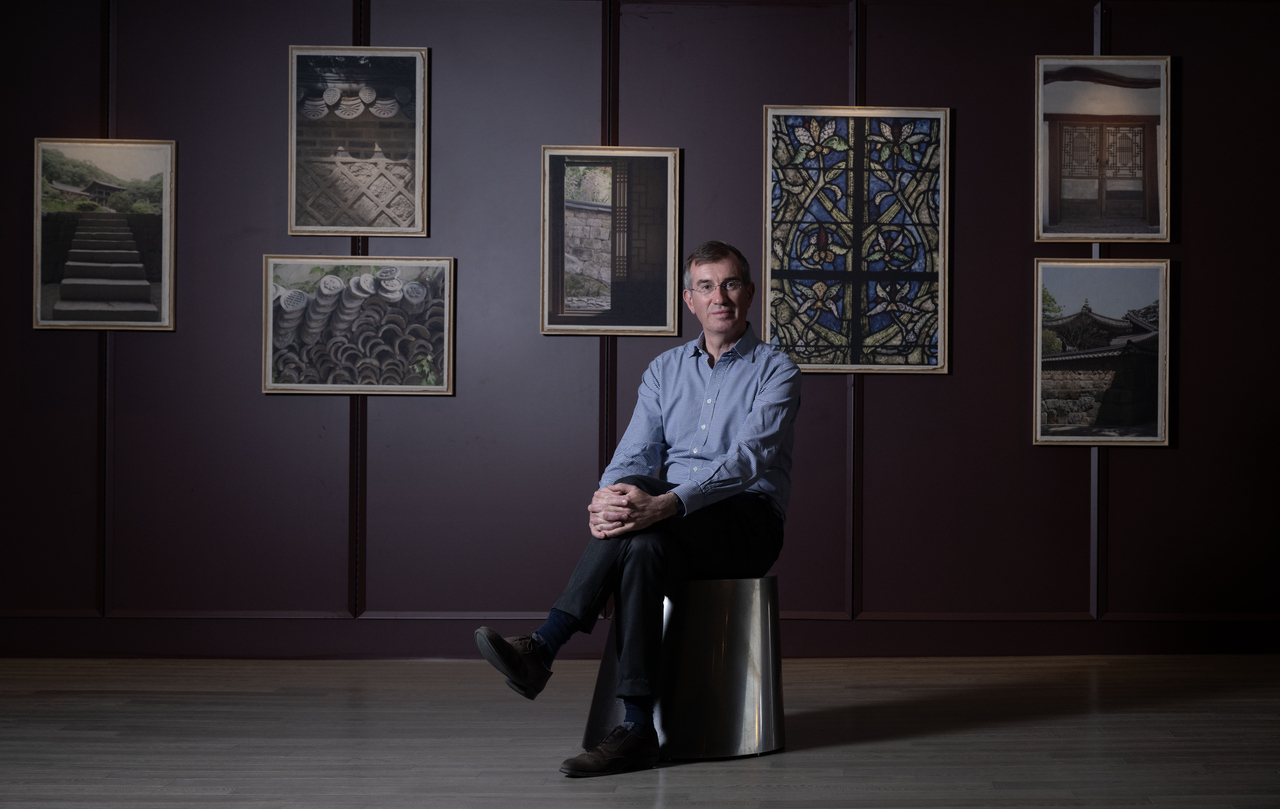
Xavier Salmon, who oversees the print collection at the Louvre Museum in Paris, considers himself, in a way, an ambassador for hanji, Korean handmade mulberry paper. What fascinates him is its duality in practical use and poetic texture for creating art.
During his visit to Korea last year, Salmon traveled through Seoul and major Buddhist monasteries, including Haeinsa and Bulguksa. Having selected 12 photographs, he matched them with 12 Parisian heritage sites, forming a visual dialogue — all printed on hanji made by Korean masters.
Those works were on view at the exhibition “Spirit of Korea, Spirit of Paris: The Curator’s Eye,” held at the Art Cube 2R2 Gallery in Seoul. The show ran through Nov. 29.
As a specialist in European art from the 17th and 18th centuries, Salmon is serving as the director of the Department of Drawings and Prints at the Louvre Museum, home to more than 500,000 pieces, encompassing thousands of years of the world’s cultural heritage.
"You can feel the materiality of the paper -- the paper gives some softness," he said on Nov. 20, pointing to the deckled edge of the hanji print, where the natural fibers remain visible.
"It's difficult to print on this paper and the result is not like when you're printing on regular paper. I think the result is very poetical in comparison with normal photos," he said.
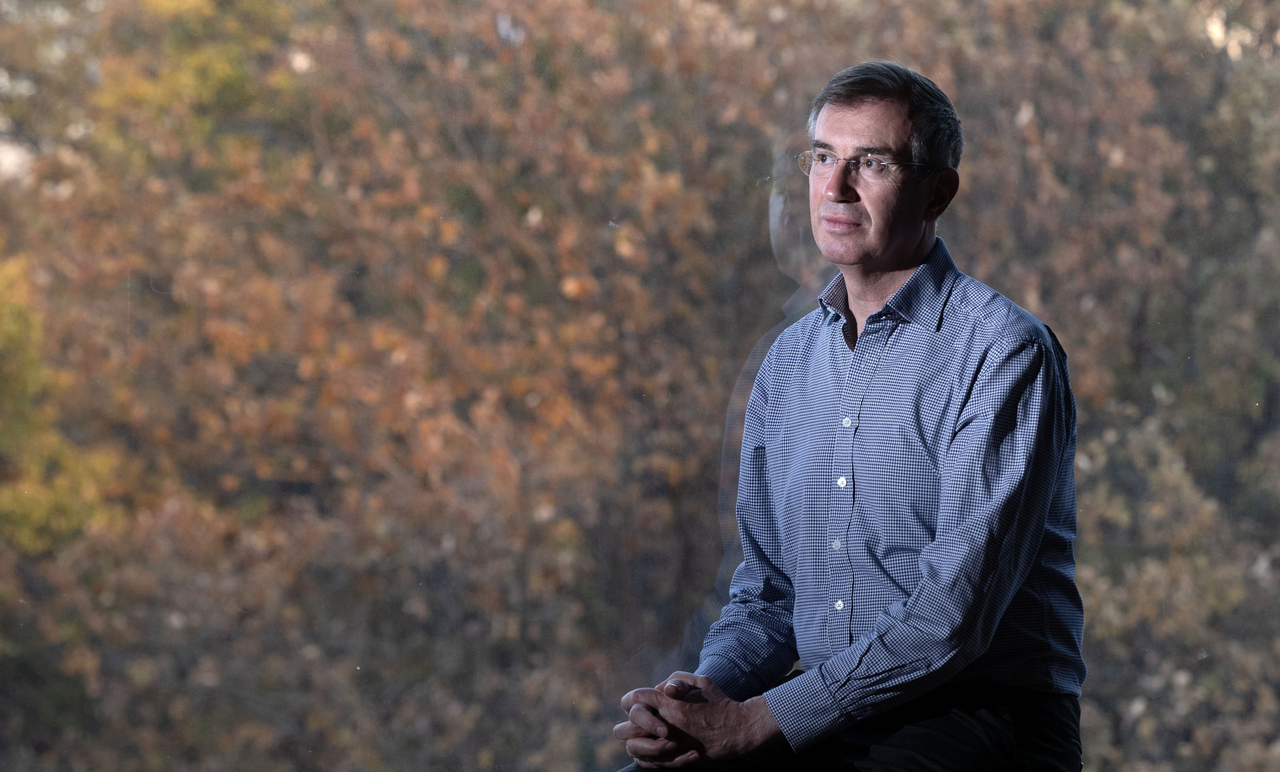
The French museum uses hanji, according to Salmon, to restore drawings, prints and even furniture, which is why the director is deeply familiar with the traditional paper. While Japanese washi paper is widely known, hanji remains relatively unfamiliar abroad -- a result, he believes, of limited promotion, particularly after the Korean War.
"For Japanese paper, the motion goes mostly side to side, but for hanji, you work both back and forth and side to side — its duality comes from the process,” Salmon said, demonstrating the traditional 'waebal tteugi' technique for hanji in which the frame is shaken to trap water and cross the fibers.
“Now people are more interested and more involved in the promotion of this incredible paper," he said.
The director co-curated the exhibition “Stories of Paper” at the Louvre Abu Dhabi that included the reconstruction of a hanok, or Korean traditional house, built by artisans from the city of Jeonju using hanji, wood, tiles and stone. That installation is now part of the museum’s collection.
During his roughly 20-day stay in Korea this time, Salmon went to Kansong Art Museum— the first private museum in Seoul, founded by collector Jeon Hyung-pil to safeguard cultural artifacts during the Japanese colonial period -- and said he was particularly impressed by the light and autumn foliage.
“You have a special light at this time of year -- a very soft light -- and it plays with the colors of the ginkgo and the maple. This mixture of colors is absolutely astonishing for a European eye,” he said.
Salmon is pushing to host a joint symposium in collaboration with the National Museum of Korea next year in Paris, marking the 140th anniversary of diplomatic ties between Korea and France.
The French city will see another major exhibition highlighting Korean culture next year at the Guimet Museum, located a 10-minute ride from the Louvre, which holds the largest collection of Asian Art in Europe.
Asked why people continue to visit museums, Salmon offered a succinct answer without hesitation: “A museum exists to meet beauty and humanity — the treasures of humanity,” he said.
Regarding the recent robbery at the Louvre, in which thieves stole royal and imperial jewels valued at more than $100 million, Salmon said the Louvre continues to strengthen its security, but expressed bitterness over how misinformation about the incident has spread online, saying, "It's a pity for the reputation of the museum."
The director, however, added that excessive security measures should not come at the expense of the visitor experience.
"Many museums are fighting against that kind of robbery. Of course, we can put cameras and protections everywhere, but when you visit a museum, it should be a place where you take pleasure in seeing things.
"If it becomes like an airport or bank, with controls everywhere, it’s no longer the same experience," Salmon said.
yunapark@heraldcorp.com


![[Exclusive] SK On fast-tracks pilot output in all-solid-state battery race](https://wimg.heraldcorp.com/news/cms/2025/11/18/news-p.v1.20251117.611a51c182b546348b32ccc3233f6193_T1.png?type=h&h=240)