In bold debut recording, six-year-old string ensemble presents Janacek and Suk after sweeping competitions
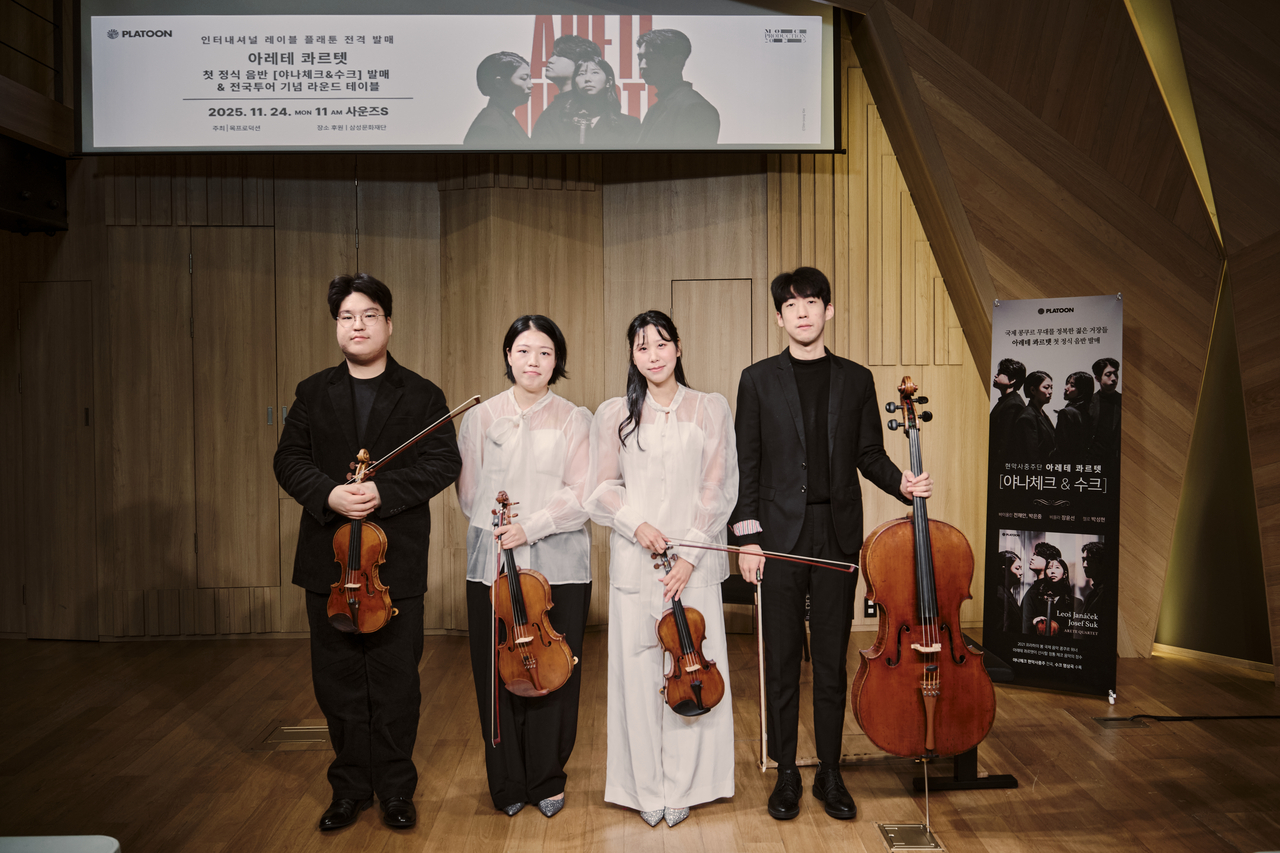
When the Arete Quartet, one of Korea’s most closely watched young chamber ensembles, began discussing their first recording, the choice of repertoire came almost instinctively. Rather than starting with the standard Beethoven-Mozart canon that they could have chosen, the group took an unconventional leap: Czech composers Leos Janacek and Josef Suk.
Their affinity for Czech music did not develop out of curiosity alone. A defining moment came at the 2021 Prague Spring International Music Competition, one of the most prestigious contests for chamber ensembles. For the final stage, the Arete Quartet, comprising violinists Jeon Chae-ann and Park Eun-joong, violist Jang Yoon-sun, and cellist Park Seong-hyeon, performed Janacek's String Quartet No. 1, "Kreutzer Sonata," and became the first Korean winners.
“The judges mentioned Janacek, saying that our interpretation is very refreshing and convincing,” cellist Park recalled in a press conference on Nov. 24.
Their debut album, released this month, extends that artistic conviction. It includes Janacek’s String Quartet No. 2, “Intimate Letters,” which the ensemble subsequently presented as part of Korea’s first complete Janacek quartet cycle in four concerts that conclude Saturday at Tongyeong Concert Hall in South Gyeongsang Province. The album also features Suk’s "Meditation on the Old Czech Chorale ‘St. Wenceslas,’ Op. 35a." Suk, a student and later son-in-law of Antonin Dvorak, is regarded as a central figure in the Czech musical tradition.
“Suk’s music may not be widely known, but he is a representative composer of the Czech Republic. Among his works, there is a piece titled 'Meditation on the Old Czech Chorale' that we felt was too beautiful for only us to know,” said second violinist and youngest member Park Eun-joong.
The quartet explained that the Czech repertoire offers a raw emotional intensity and vivid nationalism rarely explored in Korea’s chamber music scene.
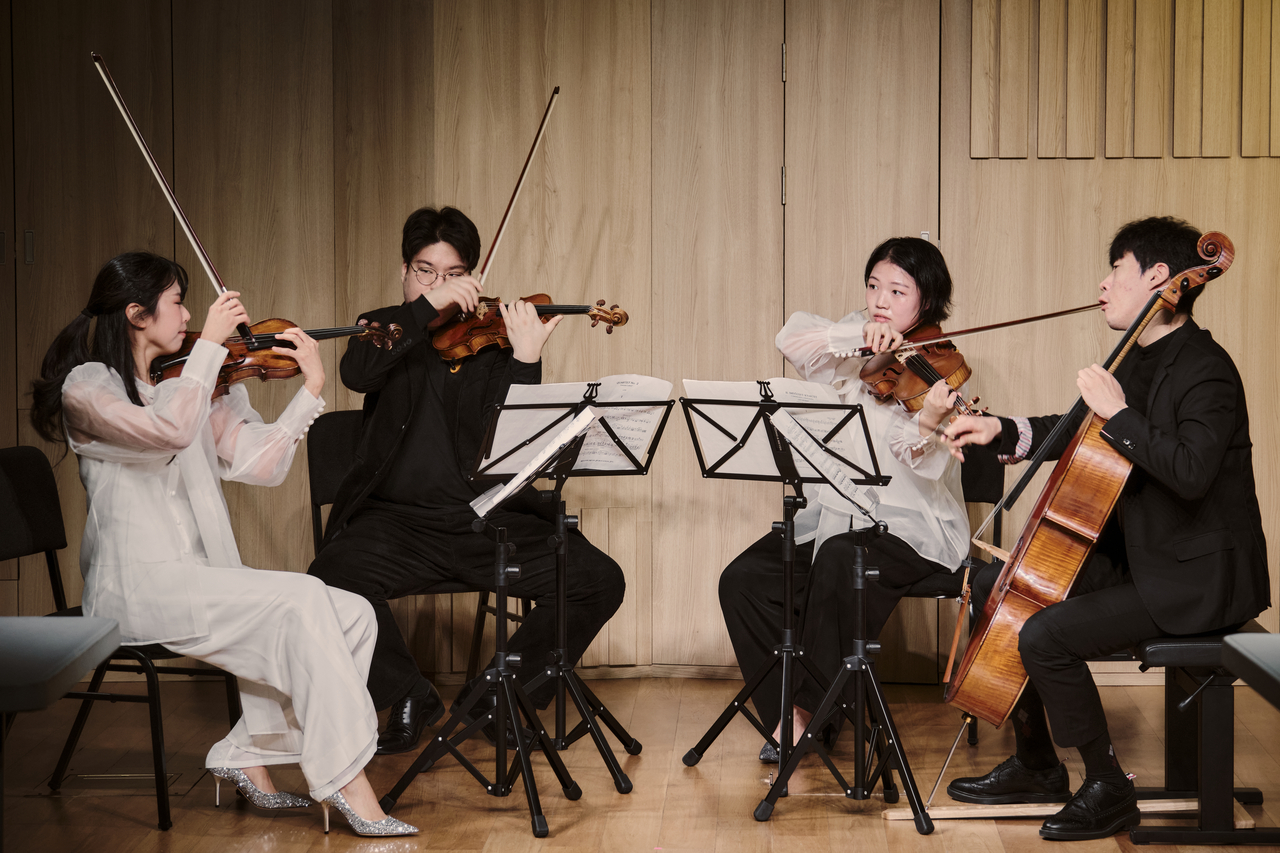
That direction has already set them apart. This year, the ensemble became the first quartet to be named Artist-in-Residence at Kumho Art Hall Yonsei, a milestone that underscores the institution’s growing recognition of chamber music’s artistic and cultural value.
The appointment instilled in the members a heightened sense of responsibility, as though they were representing the genre on a national stage, according to Park Seong-hyeon, the cellist.
Yet the members admit that the genre still faces structural limitations in Korea.
“We work with responsibility, and even though our debut has been successful, we constantly confront reality. We want to play to sold-out halls and share great music, but we are still figuring out how to reach audiences," Park, the cellist, reflected candidly.
Formed in 2019, the Arete Quartet has garnered major international recognition, winning first prize at the Prague Spring International Music Competition in 2021, the Mozart International Competition in 2023, and the Lyon International Chamber Music Competition in 2024. In 2025, the quartet took third prize at the Bordeaux International String Quartet Competition and went on to become the first Korean ensemble to reach the finals and win a prize at the Banff International String Quartet Competition.
Since artistic growth is difficult to measure, the cellist explained that the quartet has participated in numerous competitions in order to know where they stand. Without clear markers or standards, competitions have served as a practical way for them to check their progress.
The album, released after this series of competitions, represents more than a collection of recordings. To the quartet, it is a foundation -- a kind of database that future listeners and musicians can return to.
“If there is any way for the string quartet genre to grow and develop, even a little, I believe it begins with creating a database,” he said.
Their debut album, distributed by Platoon, Apple’s music distribution subsidiary, marks another first: It is the company’s first-ever physical classical album release. The quartet sees this collaboration as symbolic of chamber music’s evolving presence in the digital era.
“The times are changing so quickly. We wondered whether Mozart and Beethoven alone could continue to define classical music. While those composers remain essential, new music is constantly emerging and the platforms through which audiences encounter it are evolving just as quickly," the cellist noted.
gypark@heraldcorp.com