South Korean stocks closed almost unchanged Monday as investors sought profits amid increased uncertainties. The Korean won increased against the US dollar.
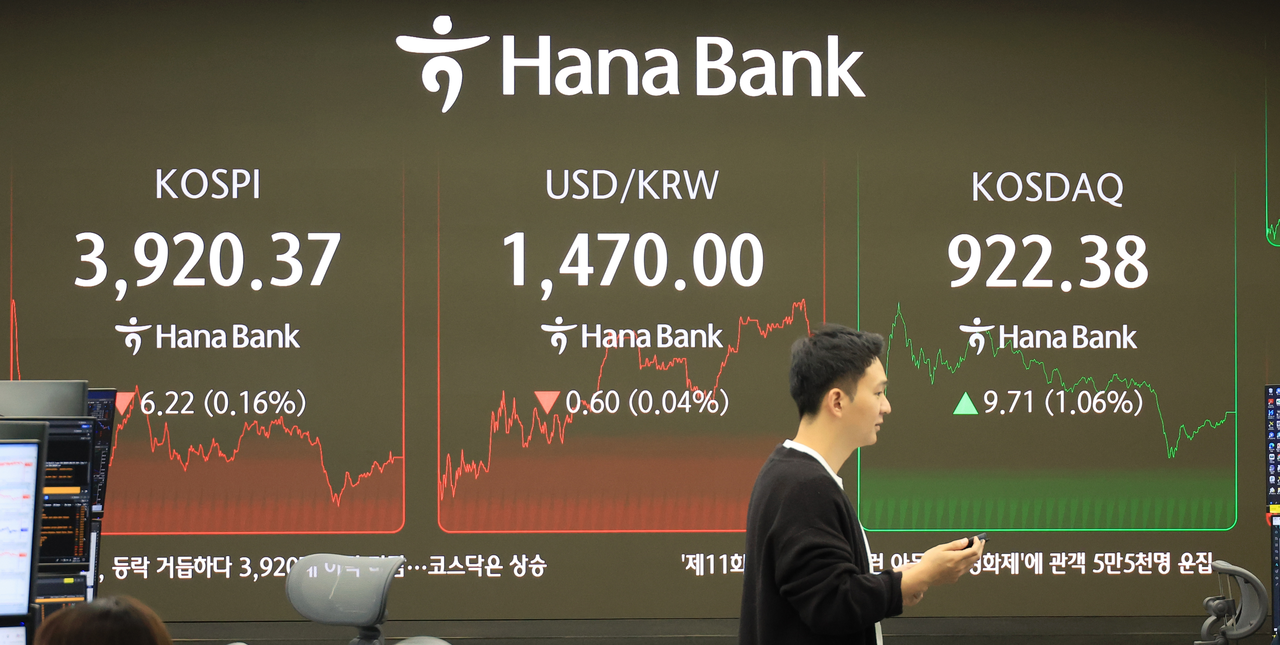
After a choppy session, the benchmark Korea Composite Stock Price Index went down 6.22 points, or 0.16 percent, to close at 3,920.37.
Trade volume was thin at 293.7 million shares worth 11.69 trillion won ($7.95 billion), with winners beating losers 489 to 380.
Foreign and individual investors purchased a net 215.4 billion won and 52.8 billion won worth of stocks, respectively, while institutions offloaded 233 billion won worth of shares alone.
The index had opened sharply higher, tracking overnight US gains. On Friday, Wall Street closed broadly higher, extending its winning streak to a fifth day amid the Thanksgiving holiday. The S&P 500 rose 0.54 percent, the Dow Jones Industrial Average gained 0.61 percent, and the tech-heavy Nasdaq composite climbed 0.65 percent.
The KOSPI, then, trimmed earlier gains on heavy institutional selling.
"The recent fluctuation in the KOSPI was influenced by the sharp decline in the bitcoin market, often viewed as a leading indicator of short-term liquidity concerns, and by the strong Japanese yen," Lee Kyung-min, an analyst at Daeshin Securities, said, adding that gains in the semiconductor sector helped support the index.
In Seoul, most large-cap shares ended mixed.
Top-cap Samsung Electronics went up 0.3 percent to 100,800 won, and its chipmaking rival SK hynix increased 1.51 percent to 538,000 won.
Battery maker LG Energy Solution increased 1.23 percent.
Bio shares were among gainers, with Samsung Biologics adding 2.61 percent to end at 1,649,000 won.
In contrast, defense giant Hanwha Aerospace lost 4.58 percent to 813,000 won, and No. 1 automaker Hyundai Motor shed 2.68 percent to 254,500.
The local currency was quoted at 1,469.9 won against the greenback at 3:30 p.m., up 0.7 won from the previous session.
Bond prices, which move inversely to yields, ended lower. The yield on three-year Treasurys went up 5.4 basis points to 3.045 percent, and the return on the benchmark five-year government bonds increased 5.7 basis points to 3.233 percent. (Yonhap)