South Korea and the United States reaffirmed their close coordination on achieving the denuclearization of the Korean Peninsula and resurrecting long-stalled dialogue with North Korea during a vice-ministerial meeting, Seoul's Foreign Ministry said Wednesday.
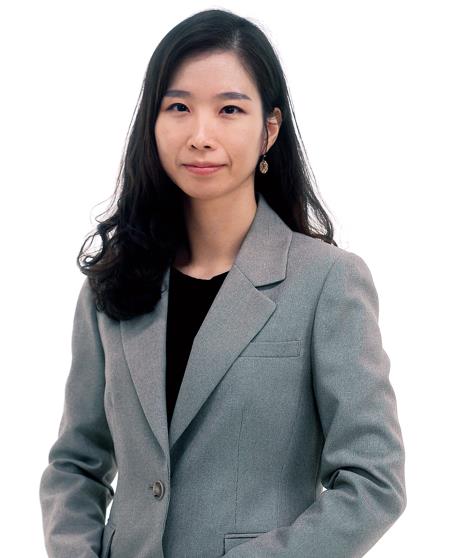
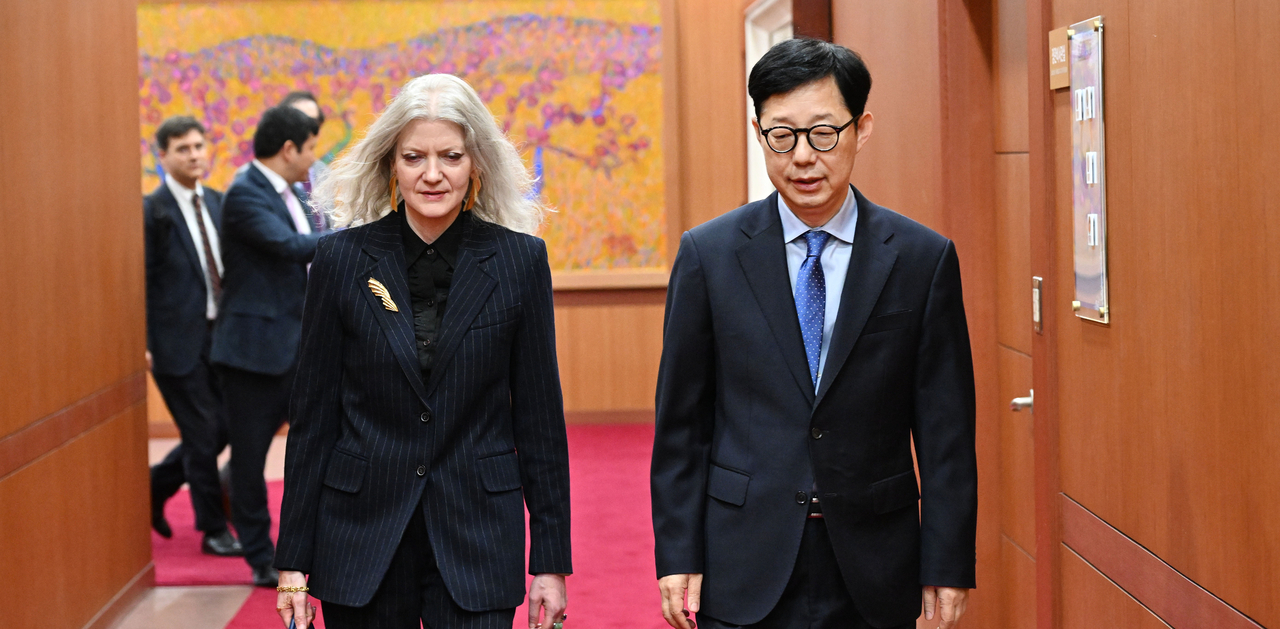
First Vice Foreign Minister Park Yoon-joo and US Undersecretary of State for Political Affairs Allison Hooker discussed follow-up measures to the joint fact sheet, coordination on North Korea policy and regional and global issues during their meeting Tuesday in Washington.
“The two vice ministers exchanged views on the recent developments on the Korean Peninsula, and agreed to continue close coordination and communication on North Korea policy, including denuclearization of the Korean Peninsula and bringing North Korea back to meaningful dialogue,” the Foreign Ministry in Seoul said in a statement.
“The two vice ministers also exchanged views on the situation in Ukraine and the US efforts to end the war,” the ministry added, referring to the US bid to terminate Russia’s war against Ukraine, including a 28-point US peace plan for Ukraine.
During the meeting, Park also underscored the importance of expeditiously implementing the South Korea-US joint fact sheet, which lays out comprehensive agreements on economic and security cooperation issued following the Gyeongju summit on Oct. 29.
Park called on Hooker “to make efforts so that concrete and visible outcomes can be produced through the operation of sector-specific working-level consultative bodies” to that end. In response, Hooker said she would "ensure the thorough implementation of the follow-up measures."
The meeting came one day after Park and US Deputy Secretary of State Christopher Landau agreed on the need to promptly launch sector-specific working-level consultative bodies to swiftly implement follow-up measures in key areas of the joint fact sheet.
In the joint fact sheet, the US gives the green light for South Korea’s civil uranium enrichment and spent fuel reprocessing for peaceful uses and stipulates approval for South Korea to pursue nuclear-powered attack submarines. South Korea is currently allowed to enrich uranium only below 20 percent with US consent under the existing nuclear cooperation agreement, revised in 2015, and is prohibited from reprocessing spent nuclear fuel in principle.
During the meeting, Park also asked Hooker to “continue urging the relevant US agencies to promptly complete the necessary steps” to implement the tariff agreements, including publication in the US Federal Register.
The Lee Jae Myung administration has called on the Trump administration to expedite the Federal Register publication of tariff reductions on automobiles and auto parts — including their retroactive application dated to Nov. 1 — so that the measures can formally take effect from the start of the month.
Seoul and Washington previously agreed that the tariff reduction would take effect retroactively from the first day of the month in which the bill was submitted to the National Assembly. To meet the condition, South Korea’s ruling Democratic Party of Korea introduced a special bill to implement its $350 billion US investment pledge on Nov. 26.
Park's meeting with Hooker — who played a central role in US-North Korea nuclear negotiations during the first Trump administration and is widely recognized for her expertise on North Korea — came just over 50 days after the Korea-US Strategic Dialogue in Seoul on Oct. 10.
dagyumji@heraldcorp.com