Dongduk Women’s University said Wednesday it will open its doors to men in 2029, a decision students have denounced as ignoring the continued need for women-only institutions in a country where gender bias still shapes women’s experiences.
The decision follows a recommendation from the school’s Coeducation Discussion Committee, which said Monday it had completed deliberations and concluded the university should transition to a coeducational model.
Despite the backlash, the university issued a statement Monday saying its president decided to "respect (the committee's recommendation) and accept it."
The announcement immediately drew backlash from students, who argued that the conclusion was based on surveys that failed to accurately reflect student opinion.
According to the committee, 75.8 percent of respondents in its main survey supported the transition, while 12.5 percent preferred to maintain the women-only status. Another 11.7 percent said the university should postpone the discussion.
Other surveys showed similar outcomes. A poll conducted during a town hall meeting found 57.1 percent in favor and 25.2 percent opposed. A separate survey of 7,055 people showed 51.8 percent supported coeducation and 33.2 percent opposed it.
All three surveys were conducted by sampling students, professors, employees and alumni in equal proportions. Citing the fact that more than two-thirds of respondents supported the change in the main survey, the committee said it decided to recommend the coeducation transition.
Students, however, said the methodology misrepresented them. The latest survey sampled 12 participants from each of four groups — students, employees, professors and alumni. Student representatives said this equal sampling ignored the fact that students make up the largest portion of the university community and would be most affected by such a major shift.
Following the university committee's recommendation, the student body said it would conduct its own survey of roughly 8,000 students and faculty to reflect their views more accurately.
“We realized that in the 2025 Korean university community, it is the school that has power and that students are in a position of relative weakness,” the university’s student body told local media.
“We repeatedly argued that the views of students, who make up the largest share of the university community, should be more fully reflected. However, the committee said the weighting was calculated not based on the total population but on a sample value, in order to 'respect the opinions of all members of the community.’”
Students argue for the continued necessity of women’s universities by pointing to their intrinsic value and to society’s perceptions of women.
They say that the original purpose of women’s universities — to provide a safe learning environment for women who historically faced social inequality and needed protection from discriminatory behavior by men — remains relevant today. With discriminatory attitudes and violence against women still pervasive, proponents add that women’s universities can serve not only as physically safe spaces, but also as places that offer psychological security and help students develop their identities.
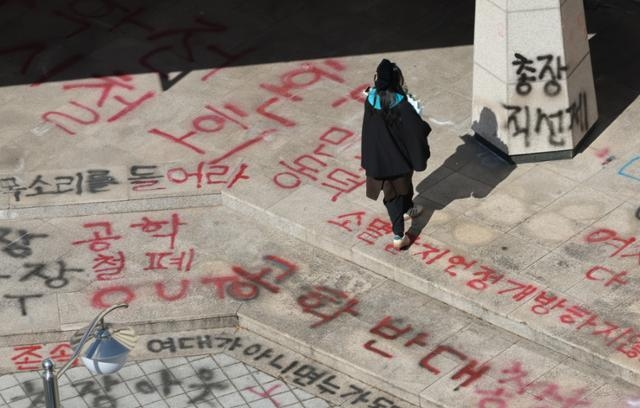
In November 2024, the campus saw mass protests after rumors circulated that the school was planning to adopt a coeducational system. Students boycotted classes and graffitied campus facilities, though the university later revealed the transition had never been included in its official agenda.
The student body and the administration remain deadlocked over who should be responsible for the resulting damages.
Women's colleges emerged in response to the exclusion of women at universities during the early 20th century.
In post-war Korea, they flourished as institutions that fostered female elites. However, shifting student preferences towards coeducational institutions in the 1990s, and the growing demographic crisis in the 21st century, have caused difficulties in student recruitment and fundraising.
"The university takes seriously the fact that many current students still express opposition and concern," said Dongduk Women's University President Kim Myeong-ae.
"For the past 115 years, through Dongduk’s founding philosophy of 'national development through women’s education,' the university has achieved significant progress in advancing women’s education," she added. "We now believe it is time to carry this founding philosophy forward in an evolving way and prepare for the next century in line with the changing times."
With the university's transition into coeducation, only six four-year women's universities will remain by 2029.
seungku99@heraldcorp.com