S. Korea could serve as a mediator in China-Japan conflict, Lee tells foreign media in news conference
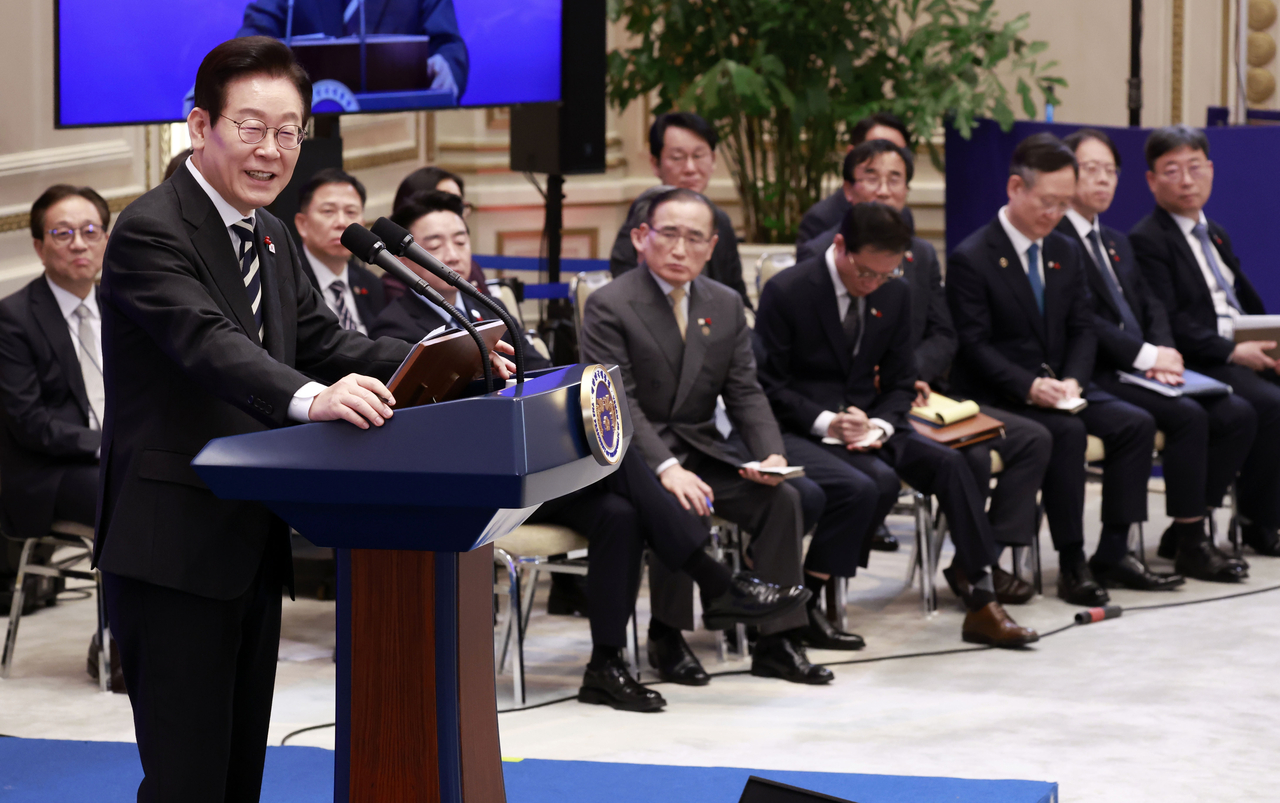
President Lee Jae Myung said Wednesday that his agreement with US President Donald Trump to allow South Korea to build nuclear-powered submarines was one of the most significant outcomes from months of negotiations on trade and security.
Speaking at a news conference with foreign media at Cheong Wa Dae on Wednesday, Lee emphasized that South Korea’s acquisition of nuclear submarines, as well as nuclear fuel reprocessing, would not constitute a violation of the Treaty on the Non-Proliferation of Nuclear Weapons.
He reiterated his administration’s position that greater nuclear fuel autonomy does not imply any sort of intention to develop or possess nuclear weapons, pointing out that neighboring Japan has similar nuclear fuel capabilities without such controversy.
Describing the US approval for South Korea to construct nuclear-powered submarines as “something South Korea has never been able to do before,” Lee said it was a “very remarkable outcome” given the strategic importance for stability in Northeast Asia and the added strategic flexibility for South Korea.
This comes as the joint fact sheet on the bilateral trade and security deal, unveiled in mid-November, confirmed US support for "the process that will lead to" South Korea's civilian uranium enrichment and spent fuel reprocessing for peaceful uses, as well as US approval to build nuclear-powered attack submarines.
Responding to Trump’s suggestion that South Korea’s nuclear-powered submarines should be built in US shipyards — made shortly after the deal was tentatively reached in late October — Lee said it would be “far from realistic.”
“We have no intention of deviating from the basic agreement between the two Koreas,” Lee said, adding that pursuing nuclear weapons at the cost of economic and international sanctions against South Korea “would be a foolish act.”
Regarding the location of uranium enrichment or spent fuel reprocessing — whether in South Korea or the US — Lee said it “will not be a major issue.” What matters more, he added, is “whether it could be done autonomously or not.”
On the topic of South Korea’s role amid escalating tensions between China and Japan - in the wake of Japanese Prime Minister Sanae Takaichi's remarks implying Japan's military intervention in case of a Taiwan contingency - Lee suggested that South Korea could position itself as a mediator between its two East Asian neighbors.
“Rather than taking sides, we should seek ways for everyone to coexist peacefully," Lee said. "If there are areas where (South Korea) can help minimize conflict, through mediation or coordination, I believe it would be more appropriate for us to play that role.”
Concerning his relationship with Chinese President Xi Jinping, Lee said, "Diplomatic relations with China had been very unstable up until now, but this has given way to a more stable situation so that we can advance diplomatic relations in future-oriented directions.”
Lee, however, played down the possibility of a follow-up summit with Xi before the end of this year. Lee and Xi first held a summit on Nov. 1 during Asia-Pacific Economic Cooperation gatherings in Gyeongju, North Gyeongsang Province.
As for Seoul's ties with Tokyo, Lee said the future-oriented ties could further develop, by separately handling disputes over historical issues and cooperation in cultural, societal and economic areas.
"I believe we don't need to link (thorny) issues to everything else and give up on other areas," Lee said.
Lee did not specify dates for the possible meeting with Takaichi in Japan, but said their frequent reciprocal visits would continue.
The press conference also covered Lee’s position on the strengthening ties between North Korea and Russia.
Lee who has long held a conciliatory stance on North Korea, said the growing North Korea-Russia relationship “has been progressing in a very undesirable way from our perspective.”
Asked whether direct communication with Russian President Vladimir Putin could help ease global geopolitical tensions, Lee responded that chances for that were “very narrow.”
Regarding ways to resolve the gridlock in inter-Korean relations, Lee said creating and maintaining an atmosphere for dialogue between Washington and Pyongyang would be key.
"Continuously creating the right environment as a mediator and facilitator is the path forward," Lee said, adding that managing Panmunjom on the border between the two Koreas and adjusting joint South Korea-US military drills could contribute to opening the doors to the dialogue.
When questioned about whether he intended to issue an apology to North Korea for covert operations carried out during the administration of his disgraced predecessor, Yoon Suk Yeol, Lee said he has considered the matter, but political considerations have held him back.
“I think that an apology should be made, but at the same time (an apology) could become a topic of ideological conflict, the so-called 'pro-North' framing, so I have not been able to bring myself to raise the issue,” Lee said, adding that he would not say more on the matter.
consnow@heraldcorp.com