President Lee Jae Myung reaffirmed South Korea’s willingness to play a proactive "pacemaker" role in facilitating dialogue between the United States and North Korea, despite current deadlock in inter-Korean relations.
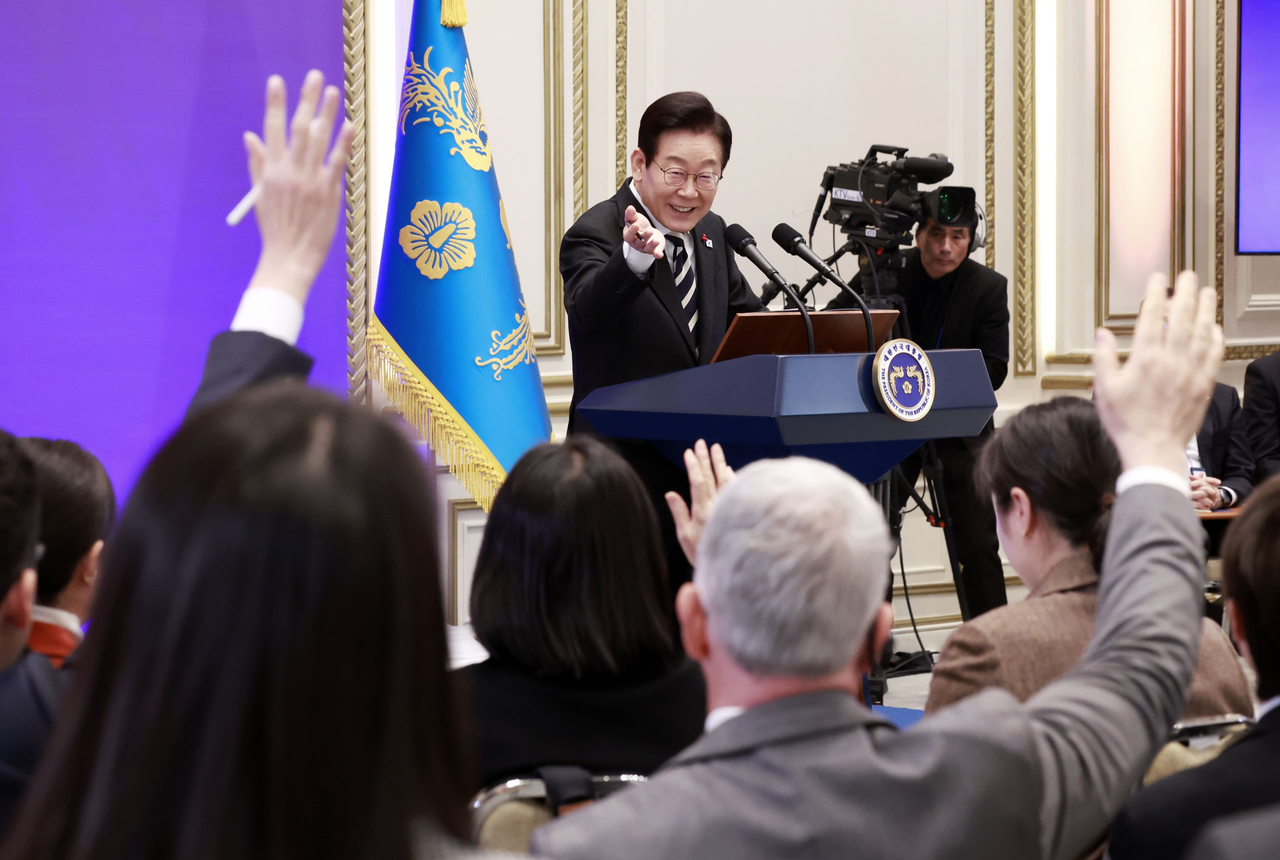
Speaking to reporters, Lee acknowledged that all communication channels with the North are severed, leaving Seoul limited to taking unilateral goodwill measures, such as halting propaganda broadcasts and minimizing military activities.
Lee emphasized that the US—as the legal party to the armistice and the only actor Pyongyang considers capable of guaranteeing regime security—remains central to any breakthrough. However, he insisted that South Korea, as a direct stakeholder, cannot remain passive.
“We will do everything possible to support US–North Korea talks,” Lee said, citing the symbolic management of Panmunjom and vocal public support as ways to create favorable conditions.
Q. You mentioned that you would play the role of a pacemaker for US President Donald Trump.
A pacemaker isn't just a bystander—it runs ahead in the race and leads the runner who will eventually win, doesn’t it?
What specific role do you, or South Korea as a nation, believe you can play as a pacemaker in relation to North Korea? Also, on what basis do you think such a role is possible?
A. The current relationship between South Korea and North Korea is so closed off , not so much as the eye of the needle.
Not only has dialogue been completely cut off, but all communication channels—including even emergency hotlines—have been severed.
And although the time frame has been short, North Korea has entirely rejected all our efforts to engage.
The only thing we can do is take unilateral conciliatory actions.
For example, as you may know, we can suspend anti-North Korea loudspeaker broadcasts, halt shortwave radio transmissions, and minimize military activities that could be misinterpreted.
In addition, we can continue to send proactive and conciliatory gestures toward the North.
On the other hand, the US has many options. And as you are aware, the Korean Peninsula remains under a ceasefire—not a peace treaty—even after more than 70 years.
The legal party to the armistice agreement is the US.
The South Korean government was not a signatory to the agreement—likely because operational wartime command had been transferred to the US military at the time.
The situation is not so different now.
North Korea sees regime preservation as its most critical goal, and it believes the US— not South Korea—is the key player capable of guaranteeing that.
But in reality, the direct stakeholders in the situation on the Korean Peninsula are South and North Korea, unfortunately.
So we can't just stand by and do nothing.
President Trump has a strong will for peace, and he also holds a position where he can play a significant role.
That’s why I want to emphasize that communication, cooperation, and negotiation between North Korea and the US should not be hindered because of South Korea’s position.
We will do our best to support the necessary conditions for North Korea– US dialogue in every way we can.
If you ask for specifics, managing Panmunjom well could be one such role.
Even just expressing our position in a transparent and public manner can help create objective conditions for dialogue.
Because sometimes the idea of communicating with the US, cutting out the South becomes a stumbling block.
I’m saying: don’t let that happen.
Improvement in North Korea– US relations—especially if it comes first—can greatly help resolve or ease tensions on the Korean Peninsula. That’s my assessment.
At the recent APEC summit, President Trump wanted and hoped to meet with Chairman Kim Jong Un, but unfortunately, it didn’t happen.
But circumstances are always changing.
We will continue to do everything we can to create objective conditions that allow for communication and cooperation at any time.
Even the issue of joint South Korea– US military drills could be a part of that.
If creating a conducive atmosphere for dialogue requires adjustments, and if the USn eeds strategic leverage, then we should be open to serious discussion about such matters.
That, I believe, would help the US open the door to negotiation or dialogue with North Korea.
Continuously creating the right environment—as a mediator and facilitator—is the path forward.
And ultimately, I believe this is how we, as the main party on the Korean Peninsula, take charge of resolving the issue ourselves.
khnews@heraldcorp.com