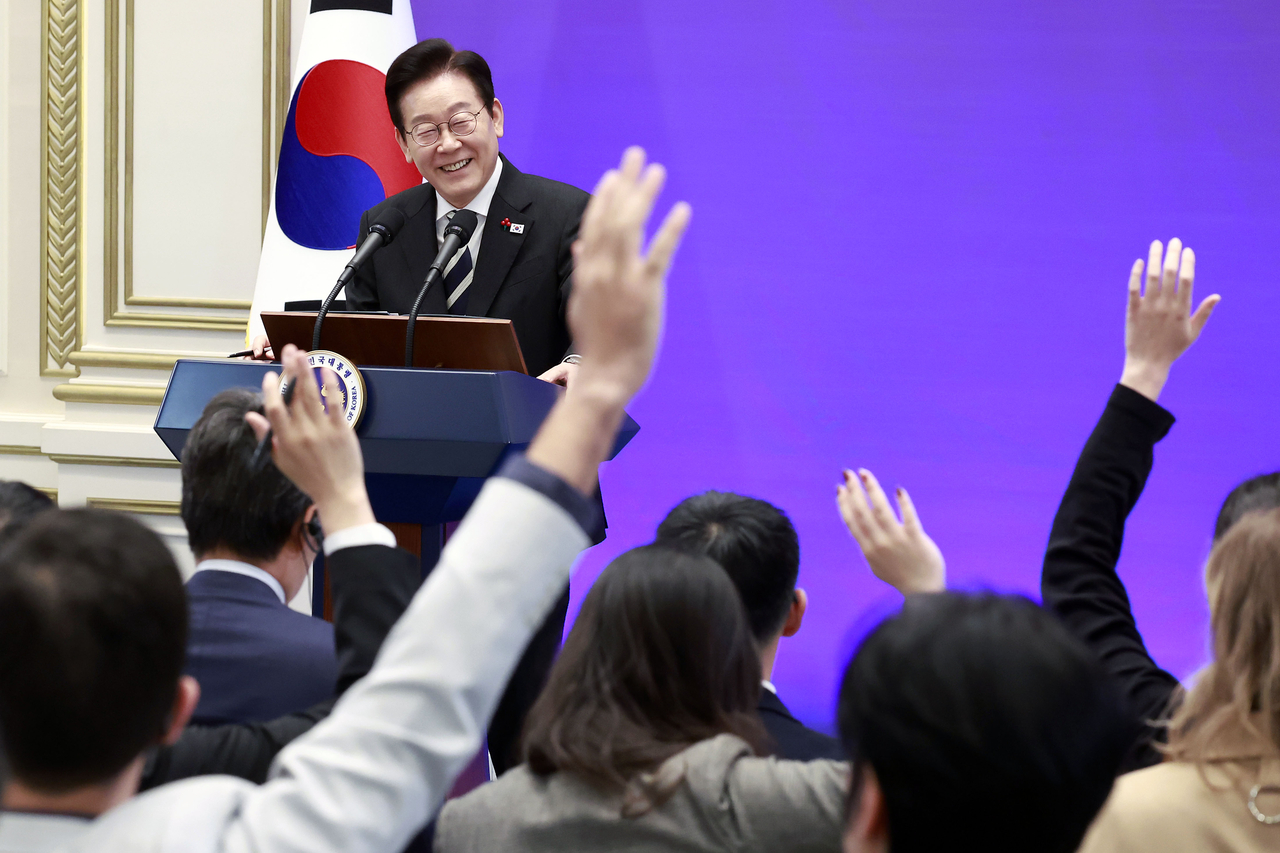
President Lee Jae Myung on Wednesday said he lacks specific information on South Korean nationals detained in North Korea — a remark that raised questions about his administration’s willingness to address the issue.
During a press conference with foreign media, Lee was asked whether his government plans to pursue the release of South Koreans held in the North, Lee avoided giving a direct answer. Instead, he turned to Wi Sung-lac, head of the presidential National Security Office, asking him to respond.
Wi confirmed the reporter’s premise that around 10 South Koreans are believed to be in North Korean custody — including four individuals sentenced to “reform through labor” in 2014 and 2015, and three others whose identities have not been disclosed.
A sentence of “reform through labor” refers to a system of forced labor and political re-education typically imposed for serious offenses in the North. North Korea is believed to operate nine such facilities.
“There are cases where they entered and could not leave, or where they were taken under circumstances not fully known to us,” Wi said.
Wi added that more details still needed verification. Lee then reiterated that he has no intelligence on when the detainees were apprehended or whether the incidents occurred in recent years.
The reporter noted that the information has appeared multiple times in reports by North Korea’s state-run Korean Central News Agency, which, he said, had previously reported that four South Koreans were arrested on espionage charges and that two North Korean defectors were captured in 2016 or 2017 and repatriated to Pyongyang.
Lee wrapped up the exchange by saying he lacked "case-specific intelligence,” describing the incidents as “too long ago.” He added, “We will look more closely into the situation and make a judgment.”
The exchange drew attention because Lee’s political record — both as president and as former leader of the Democratic Party of Korea — includes a focus on North Korea-related matters, albeit primarily aimed at restoring inter-Korean ties. A day earlier, Lee called on North Korea to restore inter-Korean communication channels, reaffirming his commitment to advancing the path toward unification.
Nor is this the first time he has dealt with matters involving South Korean abductees in the North since taking office.
On June 16, shortly after taking office on June 4, Lee met with mothers of South Koreans abducted by North Korea. During the meeting, the families appealed for the new administration’s support, while Lee asked them to refrain from using balloons to send anti-North propaganda across the DMZ.
While South Korea’s liberal administrations — including Lee’s and the former Moon Jae-in government, both of which emphasized engagement with Pyongyang — have taken an active stance on improving inter-Korean ties, conservative governments have traditionally been more proactive on issues involving abductions and human rights conditions in the North.
In 2024, former President Yoon Suk Yeol attended a Cabinet meeting wearing a forget-me-not badge — a symbol in South Korea used to remember abductees, detainees and prisoners of war held in the North. At the meeting, Yoon stressed, “The South Korean government will continue to condemn North Korea’s illegal and inhumane actions and will persistently call for the return of our citizens.”
flylikekite@heraldcorp.com