A senior South Korean diplomat has told US think tank officials that Seoul's efforts to secure rights to enrich uranium and reprocess spent nuclear fuel for peaceful purposes have nothing to do with nuclear proliferation, the foreign ministry said Wednesday.
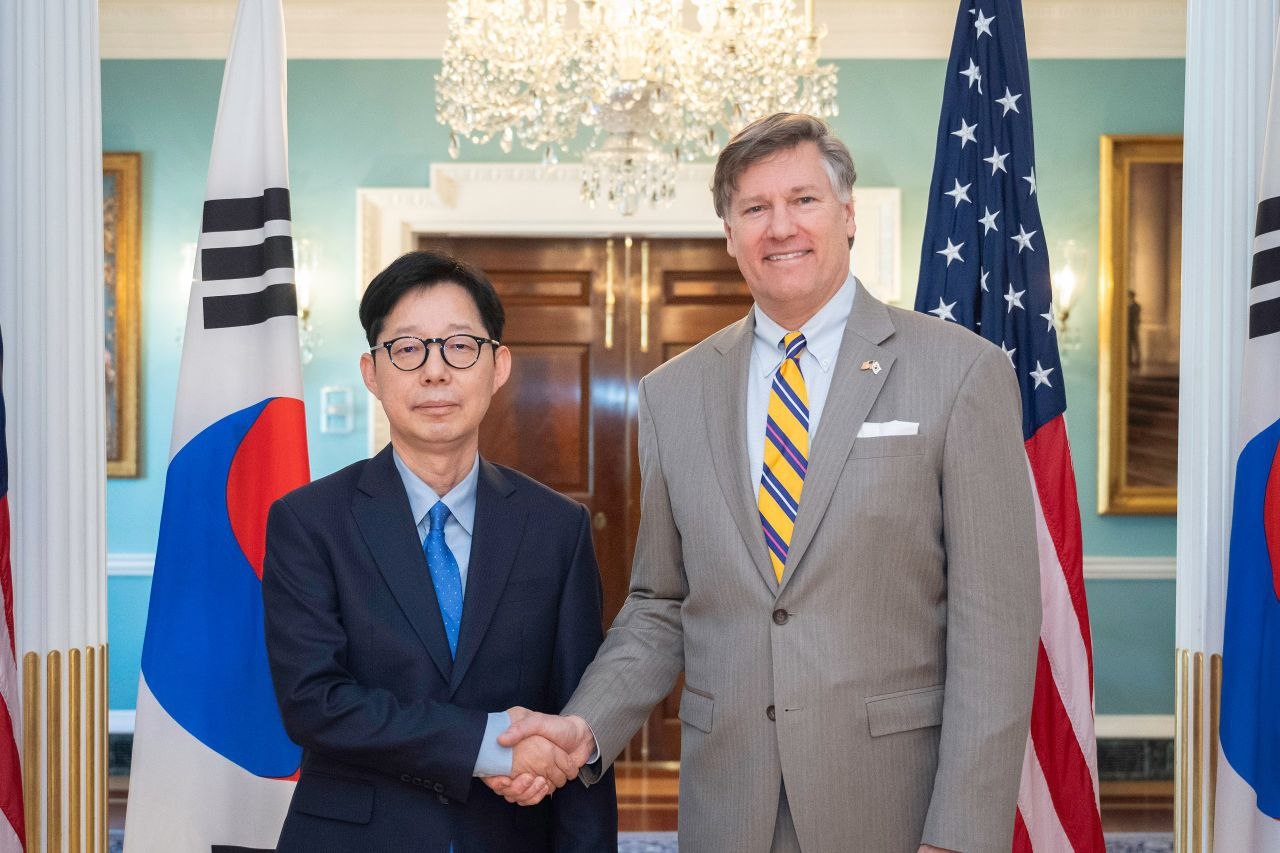
First Vice Foreign Minister Park Yoon-joo made the remarks during his visit to Washington this week, underscoring Seoul's "firm" will to abide by international nonproliferation norms related to civil nuclear energy cooperation, it said.
Released on Nov. 13, a joint fact sheet on bilateral security and trade agreements included US President Donald Trump's administration's support for the process that will lead to Korea's civil uranium enrichment and spent fuel reprocessing for peaceful uses.
Currently, South Korea is effectively barred from enriching uranium under a bilateral nuclear energy cooperation pact with the United States. The pact also bans the reprocessing of spent nuclear fuel.
"(Park) explained that for South Korea, a country that relies on nuclear power plants for a considerable portion of its entire electricity (generation), enrichment and reprocessing of nuclear fuel are necessary, and that it has nothing to do with nuclear proliferation," the ministry said in a press release.
During his stay in the US capital, he met with Derrick Morgan, executive vice president of the Heritage Foundation and Randall Schriver, chairman of the Board of the Institute for Indo-Pacific Security.
Morgan and Schriver assessed South Korea as a model ally that complies with the terms of the Non-Proliferation Treaty, and pointed out that they do not have any suspicions about South Korea's commitment to abiding by nonproliferation norms, according to the ministry.
Currently, South Korea is effectively barred from uranium enrichment under a bilateral nuclear energy agreement with the US The pact also bans South Korea's reprocessing of spent nuclear fuel.
During the meetings with the think tank officials, Park said that the fact sheet provided a foundation for the bilateral alliance to expand to cover cutting-edge technologies beyond security and economics, while asking for their support for follow-up efforts to implement agreements outlined in the document.
Morgan said that US support for South Korea is "bipartisan," and that following two summits between South Korean President Lee Jae Myung and Trump in August and October, Korea's status as a major investor in the US, a world-class shipbuilder and major partner in nuclear energy has further solidified, according to the ministry.
Positively assessing the fact sheet, Schriver pledged to support efforts toward concrete progress in bilateral strategic cooperation areas included in the document, the ministry said.
Moreover, Park asked for Morgan's interest and support for Seoul's efforts to build support in the US for bilateral shipbuilding cooperation, as well as Seoul's efforts to build nuclear-powered submarines and address visa issues affecting South Korean workers. (Yonhap)