OpenAI Korea is accelerating efforts to establish a next-generation AI infrastructure in Korea through its “Stargate Project,” partnering with Samsung Group and SK Group to position the country as a critical node in the global AI supply chain, the company said Thursday.
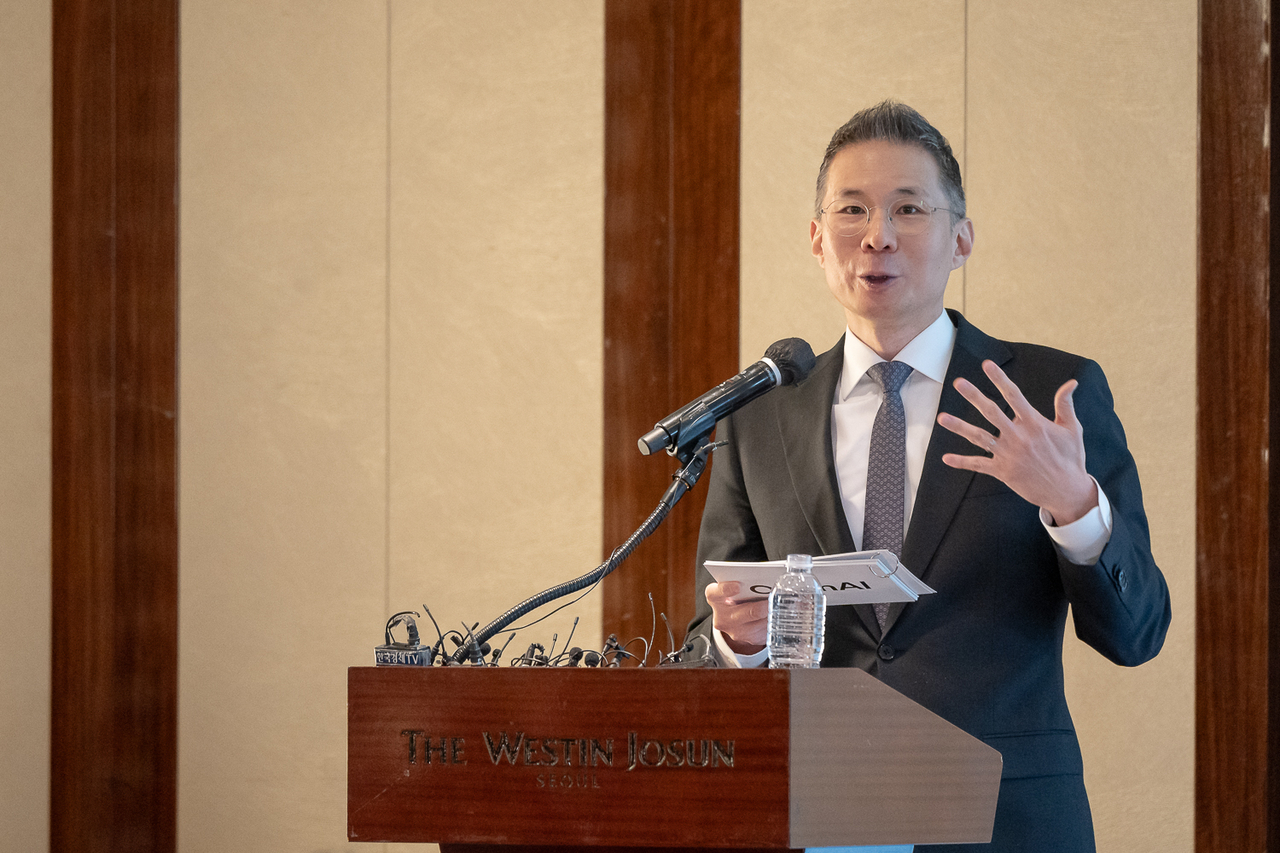
At his first press briefing since taking office in September, Kim Kyoung-hoon, general manager of OpenAI Korea, outlined the initiative as a major push to rapidly expand Korea’s AI ecosystem.
“In Korea, we are advancing the Stargate project alongside key partners Samsung and SK,” Kim said in Seoul. “This week, the global Stargate team visited Korea to meet with both companies.”
Kim emphasized that OpenAI, despite its global visibility, remains a small organization with fewer than 400 employees. “We are not yet a big tech company,” he said. “With limited internal resources, partnerships with global leaders like Oracle and SoftBank are essential to building large-scale AI infrastructure.”
Investment amounts for the Stargate project with Samsung and SK remain under discussion. Kim noted the company will not pursue large-scale investment alone, instead opting for joint development and co-funding with Korean partners.
OpenAI has cited Korea’s strong semiconductor capabilities, digital infrastructure and software talent as key advantages in hosting hyperscale AI facilities.
In October, OpenAI CEO Sam Altman met with Samsung Electronics Chair Lee Jae-yong, signing a letter of intent to pursue cooperation in building global AI infrastructure. Samsung has committed to leveraging its subsidiaries — ranging from semiconductors and cloud services to marine engineering — to bolster the Stargate initiative.
Samsung Electronics will provide high-performance, energy-efficient memory for the project, while Samsung SDS will oversee data-center design and operations. Samsung C&T and Samsung Heavy Industries are expected to contribute offshore floating data-center solutions to the planned data center in Pohang, North Gyeongsang Province.
“Offshore data centers are still in the early stage, and we are conducting technical studies,” Kim said. “We will define specific functions after construction, given fast-changing AI compute demand.”
OpenAI’s partnership with SK Group includes memory and infrastructure development. SK hynix has signed a letter of intent to supply high-bandwidth memory and secure production capacity of up to 900,000 units per month — nearly double the current global output. SK Telecom is also working with OpenAI to establish a dedicated AI data center in Korea’s southwest region.
“Time is of the essence,” Kim said. “We are evaluating sites and exploring ways to accelerate timelines.”
Kim stressed that regulatory support from the Korean government will be crucial. “We are not ready to announce milestones yet, but we are working quickly,” he said.
yeeun@heraldcorp.com