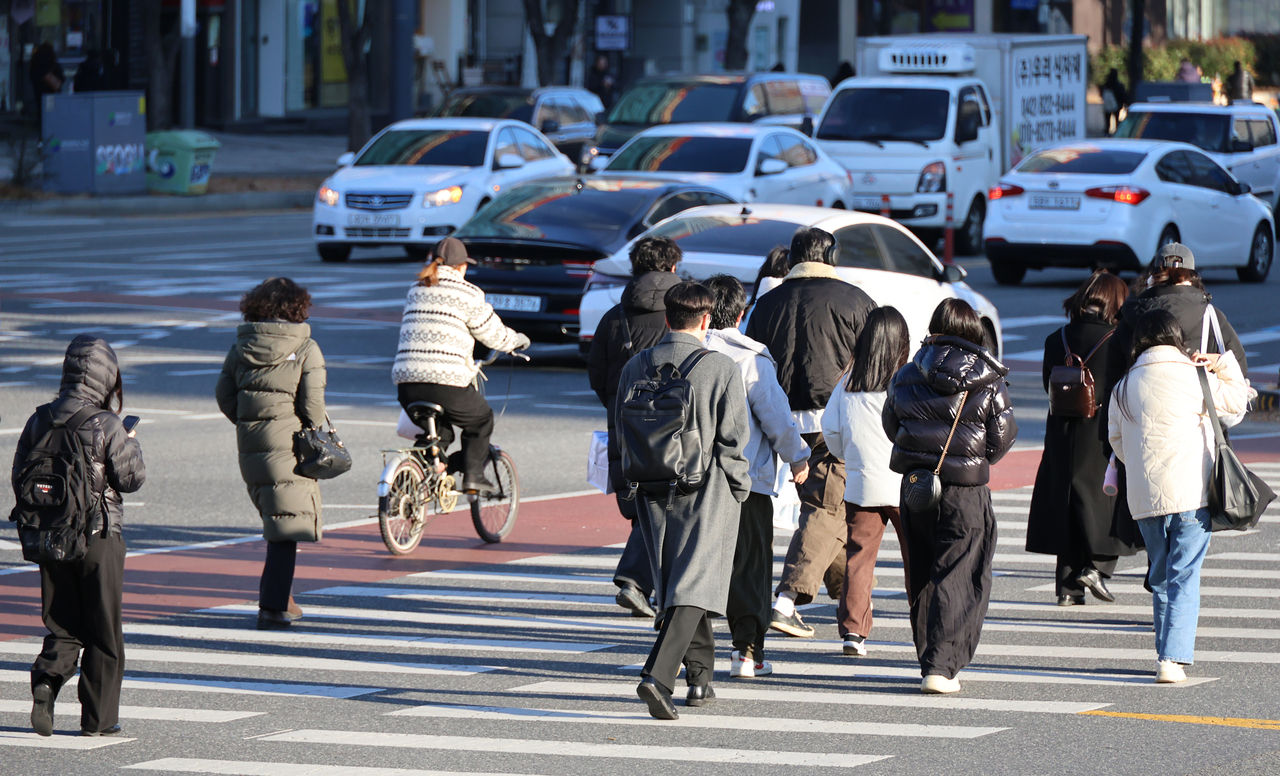
Temperatures dropped sharply across South Korea on Wednesday as a mass of Arctic air moved south, triggering cold wave advisories for Seoul, Gyeonggi Province and parts of Gangwon Province and the Chungcheong provinces, according to the Korea Meteorological Administration.
Morning lows ranged from minus 11 degrees Celsius to minus 1 C nationwide, with even colder conditions forecast through Friday. A cold wave advisory is issued when morning temperatures are expected to remain below minus 1 C for at least two consecutive days or when a rapid temperature drop is likely to cause damage.
Seoul is expected to see even lower temperatures Thursday morning and could record its first snowfall of the winter later in the day, forecasters said.
Heavy snow warnings were issued early Wednesday for coastal areas of Chungcheong and Jeolla provinces and parts of Jeju Island, where snow is expected to intensify overnight and again on Friday. The KMA projected snow accumulations of 3 to 8 centimeters along the west coast and 1 to 5 centimeters inland, with 3 to 10 centimeters possible on Jeju Island.
The cold snap is being driven by air colder than minus 35 C descending from the north, sending temperatures tumbling by 5 to 10 C from the previous day. Wind gusts reaching 70 kilometers per hour are expected in many areas, pushing felt temperatures even lower.
From Thursday afternoon, an upper-level trough passing over North Korea is expected to bring additional snow to central regions.
About 1 centimeter is forecast for Seoul, Incheon and western Gyeonggi Province, with 1 to 5 centimeters likely in eastern Gyeonggi and Gangwon Province’s Yeongseo region. Depending on local temperature shifts, some areas may see a mix of rain and snow.
The cold is expected to ease gradually from Thursday afternoon, but chilly conditions will persist through Friday. Temperatures are forecast to rebound over the weekend, rising to about 3 C above seasonal norms.
minsikyoon@heraldcorp.com