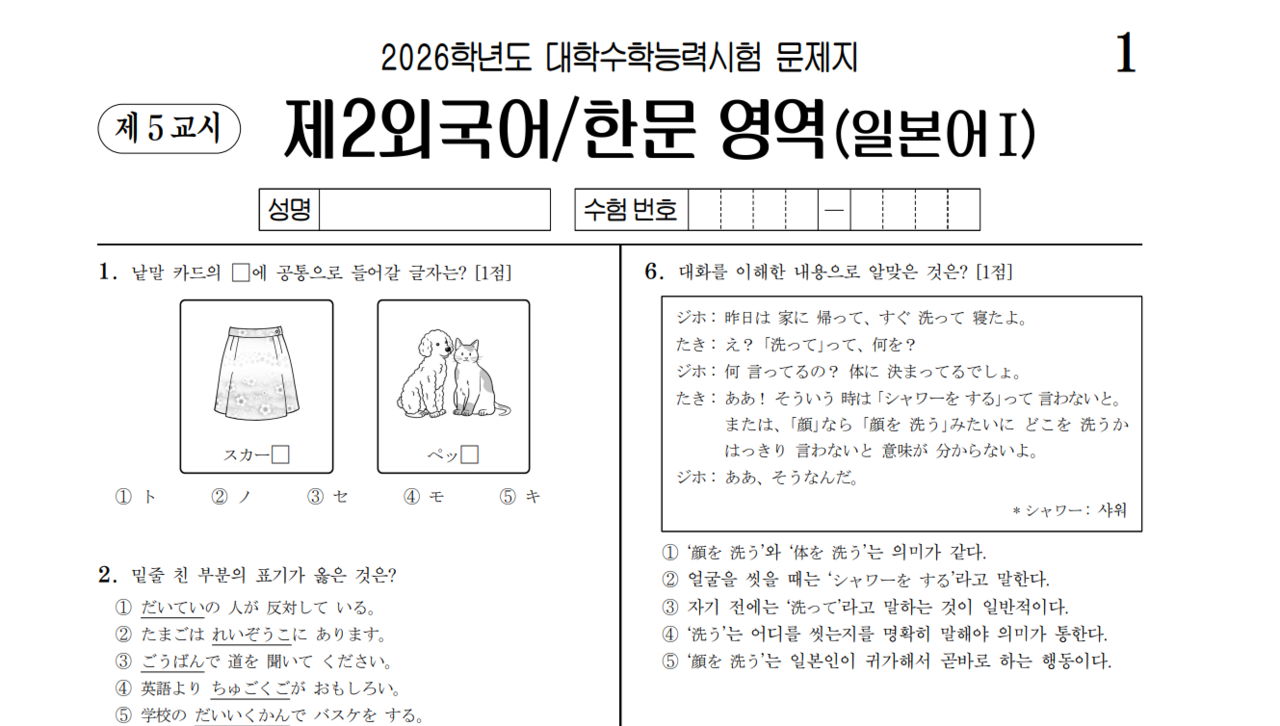
Japanese and Hanmun — classical Chinese characters used in premodern Korean texts — remained the most popular second foreign language electives on this year’s College Scholastic Ability Test, or Suneung, with overall preferences showing little change from previous years.
According to data released Thursday by the Ministry of Education, about 50,000 students, or roughly 10 percent of all test-takers, chose to sit for a second foreign language on the Nov. 14 exam, with the English section mandatory for all test-takers.
Japanese drew the largest number of participants among the elective languages, with 15,714 students selecting the subject. Hanmun followed with 13,255 test-takers, while 7,036 opted for Mandarin Chinese.
Spanish (4,073) and Arabic (3,985) saw moderate interest, while French (2,679) and German (2,309) attracted smaller cohorts.
Russian (602) and Vietnamese (491) were the least selected electives. The distribution was nearly identical to last year’s exam.
Japanese, Hanmun and Mandarin consistently rank among the most popular options, partly because they are more widely offered in Korean high schools. Arabic previously saw a surge in the late 2000s, boosted by rumors that a student, who had guessed on all the questions, emerged with the highest score.
As a relative grading system was in place at the time, some believed choosing a less widely taught language, like Arabic, could improve one’s standing on the curve.
However, overall participation in elective foreign languages has declined steadily in recent years. The drop follows the shift to an absolute grading system in 2022, which replaced the curve and removed what many students saw as a potential strategic payoff.
The change also prompted universities to end a long-standing exemption that allowed students who took a second foreign language to skip one social studies subject. Schools said it was no longer possible to guarantee comparable levels of competitiveness between the two sections.
As a result, Seoul National University remains as the only major institution whose humanities majors require applicants to submit a foreign language score.
Meanwhile, the Education Ministry data also showed that this year's Suneung saw a larger turnout than last year, with 493,896 students taking the exam. Only five obtained a perfect score.
seungku99@heraldcorp.com