A sweeping review of government departments to identify areas of cooperation with last year's martial law declaration has already begun to disrupt their work, civil servants say, as the vague terms of the probe leave many uncertain over their future.
The review, launched Nov. 21 by a task force under Prime Minister Kim Min-seok, spans 49 ministries and agencies — including the military, prosecution and police — with its assessment due Jan. 31 and personnel actions due by Feb. 21.
But civil servants say the powers granted to investigators are an invasion of privacy, and have had a chilling effect on departmental communication as fears of a purge grow. Personnel decisions have also been affected, they say.
A lack of clarity over the scope of the probe has added to the unease, with the government giving mixed messages. It says the goal is to restore constitutional order after then-President Yoon Suk Yeol's martial law declaration on Dec. 3, 2024, and emphasized a thorough review. But at the same time it has pledged a limited scope and leniency for those who cooperate with the probe.
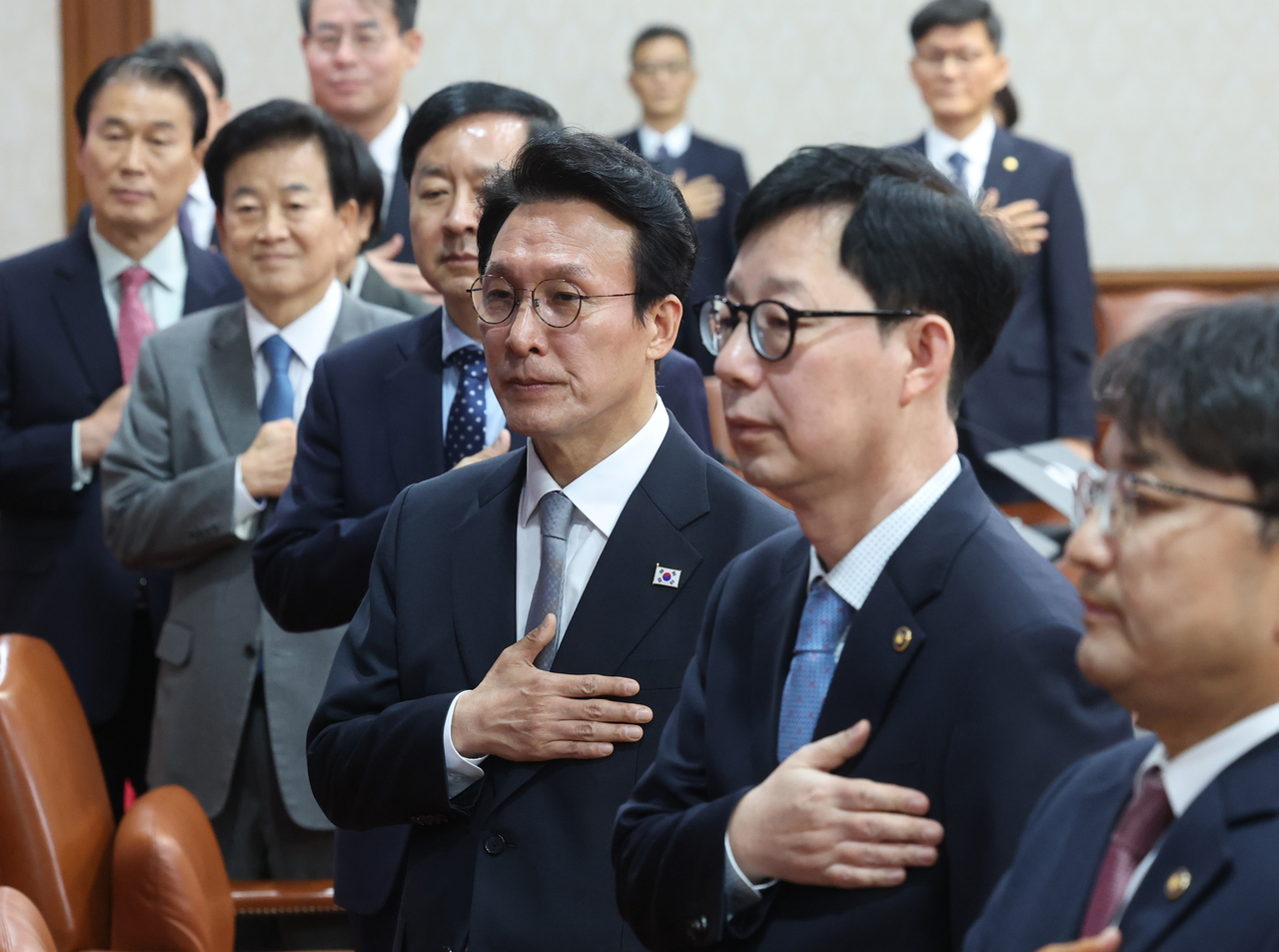
During Tuesday's Cabinet meeting, President Lee Jae Myung stressed that the goal of the task force is not to "approach it in an extreme or harsh way," and called for leniency for those who report their part in the martial law voluntarily.
"There are probably quite a few cases where people didn’t act out of personal conviction, but rather carried out their roles according to the system. So for those who report voluntarily, the policy should be to reduce their responsibility," Lee said.
But these reassurances have not stopped concern spreading within the civil service, where critics of the review point out that the criteria for “cooperation” with martial law remain so unclear that it could include even routine duties.
Victim or accomplice?
Many officials who served during the crisis argue that the debate overlooks the reality that working-level staff had little room to refuse directives during the rapid escalation on the night of Dec. 3.
“People now call it an attempted insurrection and say it was obviously wrong, but in that moment it wasn’t that easy,” a government official said on condition of anonymity.
“When an order comes down directly from the sitting president, who on the ground can realistically refuse it?”
The official requested that the ministry involved not be identified, citing concerns about potential repercussions.
Ironically, the government has also acknowledged this difficulty.
On Nov. 25, the Ministry of Personnel Management highlighted legal provisions that required officials to follow orders even when they were improper or unlawful, saying it planned to abolish them.
The government’s approach has prompted speculation that the review may be intended to remove personnel aligned with the previous administration. In November, the Lee Jae Myung government carried out an extensive military reshuffle, replacing key general-level officers across major operational commands, including the Joint Chiefs of Staff.
A different official familiar with the reshuffle said the breadth of the changes has unsettled senior ranks.
“When an entire tier of leadership is replaced at once, people inevitably wonder whether this is accountability or a move to align the leadership with the preferences of those in power,” the official said.
Shin Yul, a political science professor at Myongji University, emphasized that any attempt to restore constitutional order must rest on transparent legal standards — otherwise the review risks undermining the legitimacy it seeks to reinforce.
“The standards the government is presenting are subjective,” he said. “If the constitutional order collapsed through unlawful orders, restoring it must be done through a clear and legitimate legal process.”
Privacy issues and impact on government operations
Another source of concern is the scope of digital access granted to investigators. Officials say having call logs, messenger records and computer files examined feels overly broad — even if this is limited to what the government describes as “cases with grounds.”
Discomfort has grown further as ministries ask employees to “voluntarily” submit their personal mobile phones if suspicions arise.
“Even if you’ve done nothing wrong, the idea that your private conversations can be inspected is unsettling,” said another government official who has worked in the civil service since 2018.
The official also said civil servants were increasingly wary of the government’s “Dec. 3 Reporting Center,” which encourages staff to report colleagues suspected of cooperation. Such a system, the official argued, could trigger baseless accusations rooted in rivalry or personal conflicts.
“Being named in a report — even by mistake — leaves a mark,” the official said, adding that internal conversations have already become more restrained. “The current atmosphere naturally makes cooperation inside the office harder as everyone focuses on self-preservation.”
The main opposition People Power Party has capitalized on the discontent, branding the task force an unconstitutional “loyalty test.” Party leaders have likened it to the liberal Moon Jae-in administration’s campaigns targeting officials from the preceding Park Geun-hye government.
The opposition party has launched its own “public-servant surveillance reporting center,” accusing the government of coercively reviewing civil servants’ personal computers and mobile phones.
During a caucus meeting at the National Assembly last month, People Power Party floor leader Rep. Song Eon-seog said, “The task force is effectively a plan to inspect the personal computers and phones of 1 million civil servants. How can a democratic country justify reviewing tens of millions of call records?”
He went on to call the Lee administration and the ruling Democratic Party “the true insurrectionary forces,” arguing that they had “trampled on the country — not with guns, but through abuses of power, external pressure and the misuse of legislative authority over the past year.”
Across ministries, the review has also begun to slow routine administrative work. The Foreign Ministry has been the most affected, with bureau-level appointments on ice alongside overseas ambassadorial postings.
These appointments are typically finalized by late November, but amid the ongoing review there is currently no schedule for when either set of appointments will proceed.
At the same time, the ministry has seen a series of unusually early promotions — widely seen inside the ministry as an attempt to install a younger cohort of officials.
Professor Shin said these abnormal personnel shifts and delays — widely seen as influenced by the task force — already signal a slowdown in administrative processes, creating an environment in which officials inevitably become more cautious than functional.
“When posts remain vacant, coordination with partner countries slows as well,” he said. “The ministry’s ability to respond in real time inevitably narrows.”
“If this continues, working-level officials will spend more time watching political winds than on actual policy work,” he added. “Once hesitation takes hold, the administration slows down with them.”
flylikekite@heraldcorp.com