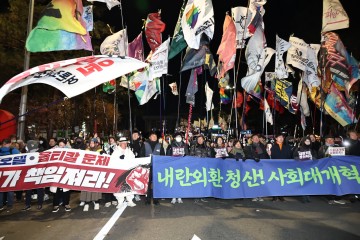
Exactly a year ago, South Korea confronted a constitutional disaster. A sitting president attempted a self-coup that could have resulted in violent confrontation or authoritarian consolidation.
Instead, South Korea overcame the crisis with extraordinary efficiency and civic maturity. Within 12 months, the country restored constitutional governance, elected a new president and stabilized national systems without falling into either bloodshed or total chaos. Such an achievement deserves recognition for refusing to let fear or anger decide its fate and consolation for enduring the long and difficult days of overcoming.
The most remarkable feature of the past year is that the political transition unfolded peacefully.
The suppression of the attempted coup, the Constitutional Court’s impeachment ruling, criminal investigations and the election of a new president all proceeded according to democratic principles and procedures. South Korea did not rely on emergency rule, martial law or mass repression. The country preserved the integrity of its institutions while making necessary decisions with speed and clarity. The absence of civilian casualties during such an extreme crisis is not accidental. It reflects a society that, even during its most anxious hours, understood that democracy is not only a system of rules, but a habit of restraint.
Economically, the country also faced great danger.
Political crises often trigger capital flight, currency collapse and steep declines in confidence. But South Korea avoided these outcomes.
The coup attempt was suppressed rapidly, allowing both government and markets to return to a state of equilibrium. Moreover, the economy confronted another shock, a sudden wave of punitive tariffs imposed by US President Donald Trump. These measures threatened South Korea’s export-driven sectors during the political crisis. Yet, the new administration reacted swiftly, mobilizing diplomatic shrewdness, corporate coordination and economic policy tools to minimize losses.
The social dimension may be the most surprising.
Historically, constitutional crises deepen polarization, fuel extremism and lead to political violence. That risk was present in South Korea as well.
Some conspiracy-driven groups, fringe religious organizations and far-right factions attempted to provoke unrest, and there were attempts to promote the return of the deposed president. Yet, these movements failed to resonate with the broader public. Rather than becoming trapped in a destructive struggle over the undisputed insurrection, Korean society moved toward consensus on restoring stability. Even though ordinary people had to endure moments of displeasure, anger, fear and anxiety during that period, they quietly remained in their routines refusing to surrender to violence or chaos.
The election of President Lee Jae Myung in June symbolized this shift. Winning approximately half of the vote in a polarized environment, he is now enjoying approval ratings above 55 percent.
In a highly polarized society, these figures indicate that political fragmentation may be easing. This stabilization did not happen automatically. It was enabled by a public that refused to accept perpetual conflict as a governing model and instead prioritized recovery. Koreans deserve credit for this.
In many cases, a failed coup results in a cycle of revenge, ideological purges or repression. South Korea did not travel that path. The state defended constitutional order and society moved on without indulging in authoritarian instincts. That maturity, restraint and sense of responsibility should be acknowledged. It is not a triumph of ideology, but of character, a form of collective wisdom earned through hardship.
However, recognition must not turn into complacency.
The Dec. 3 anniversary should not be a celebration of triumph, but a moment of reflection. Legal accountability for coup leaders remains incomplete. Institutional vulnerabilities remain unresolved. Serious questions persist regarding why ministers, military commanders, police leaders and intelligence officials failed to prevent an embarrassing assault on the constitutional order. Investigations must continue, not as acts of revenge, but as necessary steps to ensure that such a crisis never occurs again. The future cannot be built on unfinished business.
South Korea must shift from emergency response to structural reform. The crisis demonstrated that the country possesses substantial institutional capacity and civic strength; the challenge now is to convert that capacity into long-term development. Politically, South Korea must confront its greatest obstacle: polarization.
A democracy cannot thrive if political actors prioritize attacking opponents over presenting policies. Opinion leaders must lead efforts to cultivate norms that reward constructive engagement rather than performative hostility. The country needs not just better policies, but a more sophisticated political culture.
Economically, South Korea must take advantage of the postcrisis moment to upgrade its structural competitiveness. Reducing the risks associated with currency volatility, expanding transparency in finance and investing in science and technology are essential steps. A country cannot lead in advanced industries without top-tier human capital. Attracting talent to biology, chemistry, physics, mathematics and engineering will require substantial incentives, not merely rhetoric. If South Korea wants to remain competitive in a world reshaped by artificial intelligence, robotics, biotech and clean energy, it must adopt a long-term perspective on innovation.
Socially, the country must build an environment that encourages creativity. Innovation is not merely a technological phenomenon but a human one. Societies that value diversity, tolerance and empathy tend to generate more original ideas.
South Korea’s trajectory toward becoming a cultural powerhouse reflects this potential, but further progress requires investment in the arts and humanities. A society that treats creativity as a luxury rather than a foundation will find itself constrained in the future. A society that embraces it will discover unexpected sources of strength.
These tasks are difficult. But South Korea has already proven itself capable. Koreans demonstrate institutional resilience, civic maturity and a deeply rooted commitment to democracy and constitutionalism.
A society that refused to hate has already begun to heal. South Koreans deserve consolation not because everything is perfect, but because they endured a year of fear, doubt and uncertainty with dignity, and emerged not vengeful, but determined.
The task now is not to celebrate the past, but to build a future worthy of the society that made it possible.
Wang Son-taek
Wang Son-taek is an adjunct professor at Sogang University. He is a former diplomatic correspondent at YTN and a former research associate at Yeosijae. The views expressed here are the writer’s own. — Ed.
khnews@heraldcorp.com